
Grade 5 Dash in Place of Commas for Strong Emphasis

Enhancing Writing with Dashes: English Grammar Worksheet for Grade 5
Understanding the correct use of punctuation marks is essential for writing clearly and effectively. In Grade 5, students explore different ways to emphasize certain parts of sentences, and one of these techniques involves using dashes in place of commas for stronger emphasis. This English grammar worksheet on using dashes helps students learn how to incorporate this punctuation mark into their writing, making their sentences more expressive and impactful. By practicing the proper use of dashes, students can enhance their writing and better communicate their ideas.
Download these English grammar worksheets and practice regularly to strengthen your language skills and build a strong foundation. You can also book a free trial to get expert guidance and improve your reading, writing, and comprehension abilities. The worksheets are designed in a simple and structured way to help K–8 students learn grammar concepts easily and use them confidently in everyday communication.
What is the Topic?
Using dashes in place of commas for strong emphasis is a unique grammar technique that helps highlight important elements of a sentence. This worksheet introduces students to the rule of replacing commas with dashes when they want to make specific words or phrases stand out more dramatically. By practicing this technique, students will learn how to use dashes effectively, improving their ability to write with more clarity and impact.
What’s in This Worksheet?
1. Identifying when to use dashes instead of commas for emphasis
2. Multiple-choice questions to test understanding of dash usage
3. Sentence rewriting tasks to practice replacing commas with dashes
4. Fill-in-the-blank exercises for applying dashes in different contexts
5. A writing task where students can experiment with this punctuation technique in a short passage
Definitions, Examples, Techniques, and Tips
This worksheet focuses on teaching students when to replace commas with dashes to create stronger emphasis in their sentences. Some key tips and techniques covered include:
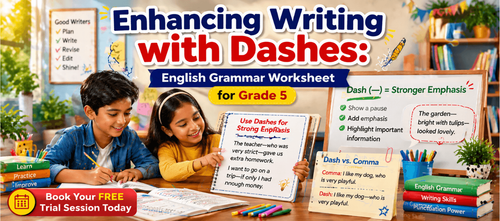
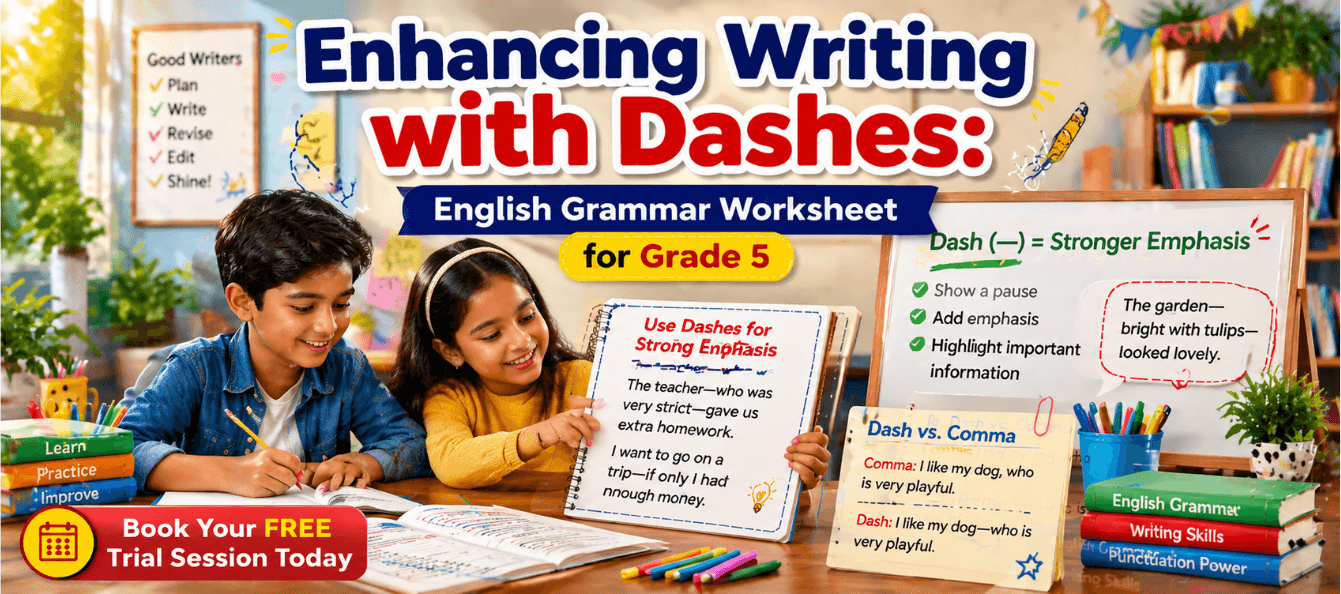
Dash Definition: A dash is a punctuation mark (—) used to indicate a pause, provide emphasis, or set off information in a sentence more dramatically than a comma.
Examples:
The teacher—who was very strict—gave us extra homework.
I want to go on a trip—if only I had enough money.
Quick Tips:
- Use dashes to emphasize a sudden change in thought or an important point.
- Be mindful not to overuse dashes—this can make writing feel cluttered or overly dramatic.
Why is it Important to Learn This?
Learning to use dashes in place of commas for emphasis helps students improve the effectiveness of their writing. This technique adds variety to sentence structure and helps convey emotion or importance more clearly. Understanding how to use dashes appropriately is crucial for making writing more engaging and compelling. It also strengthens overall writing skills by allowing students to manipulate sentence structures for different effects.
Where Will This Knowledge Help You?
Understanding when and how to use dashes will be valuable in many areas:
- In exams, when answering writing questions or completing grammar exercises.
- In writing essays, where effective punctuation helps convey meaning.
- When writing creatively, to add flair and clarity to storytelling.
- In class discussions, when students need to present their ideas clearly and with emphasis.
How to Use This Worksheet?
1. Start by attempting each question independently, without looking at any answers.
2. Read each sentence carefully and identify if a dash is needed in place of a comma.
3. Review your answers carefully once you have completed the worksheet.
4. Compare your responses with the answer key provided below to check for accuracy.
5. Practice regularly to improve your understanding and application of dashes in writing.
The solutions follow the exact worksheet order, so students should compare their answers carefully.
Important Tips and Tricks
1. When replacing commas with dashes, focus on the part of the sentence that needs emphasis.
2. Avoid using dashes for every clause; they should be used sparingly to prevent your writing from becoming too dramatic.
3. Make sure the dash is placed correctly, with no space before or after it.
4. In writing tasks, experiment with dashes in creative ways to make your sentences more engaging.
5. Always read your sentence aloud to ensure the dash enhances the flow and impact of the sentence.
Complete Answer Key
Exercise No. 1
Choose the sentence with the correct dash usage.
1. b) The train—delayed by rain—arrived late.
2. a) Ravi’s essay—well written and clear—was praised.
3. b) Asha—carrying books and bags—went to school.
4. c) Meera—always cheerful—helped her friends.
5. a) Riya—excited about cricket—ran fast.
6. b) Raj—who loves painting—created art.
7. c) The bus—packed with students—moved slowly.
8. c) The garden—bright with tulips—looked lovely.
9. a) The kite—high in the sky—flew beautifully.
10. b) The shop—near the station—sells snacks.
Exercise No. 2
Tick True or False.
1. False
2. True
3. False
4. True
5. False
6. True
7. True
8. True
9. False
10. True
Exercise No. 3
Insert dashes.
1. Rohit—who read books—learned quickly.
2. The garden—bloomed early—looked bright.
3. The student—studied hard—passed the test.
4. The cat—that ran fast—caught the mouse.
5. The bus—that was late—arrived finally.
6. Meenu—who loves painting—painted well.
7. Kabir—who plays football—scored a goal.
8. The kite—that flew high—reached the tree.
9. Tina—who practiced daily—improved fast.
10. Asha—who baked cookies—shared them.
Exercise No. 4
Rewrite with a dash for emphasis.
1. The plan—simple yet effective—worked.
2. The cake—baked by Tara—was delicious.
3. The dog—running in the park—barked loudly.
4. The story—told by Pooja—was interesting.
5. Anaya—wearing a blue dress—danced gracefully.
6. Her boss—a demanding man—ordered a re-do.
7. Everything—even the kitchen sink—was gone.
8. The garden—full of roses—looked lovely.
9. Monika—reading quietly—solved the puzzle.
10. The winner—a young artist from Delhi—accepted the award.
Exercise No. 5
Insert dashes in the paragraph:
The sun was high in the sky. All the children—even the shy ones—ran onto the grass. Maya brought her favourite toy—a red kite—to the park. The wind started to blow—soft at first—and then much faster. The kite—a bright splash of crimson against the blue—danced between the clouds. The kite soared over the trees. Everything seemed perfect until the string snapped. The kite drifted away in the wind. “Oh no!” Maya cried. Her friends—who tried to help her—ran across the field and found the kite. She tied a new knot—a double-loop special—to make it strong. The group sat down—tired but happy—under the big oak tree. They shared a snack—apples and juice—while they rested. The sky turned soft pink—the colour of a summer peach—as the day ended.
Practicing this English grammar worksheet for Grade 5 on using dashes in place of commas for strong emphasis helps students develop more engaging and impactful writing skills. With regular practice, students can confidently apply this punctuation technique in their own work, improving both clarity and creativity in writing.