
Grade 5 English Worksheet Using Commas in Compound Sentences
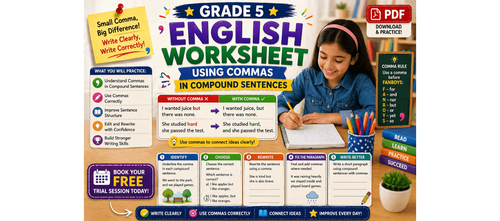

Use Commas Correctly with This Grade 5 English Grammar Worksheet on Commas in Compound Sentences (FANBOYS)
Punctuation helps make sentences clear and easy to understand. In Grade 5, students learn how commas are used in compound sentences to join ideas correctly. This English grammar worksheet on Commas in Compound Sentences (FANBOYS) helps students practice using commas with conjunctions. Through structured exercises, students learn how to combine sentences properly and improve their writing clarity.
Download these English grammar worksheets and practice regularly to strengthen your language skills and build a strong foundation. You can also book a free trial to get expert guidance and improve your reading, writing, and comprehension abilities. The worksheets are designed in a simple and structured way to help K–8 students learn grammar concepts easily and use them confidently in everyday communication.
What Is the Topic?
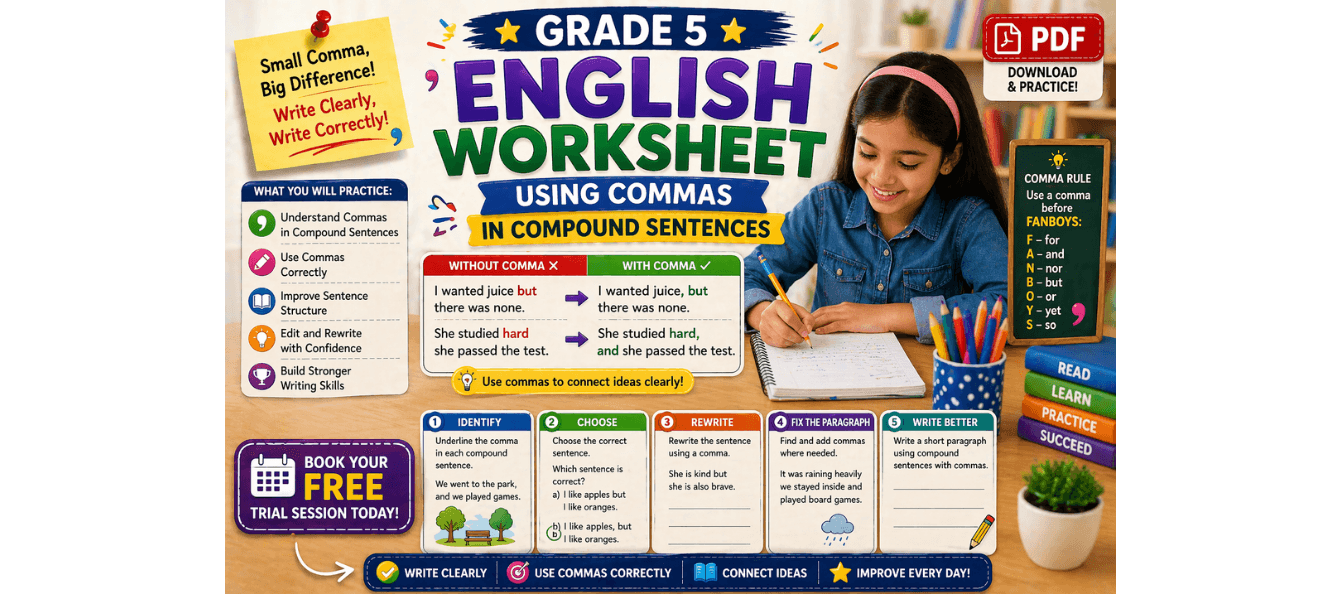
Commas in Compound Sentences (FANBOYS) is an important concept introduced in Grade 5. This worksheet helps students understand how commas are used before coordinating conjunctions to join two complete sentences. Students learn to read sentences carefully and place commas correctly to improve sentence structure and clarity.
What’s in This Worksheet?
1. Multiple choice questions to choose the correct sentence with proper comma use
2. True and False statements based on comma rules
3. Fill in the blanks using suitable conjunctions and commas
4. Sentence rewriting tasks using correct comma placement
5. Paragraph rewriting activity using correct commas
Definitions, Examples, Techniques, and Tips
This worksheet focuses on using commas correctly in compound sentences. Students are given sentences such as “I wanted to go but it started raining heavily.” and “She finished her homework so she went out to play.” where they must identify correct comma placement.
Students also practice choosing correct sentences from options like:
- I wanted to go, but it started raining heavily.
- She finished her homework, so she went out to play.
- The dog barked loudly, yet no one opened the door.
In rewriting exercises, students correct sentences like:
- She was tired but she finished her work.
- I wanted to call you but, I forgot.
Paragraph-based activities help students apply correct comma usage in longer sentences.
Why Is It Important to Learn This?
Learning correct comma usage helps students write clear and well-structured sentences. It allows them to:
- Join ideas correctly
- Avoid confusion in writing
- Improve sentence clarity
This skill is important for writing and understanding compound sentences in school and everyday communication.
Where Will This Knowledge Help You?
Understanding commas in compound sentences helps students in:
- Grammar and writing sections of exams
- Writing clear and correct sentences
- Paragraph writing tasks
- Reading comprehension and understanding sentence structure
It also helps students express ideas more clearly.
How to Use This Worksheet?
1. Attempt each question independently without help
2. Read each sentence carefully to identify correct comma placement
3. Choose or rewrite the correct sentence based on the question
4. Compare your answers with the answer key provided below
5. Practice regularly to improve accuracy
The solutions follow the exact worksheet order, so students should compare their answers carefully.
Important Tips and Tricks
1. Use a comma before conjunctions in compound sentences
2. Read the sentence carefully to check if it has two complete parts
3. Avoid placing commas in the wrong position
4. Practice rewriting sentences correctly
5. Check paragraphs carefully for correct comma usage
Complete Answer Key
Exercise No. 1
1. b
2. c
3. a
4. b
5. c
6. a
7. c
8. b
9. b
10. a
Exercise No. 2
1. True
2. True
3. False
4. False
5. False
6. False
7. False
8. True
9. True
10. True
Exercise No. 3
1. The boy was late, so he missed the bus.
2. She wanted to play, but she had homework to finish.
3. The sky was clear, and the stars were visible.
4. He tried his best, but he could not win the race.
5. The shop was closed, so we returned home.
6. The music stopped, and everyone became silent.
7. She studied all night, so she felt very tired.
8. The door was open, but no one was inside.
9. The match ended, and the players left the field.
10. He saved his money, so he could buy a new bicycle.
Exercise No. 4
1. She was tired, but she finished her work.
2. He wanted to help, yet he did not know what to do.
3. The baby was crying, so the mother picked her up.
4. I wanted to call you, but I forgot.
5. The team played well, and they won the match.
6. He did not study, nor did he complete his homework.
7. We can go now, or we can wait for some time.
8. She stayed quiet, for she was feeling upset.
9. The road was empty, yet we drove slowly.
10. He was hungry, so he ate quickly.
Exercise No. 5
The morning was calm, but the streets were already busy, and people were walking quickly, yet some shops were still closed, for the owners had not arrived, and a few customers waited outside, so the area slowly became crowded, but no one seemed impatient, and the vendors started arranging their goods, yet the noise began to grow, and everyone continued their work, but the atmosphere stayed lively.
Practicing this English grammar worksheet for Grade 5 on Commas in Compound Sentences (FANBOYS) helps students become more confident in using commas correctly. With regular practice, students can improve their sentence structure and write clearly in both schoolwork and everyday communication.