
Grade 5 Reading Worksheet on The Boy Who Cried Wolf
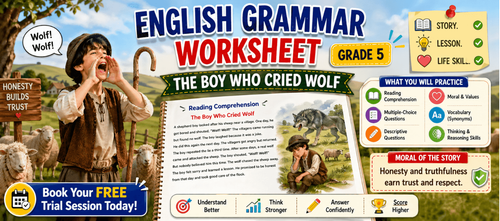

English Grammar Worksheet Grade 5 – The Boy Who Cried Wolf
Reading stories with meaningful lessons helps students improve vocabulary, understanding, and thinking skills. This English grammar worksheet Grade 5 on The Boy Who Cried Wolf is designed to help children practice reading comprehension in a simple and engaging way. The story teaches an important lesson about honesty and trust while helping students strengthen their reading and answering skills.
In this Grade 5 worksheet, students carefully read the passage and answer multiple-choice and descriptive questions. The exercises help learners understand the story, identify the moral, improve reasoning skills, and connect ideas from the text. The worksheet also encourages students to think about how honesty affects relationships and trust in everyday life.
Download these English grammar worksheets and practice regularly to strengthen your language skills and build a strong foundation. You can also book a free trial to get expert guidance and improve your reading, writing, and comprehension abilities. The worksheets are designed in a simple and structured way to help K–8 students learn grammar concepts easily and use them confidently in everyday communication.
What Is the Topic?
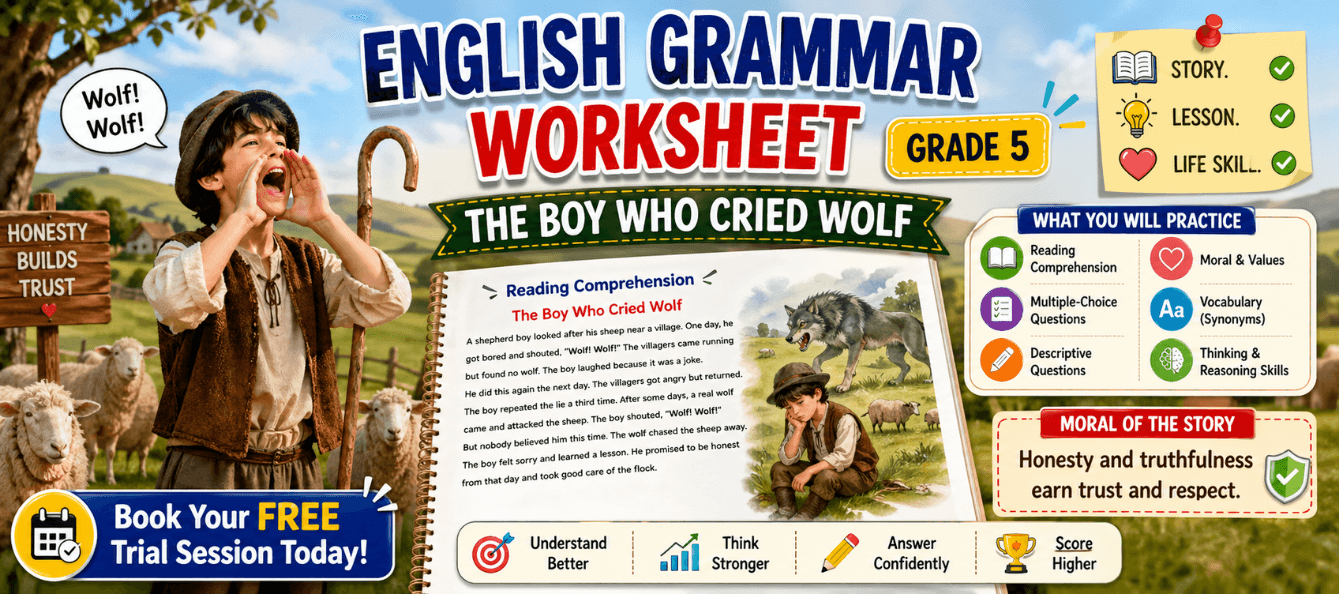
The topic of this worksheet is The Boy Who Cried Wolf. It is a reading comprehension passage for Grade 5 students. The story is about a shepherd boy who repeatedly lies to villagers by shouting “Wolf!” even when there is no danger. Later, when a real wolf appears, nobody believes him because of his earlier lies.
This worksheet helps students:
• Read and understand a short story carefully
• Identify important details from the passage
• Learn the importance of honesty and trust
• Improve comprehension and thinking skills
• Answer objective and subjective questions correctly
Students are expected to read the passage attentively and answer the questions according to the story.
What’s in This Worksheet?
1. A short and simple reading passage based on The Boy Who Cried Wolf.
2. Multiple-choice questions that test understanding of facts from the story.
3. Descriptive questions that require students to answer in complete sentences.
4. Questions that help students connect ideas and understand deeper meanings from the story.
5. Vocabulary-based learning through synonym identification.
6. Exercises arranged in a structured and student-friendly format.
7. Reading comprehension practice to improve exam preparation and confidence.
Definitions, Examples, Techniques, and Tips
Definition:
Reading comprehension means reading a passage carefully and understanding its meaning, message, characters, and events.
Example from the worksheet:
The shepherd boy shouted “Wolf! Wolf!” even when there was no wolf nearby. Later, when the real wolf came, no one believed him.
Technique:
• Read the passage slowly and carefully.
• Underline important events and actions.
• Identify the lesson or message of the story.
• Read every question properly before answering.
Quick learning tips:
• Pay attention to repeated actions in the story.
• Understand why characters behave in certain ways.
• Use clues from the passage to answer correctly.
• Look for words that explain feelings and actions.
This worksheet also teaches students how actions can affect trust and relationships.
Why Is It Important to Learn This?
Reading comprehension is important because it improves understanding, thinking ability, and communication skills. Stories like The Boy Who Cried Wolf teach valuable life lessons while helping students practice reading carefully.
This topic helps students:
• Build stronger reading habits
• Improve vocabulary and sentence understanding
• Learn moral values such as honesty and truthfulness
• Answer comprehension questions confidently
• Develop better writing and speaking skills
Understanding stories also helps students perform better in school assessments and classroom activities.
Where Will This Knowledge Help You?
Students can use these reading comprehension skills in many areas, such as:
• School exams and class tests
• Reading storybooks and lessons
• Writing answers in complete sentences
• Understanding passages in English subjects
• Participating in classroom discussions
• Improving communication and thinking abilities
The lesson about honesty and trust is also useful in daily life situations.
How to Use This Worksheet?
1. Read the entire passage carefully before answering any questions.
2. Understand the story, characters, and important events properly.
3. Attempt the multiple-choice questions independently first.
4. Read each descriptive question carefully and answer according to the passage.
5. Compare your answers carefully with the solutions provided.
6. The solutions follow the exact worksheet order, so check every answer properly.
7. Correct mistakes and understand why the correct answer is right.
8. Practice similar comprehension passages regularly to improve reading skills.
Important Tips and Tricks
1. Read every sentence of the passage carefully before answering.
2. Do not guess answers without checking the story.
3. Focus on the lesson and message of the story.
4. While answering descriptive questions, include important details from the passage.
5. In multiple-choice questions, eliminate incorrect options one by one.
6. Examiners expect students to understand both facts and deeper meanings.
7. Pay attention to character behaviour and consequences in the story.
8. Practice vocabulary questions carefully to improve word knowledge.
9. Write answers neatly and in the correct order of questions.
10. Always check whether your answer matches the information given in the passage.
Complete Answer Key
Exercise No. 1
Choose the most appropriate option in relevance to this passage.
1. What was the shepherd boy’s job?
✔ d) To look after sheep
2. Why did the villagers stop helping the boy?
✔ a) They did not trust him anymore
3. What lesson does this story teach?
✔ b) Honesty builds trust
Exercise No. 2
Answer the following questions from the passage/story.
1. Why did the boy shout “Wolf!” the first two times?
He was bored and wanted to play a trick. He shouted “Wolf!” just for fun.
2. What happened when the real wolf came?
No one believed him, so the wolf chased the sheep.
3. What change did the boy make at the end?
He promised to be honest and watched the flock carefully.
Exercise No. 3
Read the questions carefully and answer the following by making connections with the text.
1. Why is trust important in a community?
Trust helps people rely on and support each other.
2. How did the boy’s behaviour affect others’ belief in him?
His lies made others lose faith in him.
3. What message does the author want to give through this story?
The story teaches that honesty and truth earn respect.
4. Find a synonym of "truthful" from the passage.
Honest
This English grammar worksheet Grade 5 on The Boy Who Cried Wolf is a wonderful way to improve reading comprehension skills while learning an important lesson about honesty and trust. By practicing passages like these regularly, students can become more confident readers and better writers. Careful reading and regular practice will help learners perform well in exams and understand stories more effectively.