
Grade 5 Semicolon with Related Independent Clauses
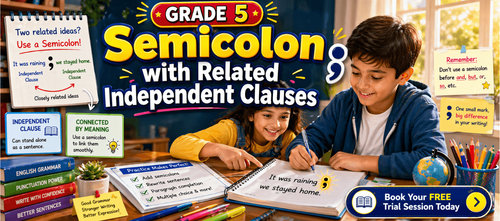

Mastering Semicolon with Related Independent Clauses: English Grammar Worksheet for Grade 5
Understanding semicolons can be a valuable tool when it comes to connecting related ideas in your writing. In Grade 5, students begin learning how to use semicolons to join independent clauses effectively. This English grammar worksheet on using semicolons with related independent clauses helps students practice this important skill through simple and engaging exercises. Mastering the use of semicolons enables students to create clearer and more concise sentences, making their writing more fluid and polished.
Download these English grammar worksheets and practice regularly to strengthen your language skills and build a strong foundation. You can also book a free trial to get expert guidance and improve your reading, writing, and comprehension abilities. The worksheets are designed in a simple and structured way to help K–8 students learn grammar concepts easily and use them confidently in everyday communication.
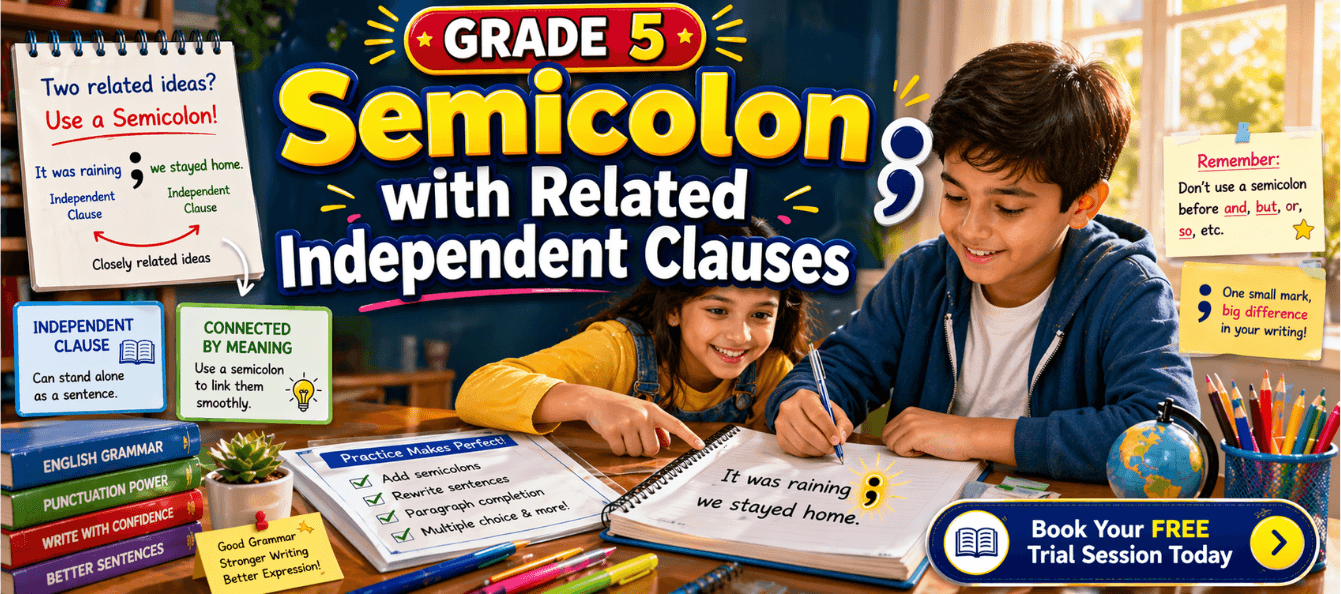
What is the Topic?
The topic of this worksheet is the semicolon and how it is used to connect related independent clauses. An independent clause is a group of words that contains a subject and a verb and can stand alone as a complete sentence. A semicolon is used to connect two independent clauses that are closely related in meaning. This skill helps students create more complex, effective sentences by connecting ideas without overusing conjunctions like "and" or "but."
In this worksheet, students will learn when and how to place semicolons correctly, making their writing smoother and more connected.
What’s in This Worksheet?
This worksheet provides a variety of exercises designed to help Grade 5 students practice the use of semicolons in different sentence structures. It includes:
1. Multiple Choice Questions: Students choose the correct semicolon usage in sentences.
2. True and False Statements: This section tests students’ understanding of semicolon rules by asking them to identify correct and incorrect statements.
3. Adding Semicolons: Students will practice inserting semicolons in sentences where they are needed.
4. Sentence Rewriting: This activity challenges students to rewrite sentences by inserting semicolons in appropriate places.
5. Paragraph Completion: A passage is provided, and students must add semicolons in the correct locations.
These activities are designed to reinforce students' understanding of semicolons while helping them develop strong grammar skills that are essential for both academic writing and everyday communication.
Definitions, Examples, Techniques, and Tips
Definitions:
Semicolon: A punctuation mark (;) used to link two independent clauses that are closely related.
Independent Clause: A group of words with a subject and a verb that can stand alone as a sentence.
Examples:
Incorrect: It was raining we stayed home.
Correct: It was raining; we stayed home.
The semicolon connects two related ideas—both clauses describe events happening because of the rain.
Techniques:
- Use a semicolon to join two independent clauses that are closely related in meaning but could stand alone as separate sentences.
- Avoid using a semicolon when the clauses are not directly related or when a conjunction such as "and," "but," or "or" can connect them.
Quick Learning Tips:
Make sure both clauses connected by a semicolon are related in meaning. If you feel that a comma would be too weak to separate the clauses, consider using a semicolon. Avoid using a semicolon before a conjunction like "and" or "but." Instead, use a comma or simply connect the clauses without punctuation.
Why is it Important to Learn This?
Learning how to use semicolons effectively is crucial for improving writing. Semicolons allow students to link related ideas, adding sophistication and variety to their sentence structure. Using semicolons correctly helps avoid choppy sentences and creates smoother, more connected writing. This is particularly important for academic writing, essays, and exams, where clarity and precision are essential.
Where Will This Knowledge Help You?
Understanding how to use semicolons will be beneficial in:
- Exams: Many tests include punctuation questions. Knowing when and how to use a semicolon will help you score better.
- Writing Tasks: Whether writing essays, stories, or reports, semicolons can improve your sentence structure and clarity.
- Class Participation: Having a good grasp of punctuation allows you to write and speak clearly, which is essential for classroom discussions and presentations.
How to Use This Worksheet?
1. Attempt each question independently: Try solving the exercises without external help to assess your understanding of the semicolon.
2. Carefully review your answers: After completing the exercises, go back and check your answers.
3. Correct mistakes: If you make mistakes, understand why the semicolon was placed differently and correct your approach.
4. Practice regularly: Consistent practice will help solidify your knowledge of semicolon usage.
The solutions follow the exact worksheet order, so students should compare their answers carefully.
Important Tips and Tricks
1. Common mistake: Using a comma instead of a semicolon between two independent clauses. Make sure the clauses are related before choosing a semicolon.
2. What examiners expect: When using semicolons, students should focus on ensuring the two clauses are linked by meaning. Avoid overusing semicolons.
3. How to score full marks: Always double-check semicolon placement to ensure it makes the sentence clearer, not more complicated.
4. How to approach sentence rewriting tasks: Focus on whether the ideas in the sentence are related before inserting a semicolon. If they are, a semicolon will likely improve the sentence.
Complete Answer Key
Exercise No. 1
Choose the correct sentence with proper semicolon usage.
1. a) We saw the rainbow; it disappeared quickly.
2. c) Meera bought a notebook; she needed a pen.
3. a) Ravi cleaned his room; he watered the plants.
4. b) Riya baked a cake; she decorated it with icing.
5. b) The market was crowded; we enjoyed the festival.
6. c) Asha studied for exams; she also attended music class.
7. a) Raj went to Delhi; he visited historical sites.
8. c) The sun set; the sky turned orange.
9. c) Children played outside; it started raining.
10. b) She finished her homework; she went out to play.
Exercise No. 2
Write True or False for semicolon usage.
1. True
2. False
3. False
4. True
5. False
6. True
7. True
8. False
9. True
10. False
Exercise No. 3
Add semicolons to the following sentences.
1. It was raining; we stayed home.
2. The sun was setting; the air began to feel colder.
3. Meenu baked a cake; she shared it with friends.
4. The bus broke down; we walked home.
5. Isha cleaned the room; she cooked lunch.
6. Rohit went to the market; he bought fruits.
7. I finished my homework; I watched television.
8. She likes apples; he prefers oranges.
9. The sun was hot; the pool was cool.
10. We visited Mumbai; we explored the museum.
Exercise No. 4
Rewrite the sentences by adding semicolons.
1. When we played outside; it rained heavily.
2. She completed her project; she went to sleep.
3. The cake was delicious; everyone wanted the recipe.
4. Tina painted the wall; she hung pictures.
5. We visited Pune; we went to the local market.
6. The bus was late; we waited patiently.
7. Tara loves to paint; her brother prefers to draw.
8. The dog ran; he was barking loudly.
9. The basketball game is over; we won!
10. Children sang songs; they danced joyfully.
Exercise No. 5
Correctly punctuate the passage with semicolons.
The local market was bursting with energy on Saturday morning; vendors shouted out their best prices to anyone walking by. I headed straight for the fruit stall to buy some crisp apples; however, the juicy peaches looked even better. My mother spent a long time picking out vegetables; she wanted the perfect bell peppers for our dinner. We saw people from all over the neighbourhood carrying heavy bags; everyone seemed to be in a great rush. The flower stall smelled like a fresh spring garden; bright daisies and red roses lined the wooden tables. A street musician played an upbeat tune on his guitar; several children stopped to dance to the rhythm. The honey vendor explained how the bees make their wax; it was the most interesting thing I heard all day.
Practicing this English grammar worksheet for Grade 5 on semicolons with related independent clauses helps students become more confident in using punctuation correctly. With regular practice, students can refine their writing skills and improve their grammar proficiency.