
Grade 6 Degrees of Comparison Worksheet with Answers

Degrees of Comparison with This English Grammar Worksheet for Grade 6
Learning degrees of comparison helps students describe people, places, and things clearly and correctly. This Grade 6 English grammar worksheet on Degrees of Comparison includes engaging exercises that help students understand positive, comparative, and superlative degrees in a simple and structured way. Students will practice identifying adjectives, completing tables, filling in the blanks, correcting sentence errors, and rewriting sentences using the correct forms.
The worksheet is designed to improve grammar accuracy and sentence formation skills. By practicing these exercises, students learn how adjectives change according to comparison and how to use them correctly while speaking and writing. The activities also help students avoid common grammar mistakes and build confidence in English communication.
Download these English grammar worksheets and practice regularly to strengthen your language skills and build a strong foundation. You can also book a free trial to get expert guidance and improve your reading, writing, and comprehension abilities. The worksheets are designed in a simple and structured way to help K–8 students learn grammar concepts easily and use them confidently in everyday communication.
What Is the Topic?
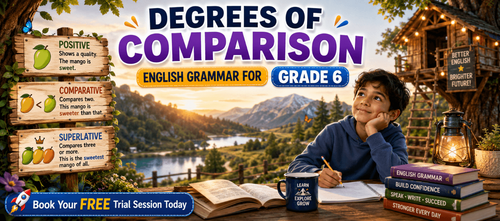
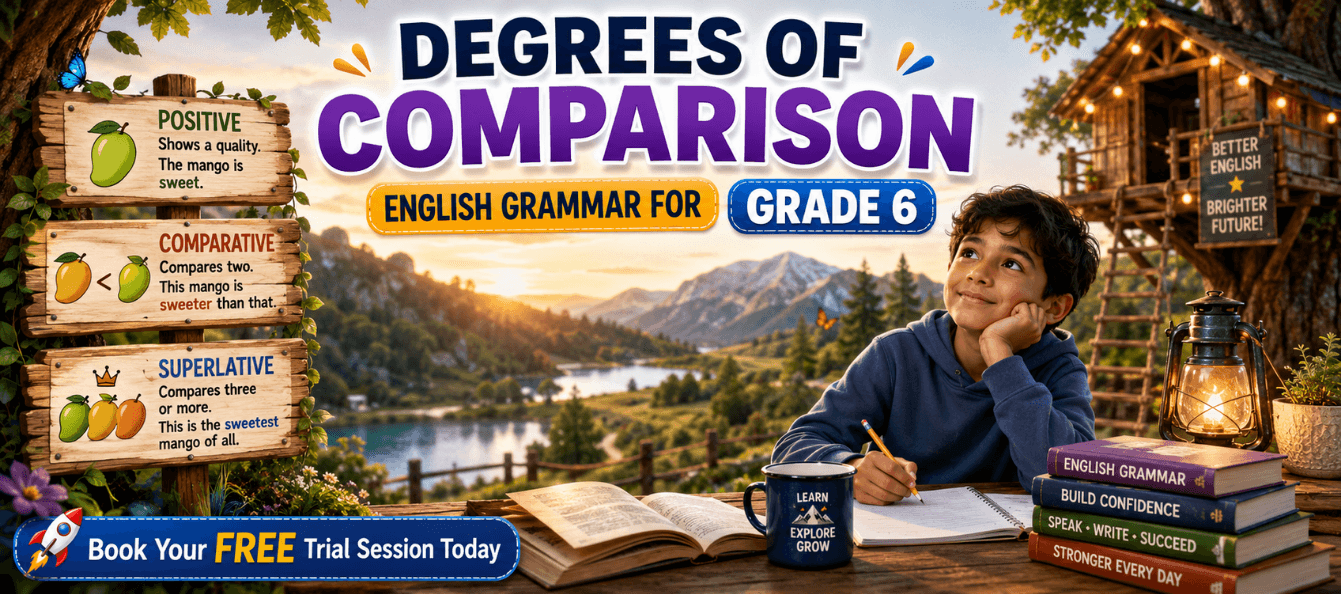
Degrees of comparison are forms of adjectives used to compare nouns. This worksheet explains that there are three degrees of comparison.
1. Positive Degree
It shows the simple quality of a noun. It is used when no comparison is made.
Example: The mango is sweet.
2. Comparative Degree
It is used to compare two people, animals, or things.
We often add -er to the adjective, or use “more” for longer words.
Example: This mango is sweeter than that one.
3. Superlative Degree
It is used to compare three or more people or things.
We usually add -est to the adjective, or use “most” for longer words.
Example: This is the sweetest mango of all.
Students learn how to identify adjective forms and use them correctly in sentences.
What’s in This Worksheet?
1. Underline the adjectives in sentences.
2. Identify positive, comparative, and superlative degrees.
3. Recognize regular and irregular adjective forms.
4. Complete adjective comparison tables.
5. Fill in the blanks using the correct adjective forms.
6. Rewrite incorrect comparison sentences correctly.
7. Rewrite sentences using the degree mentioned in brackets.
8. Practice sentence formation using adjectives.
9. Improve grammar accuracy and comparison skills.
10. Strengthen writing and speaking confidence.
Definitions, Examples, Techniques, and Tips
Positive Degree
It shows the simple quality of a noun without making comparisons.
Example: The mango is sweet.
Comparative Degree
It compares two people, places, animals, or things.
Example: This mango is sweeter than that one.
Superlative Degree
It compares three or more people or things.
Example: This is the sweetest mango of all.
Regular Forms
Many adjectives form comparisons by adding -er and -est.
Examples:
small – smaller – smallest
big – bigger – biggest
tall – taller – tallest
Longer Adjectives
Some adjectives use more and most.
Example:
interesting – more interesting – most interesting
Irregular Forms
Some adjectives change differently.
Examples:
good – better – best
bad – worse – worst
Quick Tips
1. Use comparative degree for comparing two things.
2. Use superlative degree for comparing more than two things.
3. Look for clue words like than and most.
4. Avoid using double comparison forms.
5. Read the complete sentence carefully before choosing the adjective form.
Why Is It Important to Learn This?
Degrees of comparison are important because they make communication clearer and more descriptive. Students use these forms while speaking, writing essays, answering grammar questions, and participating in class activities.
Learning comparison forms improves grammar accuracy and helps students avoid sentence errors. Correct adjective usage also improves writing quality and speaking confidence.
Where Will This Knowledge Help You?
1. School grammar exams
2. Writing assignments
3. Classroom discussions
4. Reading comprehension
5. Daily conversations
6. Descriptive writing
7. Grammar worksheets and activities
8. Sentence correction exercises
How to Use This Worksheet?
1. Read the explanation of the three degrees carefully.
2. Attempt every exercise independently first.
3. Underline adjectives correctly where required.
4. Use the correct comparison forms carefully.
5. Compare answers in the exact worksheet order.
6. Correct mistakes after checking the answer key.
7. Practice difficult forms regularly.
8. Revise irregular adjective forms often.
Important Tips and Tricks
1. Do not use double comparison forms like more easier or bestest.
2. Comparative degree compares two things only.
3. Superlative degree compares more than two things.
4. Irregular forms such as good, better, best and bad, worse, worst should be memorized carefully.
5. Always check whether the sentence needs positive, comparative, or superlative degree.
6. Words ending in -er and -est usually indicate comparison forms.
7. Long adjectives often use more and most.
8. Read rewritten sentences carefully to ensure grammatical correctness.
Complete Answer Key
Exercise 1
1. This puzzle is __easy__ to solve. – Positive, Irregular
2. My house is __bigger__ than yours. – Comparative, Regular
3. She is the __fastest__ runner in the school. – Superlative, Regular
4. Ravi is __good__ at chess. – Positive, Irregular
5. This book is __more interesting__ than others. – Comparative, Regular
6. Anil is __tall__, but his brother is __taller__. – Positive, Regular and Comparative, Regular
7. That was the __worst__ meal I’ve had. – Superlative, Irregular
8. These apples are __fresh__. – Positive, Regular
9. This is the __most difficult__ question. – Superlative, Regular
10. This test was __easier__ than yesterday’s. – Comparative, Regular
Exercise 2
Positive – Comparative – Superlative
small – smaller – smallest
big – bigger – biggest
tall – taller – tallest
fast – faster – fastest
happy – happier – happiest
strong – stronger – strongest
cold – colder – coldest
hot – hotter – hottest
easy – easier – easiest
kind – kinder – kindest
Exercise 3
1. This exam was the __easiest__ (easy) of all.
2. My bag is __heavier__ (heavy) than yours.
3. That was the __worst__ (bad) performance of the evening.
4. She is __kinder__ (kind) than her sister.
5. This movie is __more interesting__ (interesting) than the last one.
6. He has the __brightest__ (bright) idea in class.
7. My house is __bigger__ (big) than Raj’s.
8. This is the __best__ (good) cake I’ve ever tasted.
9. The new student is __taller__ (tall) than most boys.
10. Your handwriting is the __neatest__ (neat) in the group.
Exercise 4
1. This mountain is the tallest in the region.
2. She is better at drawing than before.
3. This test was easier than the last one.
4. That is the best pizza I’ve eaten.
5. Riya is taller than all her classmates.
6. This is the worst spelling I’ve seen.
7. He is friendlier now.
8. My score is better than yours.
9. This is the most fun game ever.
10. That cat is lazier than the dog.
Exercise 5
1. This mistake is worse than that mistake.
2. That road is not as long as this road.
3. This is the most beautiful flower.
4. She is more careful than her sister.
5. That was the best answer.
Practicing this Grade 6 English grammar worksheet on Degrees of Comparison regularly will help students improve grammar accuracy, sentence construction, and communication skills. These exercises make learning comparisons easier and help students become more confident while speaking and writing in English.