
Grade 6 Homonyms in Context: Printable Grammar Worksheet [Free PDF]
![Grade 6 Homonyms in Context: Printable Grammar Worksheet [Free PDF]](https://cdn5.planetspark.in/media/small_8_02a91f8fc6.png)

Grade 6 English Grammar Worksheet: Homonyms in Context [Free PDF]
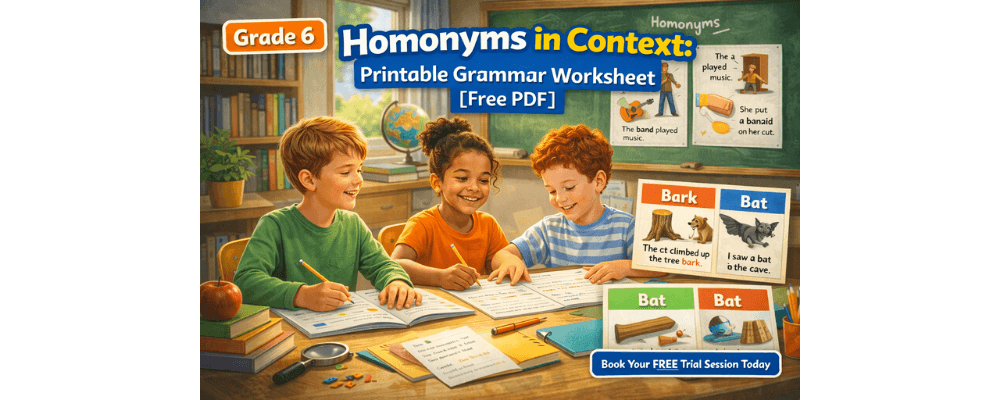
Understanding homonyms in context is crucial for mastering their use in both writing and speech. Grade 6 students will often encounter words that are spelled the same but have different meanings. This worksheet will help students identify homonyms and use them correctly in different sentence contexts, reinforcing their understanding of words with multiple meanings.
Download these English grammar worksheets and practice regularly to strengthen your language skills and build a strong foundation. You can also book a free trial to get expert guidance and improve your reading, writing, and comprehension abilities. The worksheets are designed in a simple and structured way to help K–8 students learn grammar concepts easily and use them confidently in everyday communication.
What is the topic?
This worksheet helps students understand and use homonyms in context. Homonyms are words that share the same spelling but have different meanings. Students will practice identifying which meaning is correct based on the surrounding context.
What's in this worksheet?
1. Exercises to identify and use homonyms in context.
2. Understanding the meanings of homonyms based on sentence clues.
3. Helps improve reading comprehension and writing skills.
4. Ideal for Grade 6 students, with a focus on real-world application.
Definitions, Examples, Techniques, and Tips:
• Definitions:
- Homonyms are words that are spelled the same but have different meanings depending on the context.
• Examples:
- "Tear" (to rip) vs "Tear" (a drop of liquid from the eyes).
- "Lead" (to guide) vs "Lead" (the metal).
• Tips:
- Pay close attention to the words around a homonym to figure out its meaning.
- Try reading the sentence more than once to make sure you understand the context before selecting the meaning.
Why is it important to learn this?
Learning how to use homonyms in context improves both writing and reading comprehension. By understanding which meaning is appropriate for each context, students can avoid confusion and communicate more clearly.
Where will this knowledge help you?
• Exams: Homonyms in context are often tested in language and comprehension sections of exams.
• Writing tasks: Correct use of homonyms improves the clarity and accuracy of written assignments.
• Class participation: Using homonyms correctly helps students speak more clearly and confidently during class discussions.
How to use this worksheet?
1. Read the sentence carefully to identify the homonym.
2. Understand the context to figure out which meaning of the homonym is correct.
3. Check your answers to see if you’ve selected the correct meaning.
4. Keep practicing with different homonyms to strengthen your understanding.
Important Tips and Tricks:
1. Use context clues to determine the meaning of a homonym.
2. Write your own sentences using homonyms to get comfortable with their different meanings.
3. Practice with a variety of homonyms to build your vocabulary and improve writing skills.
4. Double-check your answers before submitting to avoid mistakes.
Complete Answer Key:
Exercise 1 – Match the Following
light → not heavy
bark → dog sound
fair → a carnival
spring → water source
wave → ocean motion
ring → telephone call
match → a game start
bat → a flying mammal
palm → a type of tree
crane → a large machine
Exercise 2 – Sort the Words
Body part context: chest/breast, back/spine, nail/finger, head/mind, face/look, leg/walk, arm/body, foot/shoe
Object context: chest/box, back/chair, nail/iron, head/bed, face/clock, leg/table, arm/branch
Exercise 3 – Fill in the Blanks
1. wave
2. bark
3. crane
4. fair
5. light
6. ring
7. palm
8. spring
9. bat
10. match
Exercise 4 – Multiple Choice Questions
1. c) cave
2. c) chest
3. b) chest
4. d) tune
5. b) band
6. c) coin
7. c) cry
8. a) dry
9. a) rock
10. d) rock
Exercise 5 – Sentence Rewriting
1. Anjali felt a wave of happiness when she heard the good news.
2. Rahul used a crane to lift the heavy iron beams at the site.
3. Diya visited the fair near the old Jaipur fort last month.
4. Pooja heard the bark of the dog echo in the empty lane.
5. Arjun's bag was so light that he ran to school easily.
6. Neha sat under a palm tree and read her storybook quietly.
7. Kartik got a ring from his cousin in Lucknow last night.
8. Rohan drank from a cool spring that flowed near the village.
9. Aarav watched a bat fly silently over the dark rooftops.
10. The fair lit up the spring of the old temple in the evening.
Mastering homonyms in context will help you use these words correctly in both written and spoken language. Keep practicing with these worksheets to improve your understanding of homonyms. With regular practice, you’ll be able to use them confidently and clearly.