
Grade 6 Literature Skills - Allusion in Literature [Grammar Practice]
![Grade 6 Literature Skills - Allusion in Literature [Grammar Practice]](https://cdn5.planetspark.in/media/small_Grade_6_Literature_Skills_Allusion_in_Literature_Grammar_Practice_4e439c0b6d.png)

Grade 6 Literature Skills Worksheet: Allusion in Literature
Allusion is a literary device where the author references a well-known person, place, event, or text to enrich the meaning of a story. For instance, in "To Kill a Mockingbird," when Atticus Finch refers to the "mockingbird" as a symbol of innocence, it alludes to the idea of protecting what is pure and harmless. Allusions help connect stories to larger cultural or historical contexts, deepening the reader's understanding.
Allusion adds layers to a story by bringing in familiar ideas and comparisons. Download these English grammar worksheets and practice regularly to strengthen your language skills and build a strong foundation. You can also book a free trial to get expert guidance and improve your reading, writing, and comprehension abilities. The worksheets are designed in a simple and structured way to help K–8 students learn grammar concepts easily and use them confidently in everyday communication.
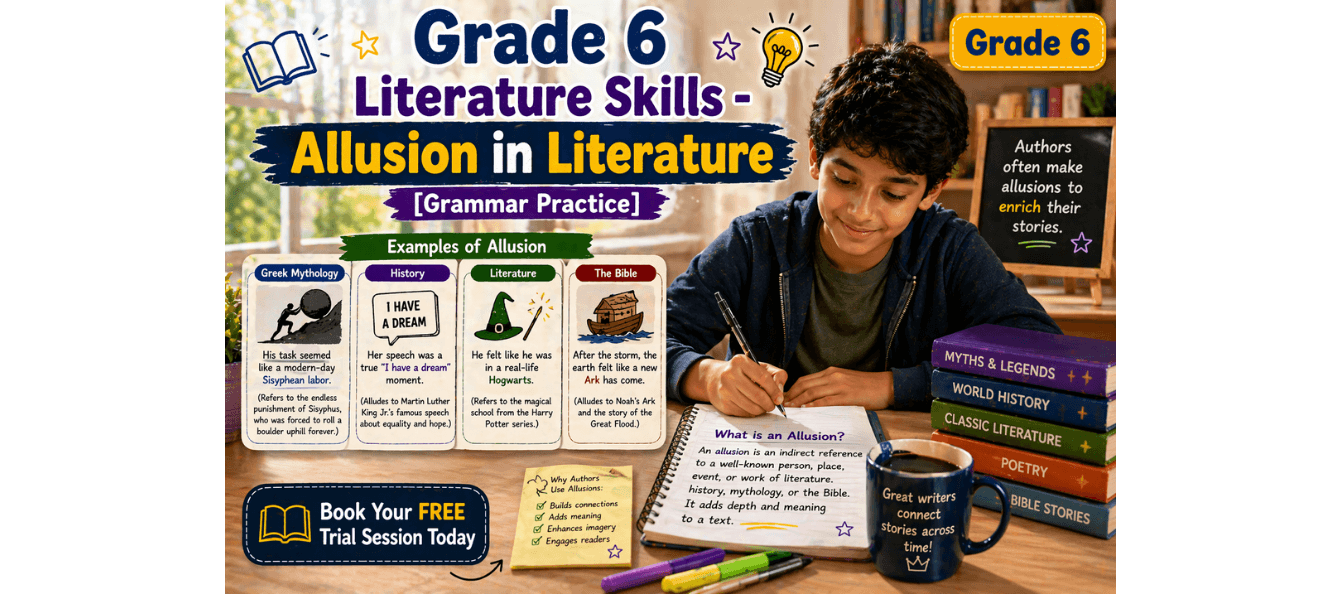
What Is the Topic?
In this worksheet, students will explore how allusions work in literature. They will learn how authors use references to familiar stories, people, or events to give their work deeper meaning.
What’s in This Worksheet?
1. Definitions and examples of allusion
2. Multiple choice questions to identify allusions in various texts
3. Exercises to practice creating your own allusions
4. A short writing assignment to analyze allusions in literature
Definitions, Examples, Techniques, and Tips
- Allusion: A reference to something outside the text, often from literature, history, or mythology.
- Example: When someone is described as "a real Romeo," it alludes to the Shakespearean character, indicating romantic qualities.
- Tip: Look for references to well-known figures or events to spot allusions.
Why Is It Important to Learn This?
Understanding allusion helps students connect the text to broader ideas or historical events. It also enriches their reading by allowing them to see how authors draw from the world around them.
Where Will This Knowledge Help You?
This knowledge is useful in both literature analysis and creative writing. It helps in understanding the depth of references in novels, poems, and plays.
How to Use This Worksheet?
1. Read each example carefully and identify the allusions.
2. Practice writing your own sentences using allusions to deepen your writing.
3. Review your answers and make sure you understand the cultural or historical context of the allusions.
Important Tips and Tricks
1. Not all allusions are obvious; sometimes they can be subtle references to well-known figures or events.
2. Allusions are often used to make a comparison without explicitly stating it.
Complete Answer Key
Exercise 1 – Multiple Choice Questions
1. b) speech work.
2. a) Tenaliram.
3. c) focused one.
4. b) compare.
5. a) assembly.
6. c) panchatantra.
7. a) richer text.
8. b) references.
9. a) allusions.
10. c) familiar.
Exercise 2 – Fill in the Blanks
1. speech work
2. Tenaliram
3. focused one
4. compare
5. assembly
6. panchatantra
7. richer text
8. references
9. allusions
10. familiar
Exercise 3 – True or False
1. True
2. True
3. False
4. False
5. True
6. False
7. True
8. False
9. True
10. True
Exercise 4 – Underline the key phrase and write the context
Answers will depend on personal perspective and may vary. (Hint:- Identify the "who, what, when, and where" of the scene.)
Exercise 5 – Paragraph Fill in the Blanks (Context Clues)
1. Tenaliram
2. understand / compare
3. focused / steady
4. Panchatantra
5. richer
6. familiar / meaningful
7. remember / recall
By the end of this worksheet, students will be better able to identify and use allusions in their own writing.