
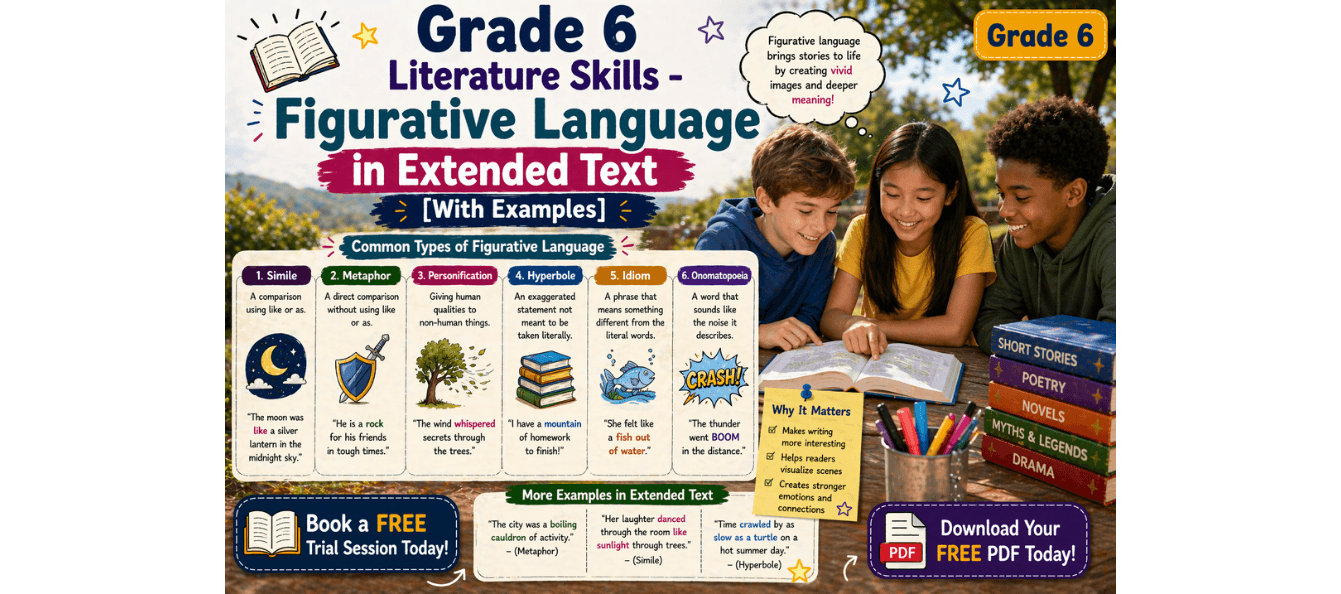
Grade 6 Literature Skills - Figurative Language in Extended Text [With Examples]
![Grade 6 Literature Skills - Figurative Language in Extended Text [With Examples]](https://cdn5.planetspark.in/media/small_Grade_6_Literature_Skills_Figurative_Language_in_Extended_Text_With_Examples_d28c908694.png)

Grade 6 Literature Skills Worksheet: Figurative Language in Extended Text
Figurative language enhances storytelling by creating vivid images and emotional effects through the use of metaphors, similes, personification, and other devices. In Anjali's poem about her first days in Mumbai, she used metaphors to describe loneliness as a "grey rain cloud" and friendship as "sunlight sliding through curtains." These figurative expressions help convey emotions in a deeper way that literal language cannot.
Understanding how figurative language works enables students to create more engaging and expressive writing. Download these English grammar worksheets and practice regularly to strengthen your language skills and build a strong foundation. You can also book a free trial to get expert guidance and improve your reading, writing, and comprehension abilities. The worksheets are designed in a simple and structured way to help K–8 students learn grammar concepts easily and use them confidently in everyday communication.
What Is the Topic?
In this worksheet, students will explore different types of figurative language, including metaphors, similes, and personification. They will learn how to identify and analyze these devices in extended texts and use them in their own writing.
What’s in This Worksheet?
1. Definitions and examples of figurative language techniques
2. Multiple choice questions to identify figurative language in texts
3. Exercises to practice writing sentences with figurative language
4. A short writing assignment to create a story using figurative language
Definitions, Examples, Techniques, and Tips
- Metaphor: A comparison between two unlike things without using "like" or "as" (e.g., "Her heart is a cold stone").
- Simile: A comparison using "like" or "as" (e.g., "Her smile was as bright as the sun").
- Personification: Giving human characteristics to non-human things (e.g., "The wind whispered through the trees").
- Tip: Look for comparisons that make ideas more vivid and emotional.
Why Is It Important to Learn This?
Figurative language is essential for creative writing, as it allows writers to express complex ideas and emotions in a more engaging way. It also helps readers to connect with the text on a deeper level.
Where Will This Knowledge Help You?
This skill is crucial in reading comprehension and writing, especially in understanding poetry, novels, and plays. It will also improve your ability to write descriptively and emotionally.
How to Use This Worksheet?
1. Identify examples of figurative language in the provided texts.
2. Write your own sentences using metaphors, similes, and personification.
3. Review your answers and analyze how the figurative language affects the meaning of the text.
Important Tips and Tricks
1. Figurative language can make your writing more vivid and help convey emotions more effectively.
2. Don’t overuse figurative language; balance it with clear, direct writing to avoid confusion.
Complete Answer Key
Exercise 1 – Multiple Choice Questions
1. b) new school.
2. b) busy hive.
3. c) Nishitha.
4. a) book chest.
5. a) silverbell.
6. b) expressing.
7. c) assembly.
8. a) loneliness.
9. b) sunrises.
10. c) word pictures.
Exercise 2 – Fill in the Blanks
1. new school
2. busy hive
3. Nishitha
4. book chest
5. silver bell
6. expressing
7. assembly
8. loneliness / sunrises
9. sunrises
10. word pictures
Exercise 3 – True or False
1. True
2. True
3. False
4. False
5. True
6. False
7. False
8. True
9. False
10. True
Exercise 4 – Underline the key phrase and write the context
Answers will depend on personal perspective and may vary. (Hint:- Identify the "who, what, when, and where" of the scene.)
Exercise 5 – Paragraph Fill in the Blanks (Context Clues)
1. new school
2. busy hive
3. assembly
4. expressing
5. pictures / images
6. felt / meant
7. pictures / images
8. silver bell
By the end of this worksheet, students will be able to identify and use figurative language to enhance their writing and reading comprehension.