
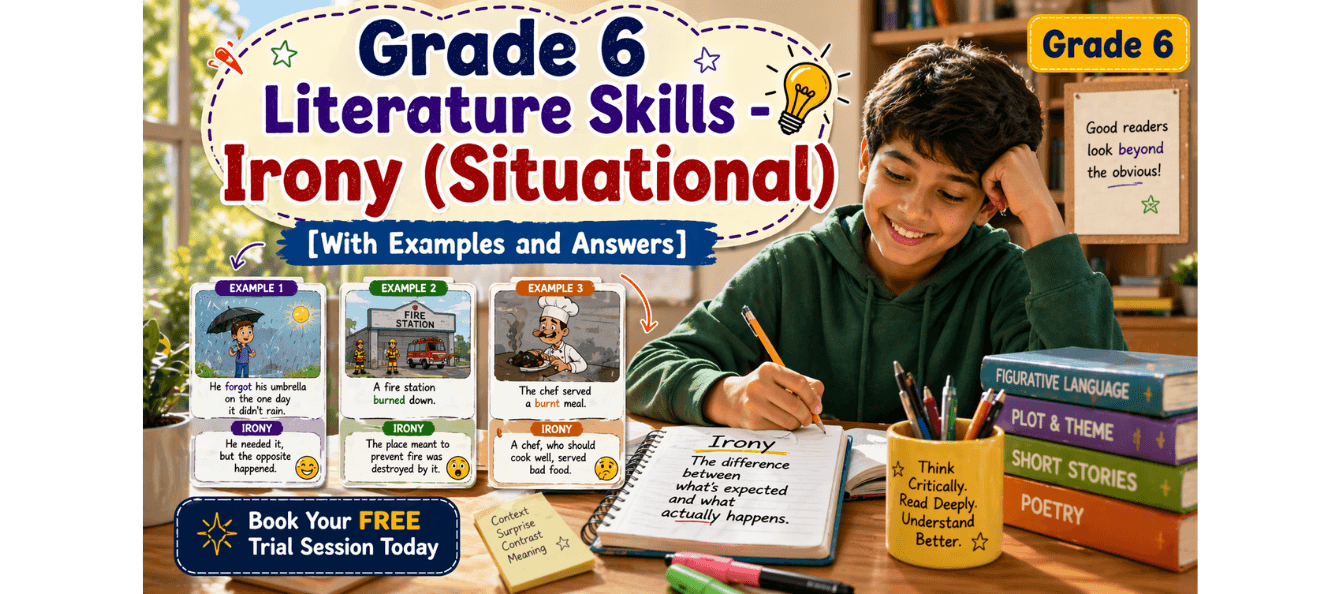
Grade 6 Literature Skills - Irony (Situational) [With Examples and Answers]
![Grade 6 Literature Skills - Irony (Situational) [With Examples and Answers]](https://cdn5.planetspark.in/media/small_Grade_6_Literature_Skills_Irony_Situational_With_Examples_and_Answers_0542c8503b.png)

Grade 6 Literature Skills Worksheet: Irony (Situational)
Situational irony occurs when there is a stark contrast between what is expected and what actually happens. It is a powerful literary tool used to engage readers and provoke thought. For example, in the story "The Gift of the Magi," the couple sells their most valued possessions to buy each other gifts, only to find that the gifts are now useless. This irony creates a deep emotional impact because the readers understand the selflessness of the characters, while the characters themselves are unaware of the outcome.
Situational irony adds depth to stories by surprising the reader and making them reconsider expectations. Download these English grammar worksheets and practice regularly to strengthen your language skills and build a strong foundation. You can also book a free trial to get expert guidance and improve your reading, writing, and comprehension abilities. The worksheets are designed in a simple and structured way to help K–8 students learn grammar concepts easily and use them confidently in everyday communication.
What Is the Topic?
In this worksheet, students will learn to identify and understand situational irony. They will explore how authors use irony to create surprising outcomes that add meaning to the story.
What’s in This Worksheet?
1. Multiple choice questions on identifying situational irony
2. Examples of situations in literature and real life that demonstrate irony
3. Exercises to create your own ironic scenarios
4. A short writing task to craft a story using situational irony
Definitions, Examples, Techniques, and Tips
- Situational Irony: A situation where the opposite of what you expect to happen occurs.
- Example: In "The Gift of the Magi," the couple's sacrifices turn into irony when their gifts are rendered useless by their love for each other.
- Tip: Pay attention to the gap between expectation and reality in a story to identify irony.
Why Is It Important to Learn This?
Understanding irony helps students recognize the deeper layers of stories and adds richness to their reading experience. It also improves their analytical skills, as they learn to spot subtle plot twists and character motivations.
Where Will This Knowledge Help You?
This knowledge will be useful in analyzing literature, particularly short stories, novels, and plays. It will also enhance your writing skills when creating your own stories with surprising twists.
How to Use This Worksheet?
1. Try identifying irony in the examples provided.
2. Practice by creating your own examples of situational irony.
3. Review your answers and understand why certain situations are ironic.
Important Tips and Tricks
1. Keep track of the characters’ expectations and compare them to the actual outcome.
2. Situational irony often appears at the climax of the story, where expectations are turned upside down.
Complete Answer Key
Exercise 1 – Multiple Choice Questions
1. c) windmill.
2. b) protective.
3. a) leakages.
4. a) watchman.
5. b) main hall.
6. c) opposite.
7. a) security.
8. b) fair entry.
9. a) grateful.
10. c) situational irony.
Exercise 2 – Fill in the Blanks
1. windmill
2. cupboard
3. leakages
4. watchman
5. opposite
6. security
7. assembly
8. carefully
9. surprised
10. corridor
Exercise 3 – True or False
1. True
2. True
3. False
4. False
5. True
6. False
7. True
8. False
9. False
10. True
Exercise 4 – Underline the key phrase and write the context
Answers will depend on personal perspective and may vary. (Hint:- Identify the "who, what, when, and where" of the scene.)
Exercise 5 – Paragraph Fill in the Blanks (Context Clues)
1. windmill
2. cupboard
3. leakages
4. corridor
5. opposite
6. irony / situation
7. intended / planned
8. surprises
By the end of this worksheet, students will be more adept at recognizing and understanding situational irony, enhancing their reading and writing skills.