
Grade 6 Literature Skills - Moral of a Story [Printable PDF]
![Grade 6 Literature Skills - Moral of a Story [Printable PDF]](https://cdn5.planetspark.in/media/small_Grade_6_Literature_Skills_Moral_of_a_Story_Printable_PDF_fee919471a.png)

Grade 6 English Grammar Worksheet: Moral of a Story
Pooja and Diya's friendship has always been close, but when they were assigned the task of writing a story for the class project, things changed. Pooja became very involved in the task, dedicating all her time and effort to it, while Diya, though supportive, didn’t take it as seriously. Tensions built up between them as the project deadline approached, and each girl began to feel the pressure differently. Pooja’s frustration grew, as she felt that Diya wasn’t as invested, while Diya struggled with the feeling that Pooja was taking over the project. In the end, after a heart-to-heart conversation, the two girls learned the importance of working together and respecting each other’s strengths. This story shows how relationships can sometimes be tested by misunderstandings, but open communication can always help rebuild trust and friendship. Download these English grammar worksheets and practice regularly to strengthen your language skills and build a strong foundation. You can also book a free trial to get expert guidance and improve your reading, writing, and comprehension abilities. The worksheets are designed in a simple and structured way to help K–8 students learn grammar concepts easily and use them confidently in everyday communication.
What Is the Topic?
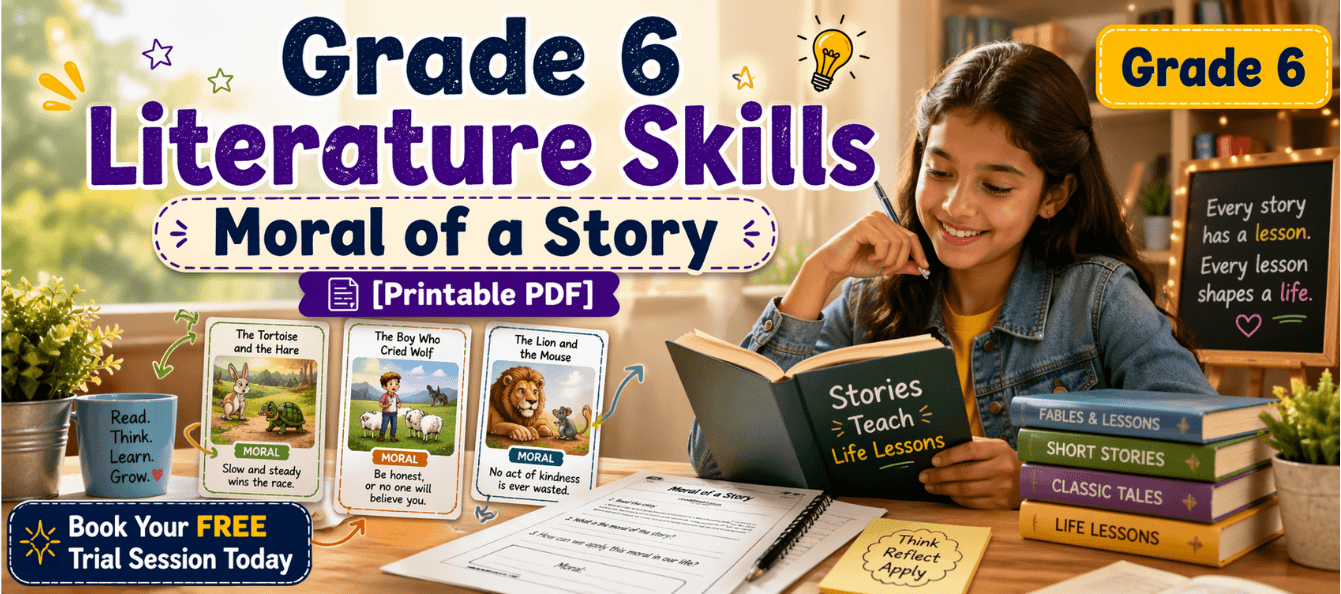
The moral of a story is the lesson or principle that it teaches. In this worksheet, students will learn how to identify and discuss the moral of various stories. They will analyze how characters’ actions lead to consequences and how these actions convey important lessons.
What’s in This Worksheet?
1. Multiple choice questions on identifying the moral of a story
2. Fill in the blanks to complete sentences about the moral
3. True/False statements about the lessons in stories
4. Activities to practice identifying morals in real-life situations
5. A final exercise for students to write their own story with a clear moral
Definitions, Examples, Techniques, and Tips
- Moral: The lesson or teaching of a story.
- Examples: In Aesop’s fable "The Tortoise and the Hare," the moral is “Slow and steady wins the race.”
- Techniques: Look for actions or consequences in stories that highlight a key lesson.
Why Is It Important to Learn This?
Learning to identify the moral of a story helps students understand the deeper meaning behind literature. It teaches them how to analyze characters’ actions and recognize important life lessons. This skill is essential for both reading comprehension and critical thinking.
Where Will This Knowledge Help You?
This knowledge helps in reading comprehension, particularly for fiction and fables. It also aids in creative writing tasks, where students must embed meaningful lessons in their own stories.
How to Use This Worksheet?
1. Attempt independently first
2. Review answers carefully
3. Correct mistakes
4. Practice regularly
Important Tips and Tricks
1. Think about the actions of the main characters and how these actions lead to consequences.
2. Pay attention to the ending of the story, where the moral is often revealed.
3. When writing your own stories, remember to keep the moral clear and meaningful.
Complete Answer Key
Exercise 1 – Multiple Choice Questions
1. c) stairwell.
2. a) kindness.
3. b) announcer.
4. c) hesitant.
5. b) medicines.
6. c) honesty.
7. a) thankfully.
8. b) being trusted.
9. a) kindness.
10. a) Kindness tops money.
Exercise 2 – Fill in the Blanks
1. stairwell
2. medicines
3. announcer
4. hesitated
5. fairness
6. book stall
7. returned
8. kindness
9. thoughtful
10. relieved
Exercise 3 – True or False
1. True
2. True
3. False
4. False
5. True
6. False
7. True
8. False
9. True
10. False
Exercise 4 – Underline the key phrase and write the context
Answers will depend on personal perspective and may vary. (Hint:- Identify the "who, what, when, and where" of the scene.)
Exercise 5 – Paragraph Fill in the Blanks (Context Clues)
1. stairwell
2. medicines
3. tempted / hesitant
4. honesty / integrity
5. relieved / grateful
6. story / reputation
7. honest / fair
By the end of the worksheet, students will be better equipped to identify morals and use them in their own stories. Practice these exercises regularly to develop a deeper understanding of storytelling techniques.