
Grade 6 Literature Skills - Symbol vs Motif [Free PDF]
![Grade 6 Literature Skills - Symbol vs Motif [Free PDF]](https://cdn5.planetspark.in/media/small_Grade_6_Literature_Skills_Symbol_vs_Motif_Free_PDF_d6a5e1c2f7.png)

Grade 6 Literature Skills Worksheet: Symbol vs Motif
A symbol is an object, character, or event in a story that represents something deeper than its literal meaning. For instance, in "The Great Gatsby," the green light symbolizes Gatsby’s hopes and dreams for the future. A motif, on the other hand, is a recurring element in a story that helps to develop the theme. For example, the repeated mention of eyes in "The Great Gatsby" represents the theme of surveillance and the unattainability of the American Dream.
Understanding the difference between a symbol and a motif allows students to better interpret and analyze texts. Download these English grammar worksheets and practice regularly to strengthen your language skills and build a strong foundation. You can also book a free trial to get expert guidance and improve your reading, writing, and comprehension abilities. The worksheets are designed in a simple and structured way to help K–8 students learn grammar concepts easily and use them confidently in everyday communication.
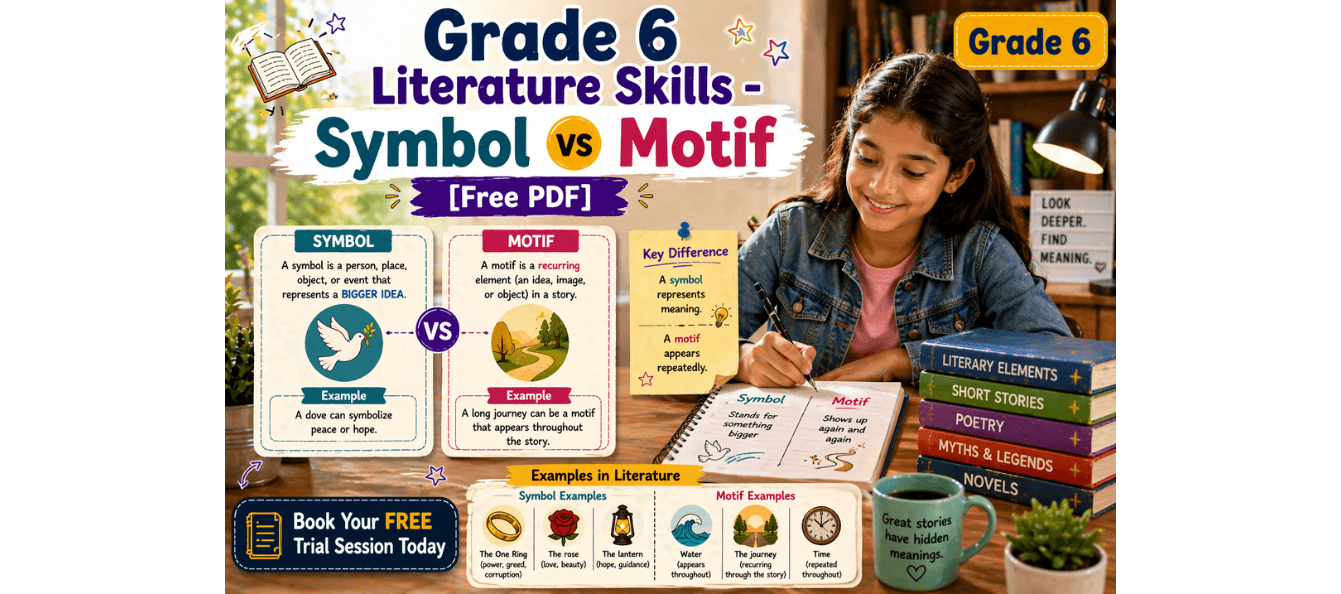
What Is the Topic?
In this worksheet, students will learn the difference between symbols and motifs. They will explore how symbols represent deeper meanings, and how motifs are repeated elements that help convey the theme of a story.
What’s in This Worksheet?
1. Definitions and examples of symbols and motifs
2. Multiple choice questions to identify symbols and motifs in literature
3. Exercises to practice using symbols and motifs in your own writing
4. A short writing task to analyze symbols and motifs in a text
Definitions, Examples, Techniques, and Tips
- Symbol: An object, person, or event that represents something beyond its literal meaning.
- Motif: A recurring element in a story that helps develop the theme.
- Example of Symbol: The green light in "The Great Gatsby" symbolizes Gatsby's unattainable dreams.
- Example of Motif: The eyes in "The Great Gatsby" are a motif representing surveillance and loss of innocence.
Why Is It Important to Learn This?
Understanding symbols and motifs enhances students’ ability to analyze literature and understand deeper meanings in stories. It also improves writing by teaching students how to use these elements to convey complex themes.
Where Will This Knowledge Help You?
This knowledge will be useful in literary analysis, especially for understanding symbolism in novels, plays, and poetry. It also enhances creative writing when students incorporate symbols and motifs into their stories.
How to Use This Worksheet?
1. Carefully read the examples of symbols and motifs in the worksheet.
2. Practice identifying symbols and motifs in the stories you read.
3. Review your answers to see if you’ve correctly identified each element.
Important Tips and Tricks
1. Look for objects, events, or phrases that repeat throughout the story—these may be motifs.
2. Symbols often carry emotional or conceptual weight, representing abstract ideas.
Complete Answer Key
Exercise 1 – Multiple Choice Questions
1. c) blue scarf.
2. b) whistles.
3. c) comforting.
4. b) courage.
5. b) mornings.
6. a) Nagpur camp.
7. c) platforms.
8. a) nervously.
9. a) repeats one.
10. b) symbolism.
Exercise 2 – Fill in the Blanks
1. blue scarf
2. whistles
3. comforting
4. courage
5. mornings
6. platforms
7. nervously
8. repeats one
9. symbolism
10. Nagpur
Exercise 3 – True or False
1. True
2. False
3. True
4. True
5. True
6. True
7. False
8. False
9. True
10. False
Exercise 4 – Underline the key phrase and write the context
Answers will depend on personal perspective and may vary. (Hint:- Identify the "who, what, when, and where" of the scene.)
Exercise 5 – Paragraph Fill in the Blanks (Context Clues)
1. scarf
2. comforting
3. whistle
4. repeats / returns
5. meaning / symbolism
6. symbolic / meaningful
7. strength / confidence
By the end of this worksheet, students will have a clearer understanding of how symbols and motifs work in literature.