
Grade 6 Narrative vs Informational Text Worksheet – Compare Practice
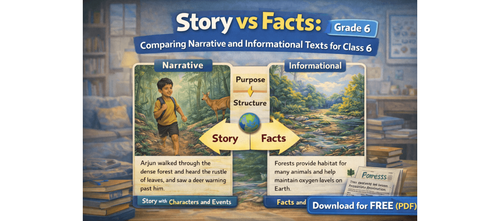

Comparing Narrative and Informational Texts: Grade 6 English Grammar Worksheet with Reading Comprehension Practice
Have you ever read a story and then read a factual passage on the same topic? You may have noticed that both feel very different. In this English grammar worksheet for Grade 6, students explore how narrative and informational texts differ in purpose, style, and structure.
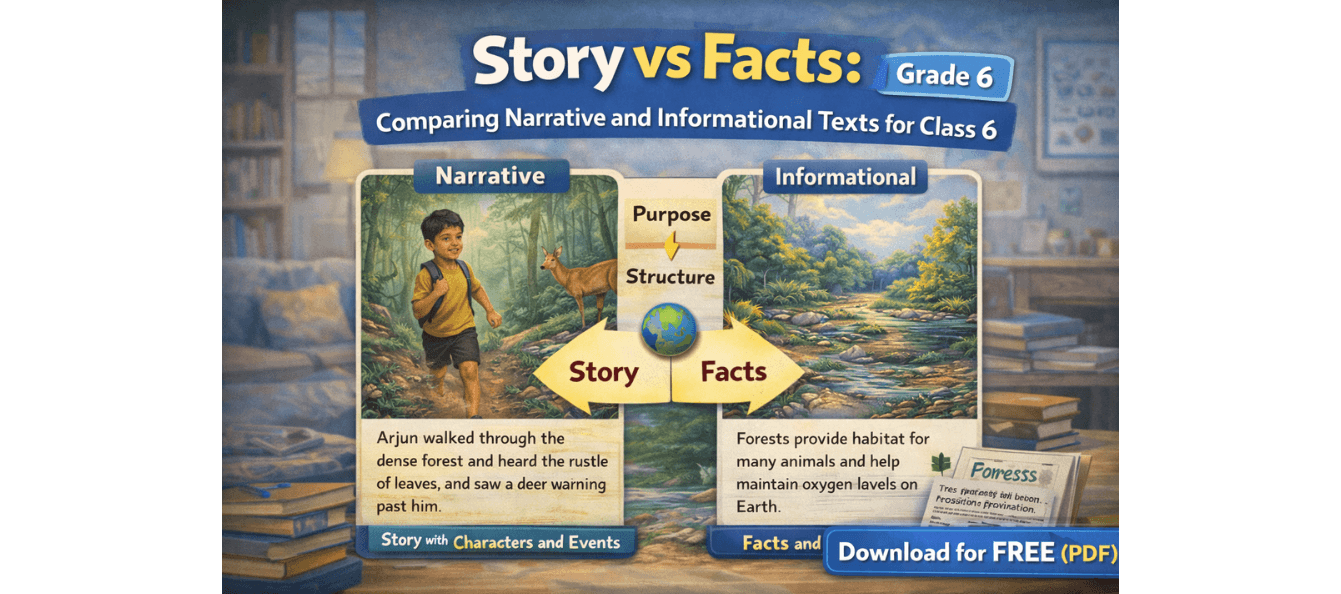
This worksheet on Comparing Narrative and Informational Text presents two passages about forests. One is a narrative text describing Arjun’s personal experience in a forest, while the other is an informational text explaining facts about forest ecosystems. As students read both texts, they observe how one tells a story and the other provides factual information. Through structured exercises, learners understand how different types of texts serve different purposes.
Download these English grammar worksheets and practice regularly to strengthen your language skills and build a strong foundation. You can also book a free trial to get expert guidance and improve your reading, writing, and comprehension abilities. The worksheets are designed in a simple and structured way to help K–8 students learn grammar concepts easily and use them confidently in everyday communication.
What Is the Topic?
Comparing Narrative and Informational Text is the main focus of this worksheet. It explains how different types of texts present information in different ways.
In the passages, the narrative text tells a story about Arjun walking through a forest, describing his experiences and feelings. The informational text explains facts about forests, such as their importance for animals, oxygen balance, and biodiversity. This comparison helps students understand how purpose and structure differ.
What’s in This Worksheet?
1. A narrative passage and an informational passage on a similar topic.
2. Multiple choice questions to identify features and purposes.
3. Fill in the blanks focused on key differences.
4. True or False questions to test understanding.
5. Underline the sentences that belong to informational text.
6. A paragraph writing task to compare both text types.
This worksheet includes both objective-type questions to check clear understanding and subjective-type questions to develop analytical skills.
Definitions, Examples, Techniques, and Tips
A narrative text tells a story. It includes characters, events, and personal experiences.
An informational text provides facts and explanations. It focuses on real information rather than storytelling.
Examples from the texts include:
- Narrative: “Arjun walked carefully through the dense forest”
- Narrative: “He saw a deer running past him”
- Informational: “Forests provide habitat for animals”
- Informational: “Forests help maintain oxygen levels”
These examples show how narrative uses events, while informational text uses facts.
Techniques used in this worksheet:
- Reading both texts carefully
- Identifying purpose and structure
- Comparing storytelling and factual explanation
- Recognising features of each text type
Quick learning tips:
- Look for characters and events to identify narrative text
- Look for facts and explanations to identify informational text
- Think about the purpose of the text
- Compare how information is presented
Why Is It Important to Learn This?
Learning to compare narrative and informational texts helps students understand how writing works in different contexts. It improves reading comprehension and analytical skills.
This topic also helps in writing. Students learn when to use storytelling and when to present facts clearly. This is important for academic tasks and communication.
Where Will This Knowledge Help You?
This knowledge can help students in many ways:
- In exams where text comparison is required
- In reading comprehension tasks
- In writing different types of texts
- In understanding informational and literary content
Understanding these differences helps students become better readers and writers.
How to Use This Worksheet?
1. Read both passages carefully before answering.
2. Identify which text tells a story and which gives facts.
3. Compare their purpose and structure.
4. Attempt all questions independently.
5. Review your answers after completing the worksheet.
6. Compare your answers carefully with the given solutions.
The solutions follow the exact worksheet order, so students should compare their answers carefully with the given answers.
Important Tips and Tricks
1. Always read both texts fully before answering.
2. Identify whether the text tells a story or gives facts.
3. Focus on purpose—entertain or inform.
4. Look for key features like characters or explanations.
5. In multiple choice questions, read all options carefully.
6. In fill in the blanks, use words from the passage.
7. For True or False questions, check each statement carefully.
8. In underline activities, select factual sentences.
9. In writing tasks, include examples from both texts.
10. Practice regularly to improve understanding.
Complete Answer Key
Exercise No. 1
Choose the correct answer based on narrative and informational texts.
1. a) Narrative text
2. b) Informational text
3. c) Includes characters and events
4. b) Provides facts and explanations
5. c) To entertain
6. b) To inform
7. a) Arjun saw a deer
8. b) Forests support biodiversity
9. a) One is factual, the other is story-based
10. c) It gives clear facts
Exercise No. 2
Fill in the blanks based on narrative and informational texts.
1. story
2. facts
3. events
4. explanations
5. experience
6. forests
7. habitat
8. events
9. information
10. forests
Exercise No. 3
Read each statement about narrative and informational texts. Mark it as True or False.
1. False
2. True
3. True
4. True
5. True
6. False
7. True
8. False
9. False
10. True
Exercise No. 4
Underline the sentences that belong to the informational text.
1. Forests help maintain oxygen levels.
2. Arjun walked through the forest.
3. Forests support biodiversity.
4. The deer ran past Arjun.
5. Trees prevent soil erosion.
6. Arjun felt excited.
7. Forests provide habitat for animals.
8. The stream flowed quietly.
9. Forests are important for the environment.
10. Arjun returned home.
Exercise No.5
Write a paragraph in 60–80 words on the given question.
How are narrative and informational texts different in what they do and how they are written? Use one example from each text and one example of your own.
Answers may vary.
Practicing this English grammar worksheet for Grade 6 on Comparing Narrative and Informational Text will help you understand how different types of texts present information in unique ways. Keep practicing regularly to improve your comprehension and analytical skills. With time and effort, you will become more confident in identifying and comparing text types.