
Grade 6 Objective vs Subjective Worksheet – Clear Examples & PDF

Objective vs Subjective Writing: Grade 6 English Grammar Worksheet with Reading Comprehension Practice
Have you ever noticed how the same situation can be described in completely different ways? Sometimes, writing simply reports facts, while other times it expresses feelings and opinions. In this English grammar worksheet for Grade 6, students explore the difference between objective and subjective writing through a real-life example.
This worksheet on Objective vs Subjective Writing presents two descriptions of the same weather conditions—one as a factual report and the other as a personal blog. As students read the passage, they observe how facts and opinions create different impressions. Through a variety of exercises, learners understand how writing can either present information clearly or express personal feelings.
Download these English grammar worksheets and practice regularly to strengthen your language skills and build a strong foundation. You can also book a free trial to get expert guidance and improve your reading, writing, and comprehension abilities. The worksheets are designed in a simple and structured way to help K–8 students learn grammar concepts easily and use them confidently in everyday communication.
What Is the Topic?
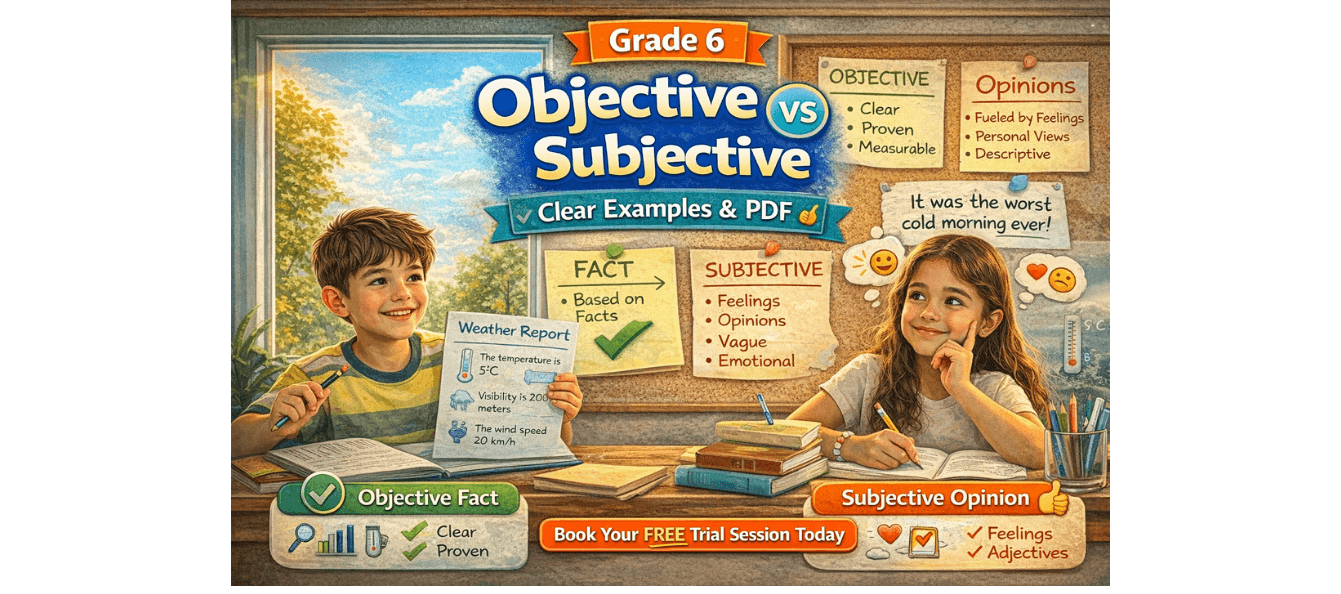
Objective vs Subjective Writing is the main focus of this worksheet. It explains the difference between writing based on facts and writing based on personal opinions. In the passage, the same weather is described in two ways—one using data and the other using feelings.
Students learn that objective writing includes measurable facts such as temperature, wind speed, and rainfall. Subjective writing, on the other hand, includes personal opinions and emotions, such as describing the weather as “terrible” or “unpleasant.” This helps students understand how writing style changes meaning.
What’s in This Worksheet?
1. A short, simple passage comparing a weather report and a personal blog.
2. Multiple choice questions to identify objective and subjective sentences.
3. Fill in the blanks focused on understanding facts and opinions.
4. True or False questions to test understanding of writing types.
5. Underline the subjective statements activity.
6. A paragraph writing task to explain how to change subjective writing into objective writing.
This worksheet includes both objective-type questions to check clear facts and subjective-type questions to check deeper understanding. It is designed to help students improve reading comprehension while learning an important writing skill.
Definitions, Examples, Techniques, and Tips
Objective writing is shown in the passage through factual details such as temperature, wind speed, and rainfall. It focuses on clear and measurable information.
Subjective writing is shown through expressions such as:
- “the worst cold morning ever”
- “unbearably freezing”
- “terrible”
- “miserable”
- “gloomy and unpleasant”
These examples show how personal feelings and opinions influence writing.
Techniques used in this worksheet:
- Reading carefully to identify facts and opinions
- Comparing two different styles of writing
- Recognising emotional and descriptive language
- Understanding how tone affects meaning
Quick learning tips:
- Look for numbers and data to identify objective writing
- Identify words that show feelings or opinions
- Think about whether the sentence can be proven or measured
- Notice how language changes the reader’s impression
Why Is It Important to Learn This?
Learning the difference between objective and subjective writing helps students understand how information is presented. It allows them to recognise whether a text is factual or based on opinion.
This topic also improves writing skills. Students learn how to present information clearly and avoid confusion between facts and feelings. This is important for academic work and effective communication.
Where Will This Knowledge Help You?
This knowledge can help students in many ways:
- In exams where identifying facts and opinions is required
- In reading comprehension tasks
- In writing reports and descriptive paragraphs
- In analysing different types of texts
Understanding this concept helps students become more accurate and thoughtful writers.
How to Use This Worksheet?
1. Read the passage carefully before answering questions.
2. Attempt all questions independently without looking at answers.
3. Identify whether each sentence is objective or subjective.
4. Review your answers after completing the worksheet.
5. Compare your answers carefully with the given solutions.
6. Correct your mistakes and understand the concept better.
The solutions follow the exact worksheet order, so students should compare their answers carefully with the given answers.
Important Tips and Tricks
1. Always read the passage fully before answering.
2. Look for facts such as numbers, data, and measurable details.
3. Identify words that show feelings or opinions.
4. Do not confuse descriptive language with factual information.
5. In multiple choice questions, read all options carefully.
6. In fill in the blanks, focus on concepts related to facts and opinions.
7. For True or False questions, check each statement carefully.
8. In underline activities, identify subjective statements clearly.
9. In writing tasks, explain using examples.
10. Practice regularly to improve understanding.
Complete Answer Key
Exercise No. 1
Choose whether each sentence is objective or subjective.
1. a) The temperature was 5°C
2. b) The morning was unpleasant
3. b) Visibility was reduced
4. a) It was unbearably cold
5. c) The wind speed was 20 km/h
6. b) The fog was terrible
7. c) The fog reduced visibility to 200 metres
8. a) The weather was lifeless
9. c) The temperature was recorded
10. b) The weather was terrible
Exercise No. 2
Fill in the blanks using words related to objective and subjective writing.
1. opinions
2. facts
3. subjective
4. reliable
5. feelings
6. opinions
7. data
8. reader’s
9. accurate
10. opinions
Exercise No. 3
Read each statement about objective and subjective writing. Write True or False.
1. True
2. True
3. False
4. True
5. False
6. False
7. True
8. True
9. True
10. False
Exercise No. 4
Underline the subjective statements.
1. This was the worst cold morning.
2. The wind speed was 20 km/h.
3. It was an extremely unpleasant day.
4. The weather created a miserable experience.
5. It felt unbearably freezing.
6. The temperature dropped to 5°C.
7. The fog was terrible.
8. Visibility was reduced due to fog.
9. The rainfall lasted two hours.
10. The report was very detailed.
Exercise No.5
Write a 60–80 word paragraph answering the question.
How can you change a subjective sentence into an objective one? Explain using one example from the passage and one of your own.
Answers may vary.
Practicing this English grammar worksheet for Grade 6 on Objective vs Subjective Writing will help you understand how facts and opinions shape meaning in writing. Keep practicing regularly to improve your reading and writing skills. With time and effort, you will become more confident in identifying and using both types of writing effectively.