
Grade 6 Prefixes and Suffixes Exercises for Better Vocabulary
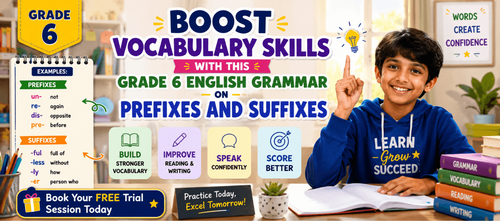

Boost Vocabulary Skills with This Grade 6 English Grammar Worksheet on Prefixes and Suffixes
Learning prefixes and suffixes can make English grammar easier and more exciting for students. This Grade 6 English grammar worksheet on prefixes and suffixes helps students understand how words change when letters are added at the beginning or end. Students get to practice sentence formation, fill in the blanks, rewriting sentences, and identifying prefixes and suffixes in different words. These activities improve vocabulary, reading skills, writing skills, and confidence in communication.
This worksheet is designed in a simple and engaging way so that Grade 6 students can understand how prefixes and suffixes work in everyday language. With regular practice, students can quickly identify word meanings and build stronger grammar foundations. The exercises also help students improve spelling, sentence construction, and comprehension skills in a fun and structured manner.
Download these English grammar worksheets and practice regularly to strengthen your language skills and build a strong foundation. You can also book a free trial to get expert guidance and improve your reading, writing, and comprehension abilities. The worksheets are designed in a simple and structured way to help K–8 students learn grammar concepts easily and use them confidently in everyday communication.
What Is the Topic?
Prefixes and suffixes are groups of letters added to words to change their meanings or forms.
A prefix is a group of letters added to the beginning of a word. It changes the meaning of the word.
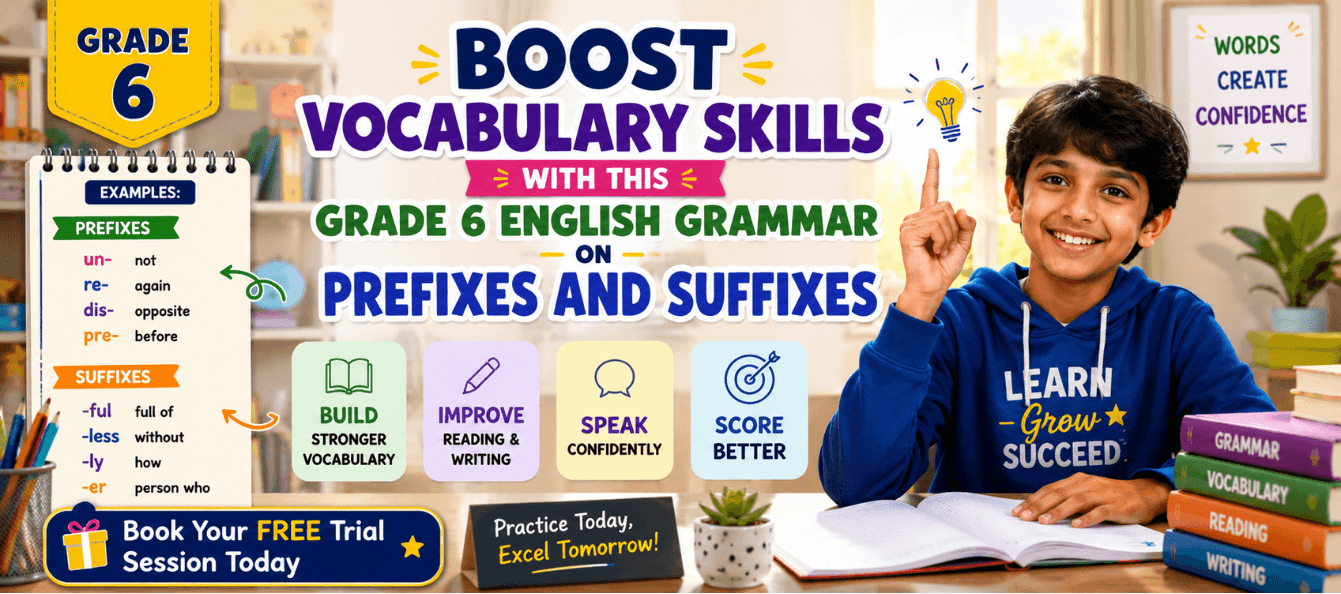
Examples of prefixes:
1. un- means not
2. re- means again
3. dis- means opposite of
4. pre- means before
A suffix is a group of letters added to the end of a word. It can change the word’s form or meaning.
Examples of suffixes:
1. -ful means full of
2. -less means without
3. -ly describes how something happens
4. -er means a person who does something
In this Grade 6 English grammar worksheet, students learn how prefixes and suffixes help create new words and improve vocabulary. Students also learn how to use these words correctly in sentences.
What’s in This Worksheet?
1. Students underline words with prefixes and suffixes in sentences.
2. Students complete fill in the blanks using the correct prefix or suffix form.
3. Students rewrite incorrect words using the correct prefix or suffix.
4. Students create new words from root words using prefixes and suffixes.
5. Students write sentences using newly formed words.
6. The worksheet practices vocabulary building, grammar usage, sentence formation, and word understanding.
7. The exercises help students prepare for school grammar tests and improve everyday communication skills.
Definitions, Examples, Techniques, and Tips
A prefix is added before a root word.
Example:
unhappy = not happy
rewrite = write again
dislike = not like
preview = view before
A suffix is added after a root word.
Example:
hopeful = full of hope
careless = without care
quickly = in a quick manner
teacher = a person who teaches
Students can identify prefixes by checking the beginning of a word.
Students can identify suffixes by checking the ending of a word.
Learning new words through prefixes and suffixes improves vocabulary and helps students understand word meanings more easily.
Practicing sentence formation with new words improves grammar and writing skills.
Why Is It Important to Learn This?
Learning prefixes and suffixes helps students understand the meanings of many English words. It improves vocabulary and helps students become stronger readers and writers. Students can understand unfamiliar words more easily when they know common prefixes and suffixes.
This topic also improves spelling and sentence formation skills. Students learn how words change forms and meanings, which helps in grammar exercises, writing tasks, and classroom activities.
Understanding prefixes and suffixes also helps students speak more confidently and communicate clearly in everyday situations.
Where Will This Knowledge Help You?
Students can use prefixes and suffixes during grammar exams and class assignments.
This knowledge helps students improve creative writing and sentence construction.
Students can identify word meanings while reading stories and passages.
It helps during classroom discussions and communication activities.
Students can also improve spelling and vocabulary in daily conversations.
How to Use This Worksheet?
1. Read each question carefully before answering.
2. Attempt every exercise independently first.
3. Follow the question order exactly while solving.
4. Underline the prefixes and suffixes carefully wherever asked.
5. Rewrite incorrect words correctly in sentence rewriting exercises.
6. Create meaningful sentences using the new words formed from root words.
7. Compare your answers carefully with the solutions.
8. The solutions follow the exact worksheet order for easier checking.
9. Practice regularly to improve vocabulary and grammar skills.
Important Tips and Tricks
1. Always check whether letters are added at the beginning or end of the word.
2. Prefixes usually change the meaning of the word.
3. Suffixes usually change the form of the word.
4. Read the complete sentence before choosing the correct word form.
5. Be careful with spelling while adding prefixes and suffixes.
6. Use meaningful and grammatically correct sentences during sentence formation activities.
7. Practice identifying common prefixes like un-, re-, dis-, and pre-.
8. Practice identifying common suffixes like -ful, -less, -ly, and -er.
9. Write neatly and follow the exact order of the questions during exams.
Complete Answer Key
Exercise 1
Underline words with prefixes and suffixes in each sentence.
1. He felt _unhappy_ when his game didn’t work.
2. The teacher asked us to _rewrite_ the sentence neatly.
3. My brother _dislikes_ eating spinach.
4. We saw a _preview_ of the film before it released.
5. She gave me a _hopeful_ smile after the interview.
6. It was a _careless_ mistake that cost him the match.
7. The rabbit hopped _quickly_ into the bushes.
8. The _painter_ worked all day to finish the wall.
9. She looked _fearless_ as she stood on the stage.
10. The speaker spoke _clearly_ so everyone could understand.
Exercise 2
Choose the correct word form using the right prefix or suffix to complete the sentence.
1. The baby looked _happy_ after his nap.
2. We had to _restart_ the test because of a mistake.
3. Don’t be _disagreeable_ just to be rude.
4. He gave us a quick _preview_ of the next lesson.
5. This was a very _careless_ thing to do.
6. She waited _patiently_ for her turn.
7. My sister is a great _painter_.
8. The cat moved _quickly_ when it heard a sound.
9. The class was full of _cheerful_ students.
10. We should never be _disrespectful_ to others.
Exercise 3
Each sentence uses a wrong prefix/suffix form. Rewrite the sentence with the correct word.
1. She was very hopeful in class.
2. He acted carelessly at the party.
3. They disagreed with the idea.
4. It was a joyful day.
5. The teacher is very knowledgeable.
6. Her action was so childish.
7. That was a helpful gesture.
8. He was very playful in school.
9. The solution was very confusing.
10. The king was fearless.
Exercise 4
Use the given root words to:
a) Create a new word using a prefix
b) Create a new word using a suffix
c) Write a sentence using one of the new words
1. Root word: like
Prefix: dislike
Suffix: likely
Sentence: I dislike wasting food.
2. Root word: use
Prefix: misuse
Suffix: useful
Sentence: This book is very useful for studies.
3. Root word: help
Prefix: unhelpful
Suffix: helpful
Sentence: My friend was very helpful during the project.
4. Root word: hope
Prefix: hopeless
Suffix: hopeful
Sentence: She felt hopeful before the competition.
5. Root word: read
Prefix: reread
Suffix: reader
Sentence: My brother is a fast reader.
Regular practice with this Grade 6 English grammar worksheet on prefixes and suffixes can help students improve vocabulary, grammar accuracy, and sentence-building skills. By learning how prefixes and suffixes change word meanings and forms, students become more confident readers and writers. Continue practicing these exercises to strengthen your English communication skills and perform better in school activities and exams.