
Grade 7 Adjective vs Adverb Usage [Printable Worksheet]
![Grade 7 Adjective vs Adverb Usage [Printable Worksheet]](https://cdn5.planetspark.in/media/small_Grade_7_Adjective_vs_Adverb_Usage_Printable_Worksheet_cebcaa8a85.png)

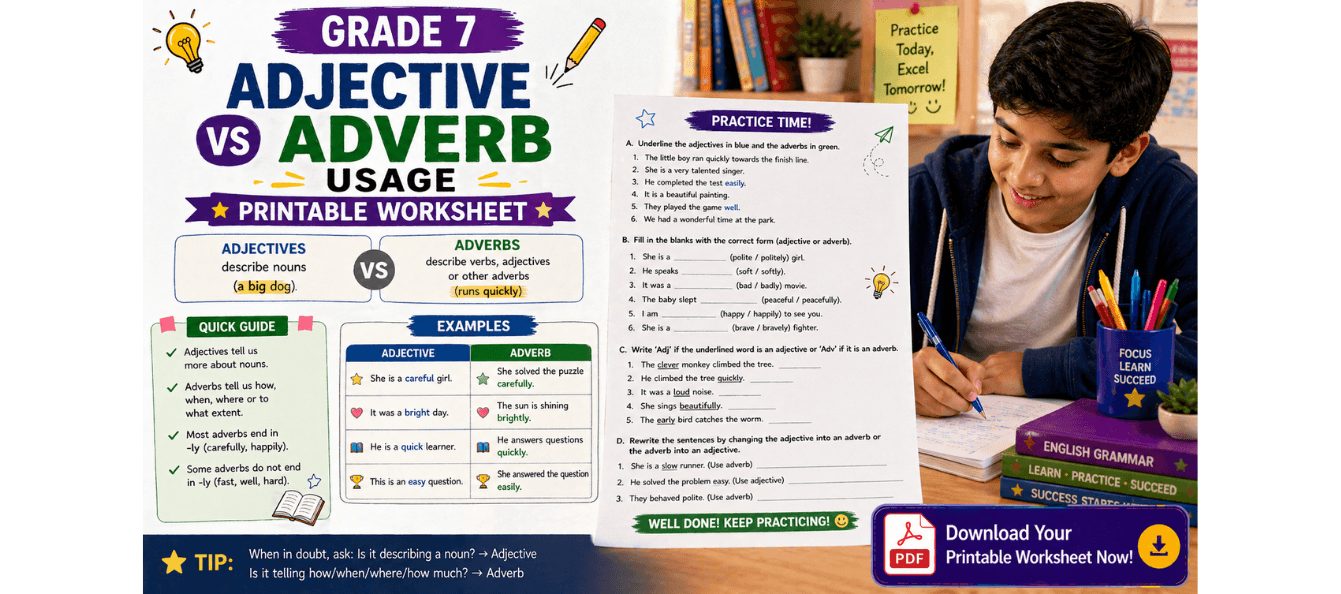
English Grammar Worksheet for Grade 7 on Adjective vs Adverb Usage
Differentiating between adjectives and adverbs is a common challenge for students, yet it is essential for mastering English grammar in Grade 7. These two parts of speech serve distinct purposes: adjectives describe people, places, and things, while adverbs describe actions, feelings, or other descriptions. Mixing them up can lead to sentences that sound awkward or convey the wrong meaning. For example, saying "She sings beautiful" is incorrect because "sings" is an action that needs an adverb. This worksheet is designed to clear up that confusion, offering targeted practice to help students use the right word in the right place every time.
Download these English grammar worksheets and practice regularly to strengthen your language skills and build a strong foundation. You can also book a free trial to get expert guidance and improve your reading, writing, and comprehension abilities. The worksheets are designed in a simple and structured way to help students learn grammar concepts easily and use them confidently in everyday communication.
What Is the Topic?
This English grammar worksheet focuses on the correct usage of Adjectives versus Adverbs. An adjective is a word that modifies a noun or a pronoun. It tells us more about the quality or state of a person or thing, such as a "fast runner" or "delicious" food. An adverb, on the other hand, modifies a verb, an adjective, or another adverb. It often tells us how an action is performed, such as "barking loudly" or "completed the work perfectly." The core of this topic lies in identifying whether a word is describing a "thing" (use an adjective) or an "action" (use an adverb).
What’s in This Worksheet?
This worksheet is structured to build understanding progressively through a variety of exercises. It includes:
1. Multiple Choice Questions that ask students to choose between sentences using adjectives and adverbs to find the grammatically correct one.
2. True and False questions that test specific rules, such as the usage of suffixes like "-ly" and the meanings of similar words like "hard" and "hardly."
3. Fill in the Blanks exercises that require students to complete definitions and rules regarding where adjectives and adverbs should be placed in a sentence.
4. Sentence Rewriting tasks where students must convert incorrect sentences into correct ones using the proper form of the word, whether it be adjective or adverb.
5. Paragraph Writing exercises that provide a real-world context, requiring students to fill in a paragraph with appropriate adjectives and adverbs to make the text coherent and descriptive.
Definitions, Examples, Techniques, and Tips
To master this topic, students must understand the definitions and rules presented in the worksheet. The worksheet clearly states that adjectives modify nouns and pronouns, whereas adverbs modify verbs, adjectives, or other adverbs.
A crucial technique for distinguishing between the two is to look at the verb in the sentence. The worksheet highlights two types of verbs: Linking Verbs and Action Verbs. Linking verbs (such as *is, are, was, were, looks, smells, tastes, feels, seem, become*) connect the subject to a description. After a linking verb, you must use an adjective. For example, "The food tastes delicious" is correct because "delicious" describes the food (noun), not the taste. "The flowers smell sweet" is correct because "sweet" describes the flowers.
In contrast, Action Verbs describe something being done. After an action verb, you must use an adverb. For example, "Anjali sings beautifully" is correct because "beautifully" describes *how* she sings.
Tips for identification include looking for the suffix "-ly," as many adverbs end with these letters (e.g., quickly, politely). However, students should be careful, as not all adverbs end in "-ly" (e.g., "fast" and "hard" can be adverbs). Additionally, the worksheet clarifies that "well" is the adverb form of the adjective "good."
Why Is It Important to Learn This?
Correctly using adjectives and adverbs is vital for precise communication. Using the wrong form can confuse the listener or reader. For instance, saying "The soup tastes nicely" implies the soup has the ability to taste things, whereas "The soup tastes nice" correctly describes the flavor of the soup. For Grade 7 students, this knowledge improves the quality of their descriptive writing and ensures they meet grammar standards in exams. It helps them express themselves with clarity and sophistication, avoiding common errors that can make their writing seem immature.
Where Will This Knowledge Help You?
This knowledge is applicable in all areas of English study. In essay and story writing, using adjectives adds color to descriptions, and using adverbs adds detail to actions. In reading comprehension, understanding the difference helps in analyzing how authors build scenes and characters. In exams, questions frequently test sentence correction and fill-in-the-blanks specifically looking for adjective-adverb agreement. Furthermore, in oral communication, using these parts of speech correctly helps in speaking fluently and accurately.
How to Use This Worksheet?
Students should approach this worksheet methodically to reinforce their learning:
1. Read the sentence carefully and identify the verb. Is it a linking verb or an action verb?
2. Determine what is being modified. Is it a noun (use adjective) or a verb/adjective (use adverb)?
3. For the Sentence Rewriting section, follow the direction (e.g., "Change to Adjective Form") and rewrite the sentence structure if necessary to make the grammar correct (e.g., changing "drives careful" to "is a careful driver").
4. For the Paragraph section, read the context clues to decide if a description of a thing or an action is needed.
5. Check your answers against the Answer Key below to ensure you have applied the rules correctly.
Important Tips and Tricks
Here are some key takeaways to help you remember the rules and avoid mistakes:
1. The "Linking Verb" Rule: If the verb describes a state of being (looks, smells, tastes, feels), use an adjective (e.g., "I feel happy").
2. The "Action Verb" Rule: If the verb describes an action (run, sing, speak), use an adverb (e.g., "He runs fast").
3. Watch Out for "Good" and "Well": "Good" is an adjective (e.g., "a good book"); "Well" is usually an adverb (e.g., "He plays well").
4. Beware of "Hardly": "Hard" can be an adjective or adverb (e.g., "hard worker," "work hard"), but "Hardly" means "almost not" and is not interchangeable with "hard."
5. "Fast" is Special: "Fast" can be both an adjective (a fast car) and an adverb (he runs fast). It does not need "-ly."
6. Check the "-ly": While "-ly" is a common adverb marker, always check if the verb is linking or acting. If it is linking, skip the "-ly" and use the adjective.
Complete Answer Key
Exercise No. 1
1. b) Rahul is a fast runner on the track.
2. a) Anjali sings beautifully on stage.
3. a) The food tastes delicious every time.
4. b) The dog barked loudly at the gate.
5. b) The flowers smell sweet in the garden.
6. a) Arjun completed the work perfectly.
7. b) Neha looked happy at the results.
8. a) Kartik drove carefully through traffic.
9. a) The soup became cold very quickly.
10. b) The teacher explained the lesson clearly.
Exercise No. 2
1. True
2. True
3. False (Hard and hardly have different meanings)
4. False (Adjectives describe nouns, not how an action is performed)
5. True
6. False (She sings beautiful is incorrect; it should be beautifully)
7. True
8. True
9. False (Not all adverbs end in -ly, e.g., fast, hard)
10. True
Exercise No. 3
1. Adjectives describe nouns and adverbs describe verbs.
2. An adjective tells more about a noun.
3. An adverb tells more about an action.
4. Use an adjective after a linking verb.
5. Use an adverb after an action verb.
6. The word 'quick' is an adjective.
7. The word 'quickly' is an adverb.
8. After 'is', 'seems', 'looks', use an adjective.
9. After 'runs', 'speaks', use an adverb.
10. Adverbs often end with the suffix -ly.
Exercise No. 4
1. She danced beautifully at the school function.
2. He is a very careful driver on the busy road.
3. The flowers smell sweet in the garden.
4. The food tastes good today.
5. The soup is tasting nice today.
6. She speaks English very fluently.
7. Anjali appeared happy after the result.
8. He worked hard all through the night.
9. The music sounds beautiful to everyone.
10. The silk feels smooth to the touch.
Exercise No. 5
Answers may vary. (Suggested answers based on context: well, eloquently, strong, confidently, loud, smartly, attentively, confident, impressive, well.)
By mastering the difference between adjectives and adverbs, Grade 7 students can significantly improve the precision and quality of their English. Remembering the simple rule of checking the verb—linking versus action—will help solve most problems. Keep practicing with these worksheets to turn these grammar rules into second nature.