
Grade 7 Adjectives (Types & Usage) [Printable PDF]
![Grade 7 Adjectives (Types & Usage) [Printable PDF]](https://cdn5.planetspark.in/media/small_Grade_7_Adjectives_Types_and_Usage_Printable_PDF_62393f41ec.png)

Mastering Adjectives: English Grammar Worksheet for Grade 7
Language is a powerful tool that allows us to express our thoughts, feelings, and observations about the world around us. To make our communication vivid and precise, we rely heavily on descriptive words known as adjectives. Imagine trying to describe a beautiful sunset or a delicious meal without these colorful words; our sentences would be plain and lack detail. For students in Grade 7, understanding the different types of adjectives and their correct usage is a crucial step in mastering English grammar. This English grammar worksheet focuses on Adjectives (Types & Usage), providing a structured way for students to learn how to identify and use these descriptive words effectively. By practicing with these exercises, students can enhance their writing skills, making their stories and essays more engaging and specific.
Download these English grammar worksheets and practice regularly to strengthen your language skills and build a strong foundation. You can also book a free trial to get expert guidance and improve your reading, writing, and comprehension abilities. The worksheets are designed in a simple and structured way to help K–8 students learn grammar concepts easily and use them confidently in everyday communication.
What Is the Topic?
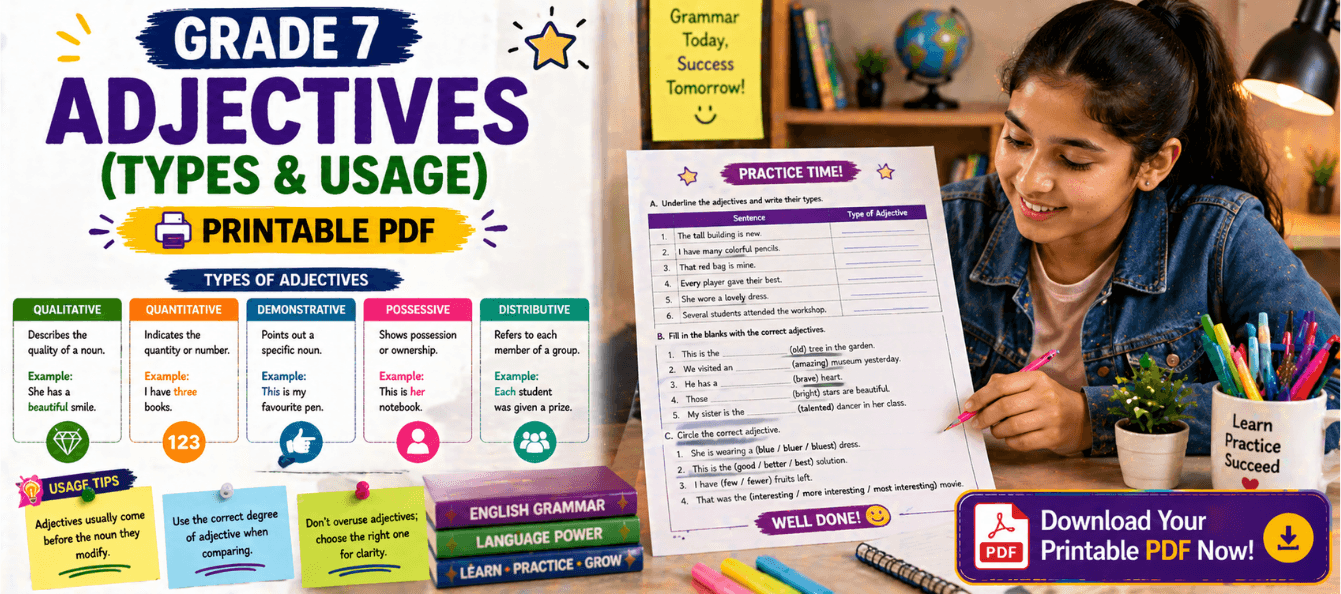
The topic of this worksheet is Adjectives (Types & Usage). An adjective is a word that describes or modifies a noun or pronoun. It gives us more information about the size, shape, color, quality, quantity, or number of the object being discussed. This worksheet covers various types of adjectives, including Descriptive Adjectives (which describe quality, like "warm" or "tall"), Quantitative Adjectives (which describe quantity, like "some" or "little"), Demonstrative Adjectives (which point out specific things, like "that" or "this"), Possessive Adjectives (which show ownership, like "his" or "their"), Proper Adjectives (formed from proper nouns, like "Indian"), Numeral Adjectives (which indicate numbers or order, like "two" or "first"), Interrogative Adjectives (used in questions), and Distributive Adjectives (which refer to individual members of a group, like "each").
What’s in This Worksheet?
This comprehensive English grammar worksheet is designed to test and improve a student's grasp of adjectives through varied exercises. Here is what is included:
1. Multiple Choice Questions: Students must identify specific types of adjectives within sentences, distinguishing between descriptive words and quantity indicators.
2. True and False: This section assesses understanding of grammatical rules, such as the position of adjectives and the function of possessive words.
3. Fill in the Blanks: Students must complete sentences using appropriate grammatical terms related to adjectives.
4. Sentence Rewriting: This section challenges students to correct errors related to adjective order, position, and usage (e.g., changing "red big ball" to "big red ball").
5. Paragraph Writing: A creative exercise where students fill in blanks in a story about Holi using appropriate adjectives based on provided hints.
Definitions, Examples, Techniques, and Tips
Based on the exercises provided in this worksheet, here are the key definitions and examples students need to know:
- Definition: An adjective describes a noun. For example, in "Rahul wore a warm sweater," the word "warm" describes the sweater.
- Descriptive Adjective: These describe the quality of a noun. Examples include "warm" (sweater), "tall" (tower), and "lovely" (sisters).
- Quantitative Adjective: These tell us how much or how many. Examples include "some" (rice) and "few" (friends).
- Demonstrative Adjective: These point out specific nouns. Examples include "that" (temple) and "those" (boys).
- Possessive Adjective: These show ownership or relationship. Examples include "his" (bat) and "their" (house).
- Proper Adjective: These are derived from proper nouns. An example is "Indian" (classical music).
- Numeral Adjective: These indicate numbers. Examples include "two" (sisters), "first" (prize), and "second" (tower).
- Interrogative Adjective: These are used to ask questions about nouns. While the worksheet provides simple sentences, typically words like "what," "which," or "whose" fit this category.
- Distributive Adjective: These refer to individual members of a group separately. Examples include "each" (student) and "every" (player).
Techniques for identifying them include looking at the function of the word. If it shows ownership, it's possessive. If it counts, it's numeral. A tip for usage is to remember the specific order of adjectives (Opinion, Size, Age, Shape, Color, Origin, Material, Purpose). For instance, we say "soft silk pillow" (Quality then Material), not "silk soft pillow."
Why Is It Important to Learn This?
Learning the different types of adjectives is essential for clear and descriptive communication. Adjectives allow us to add color, emotion, and precision to our language. Without them, speech and writing would be robotic and difficult to visualize. For a Grade 7 student, knowing the difference between "few" and "some," or how to arrange "big" and "red," prevents common grammatical errors. It also helps in academic writing, where being specific about the subject matter is often graded. Mastery of adjectives directly impacts reading comprehension as well, helping students understand the nuances of what they read.
Where Will This Knowledge Help You?
The knowledge gained from this Adjectives worksheet is applicable in many areas:
- Creative Writing: Describing settings, characters, and actions vividly.
- Exams: Answering grammar questions specifically related to parts of speech.
- Daily Conversation: Communicating details effectively, such as describing an object or giving directions.
- Editing and Proofreading: Identifying errors in sentence structure, such as misplaced adjectives.
How to Use This Worksheet?
To get the best results from this Grade 7 English grammar worksheet, follow these steps:
1. Attempt independently first: Try to answer all questions, from the multiple choice to the paragraph writing, without external help.
2. Review answers carefully: Use the answer key provided below to check your responses.
3. Correct mistakes: Pay special attention to the sentence rewriting section. Understand why "red big" is changed to "big red" and "much books" is changed to "many books."
4. Practice regularly: Try to write your own sentences using the specific types of adjectives you found difficult.
The solutions below follow the exact worksheet order. Students should compare their answers carefully to ensure they have grasped the concepts of types and usage.
Important Tips and Tricks
Here are some tips to help you score full marks based on the content of this worksheet:
- Position Matters: Adjectives usually come before the noun they modify (e.g., "warm sweater"), except in certain cases where they come after.
- Order of Adjectives: When using multiple adjectives for one noun, follow the order: Opinion -> Size -> Age -> Shape -> Color -> Origin -> Material -> Purpose. "Big red ball" (Size -> Color) is correct.
- Countable vs. Uncountable: Use "many" or "few" for things you can count (books), and "much" or "little" for things you cannot (water).
- Distributive Words: Words like "each" and "every" take a singular noun. "Each player" is correct; "Each players" is incorrect.
- Possessive Clashes: Avoid using a possessive adjective and a demonstrative adjective together for the same noun in the same position (e.g., "My these shoes" is wrong; use "These shoes").
Complete Answer Key
Exercise No. 1 Choose the correct answer from the options.
1. b) Rahul wore a warm sweater today.
2. a) Anjali ate some rice for her lunch.
3. b) That temple in Agra is very famous.
4. b) Kartik lost his cricket bat yesterday.
5. a) Neha loves Indian classical music.
6. a) Arjun has two younger sisters at home.
7. b) Is that the shortest route that leads to the station?
8. a) The tall tower stands in old Delhi.
9. a) Each student received a prize on stage.
10. b) Their house is near the riverbank.
Exercise No. 2 Tick T if the statement is true or F if the statement is false.
1. Adjectives describe or modify nouns and pronouns. T
2. Possessive adjectives show ownership of a noun. T
3. Descriptive adjectives tell the quality of a noun. T
4. Adjectives of quality answer how many. F
5. Adjectives always come after the noun they modify. F
6. A demonstrative adjective points out a noun. T
7. Numeral adjectives indicate quantity or order. T
8. Adjectives can never be used without a noun. F
9. This is an example of a demonstrative adjective. T
10. My and our are examples of possessive adjectives. T
Exercise No. 3 Fill in the blanks with the correct word or phrase to complete each sentence.
1. A quality adjective is called an Adjective of Quality.
2. Words like 'this' and 'that' are Demonstrative Adjectives.
3. An adjective telling how many is a Quantitative Adjective.
4. Words like 'my', 'your', 'his' are Possessive Adjectives.
5. An adjective from a proper noun is a Proper Adjective.
6. Words like 'each' and 'every' are Distributive Adjectives.
7. An adjective asking a question is an Interrogative Adjective.
8. Words like 'some' and 'many' are Quantitative Adjectives.
9. An adjective pointing out a noun is a Demonstrative Adjective.
10. Words like 'first' and 'second' are Numeral Adjectives.
Exercise No. 4 Rewrite the following sentences according to the directions given on the right.
1. The girl happy won the first prize. -> The happy girl won the first prize.
2. This those boys are my classmates. -> Those boys are my classmates.
3. Each every player scored a goal today. -> Every player scored a goal today.
4. She has much books in her school bag. -> She has many books in her school bag.
5. The red big ball rolled down the hill. -> The big red ball rolled down the hill.
6. He is more taller than his elder brother. -> He is taller than his elder brother.
7. Anjali has little friends in school. -> Anjali has few friends in school.
8. My these shoes are very old and torn. -> These shoes are very old and torn.
9. The silk soft pillow was very comfortable. -> The soft silk pillow was very comfortable.
10. The wooden old desk is very heavy. -> The old wooden desk is very heavy.
Exercise No. 5 Read the paragraph and fill in the blanks with the correct words using the hints given below.
The joyful festival of Holi is celebrated with great excitement across India every spring season. Narrow streets are filled with laughing children running in every direction with joy and delight. Many friends gather at the community ground to play with colours together in the open. My grandmother makes delicious gujiyas for the entire family to enjoy on this special day. Bright colours like pink and green cover everyone from head to toe in bright shades. Each bucket is filled with colourful water balloons for the little children to throw around. A neighbour brings a large plate of festive sweets to share with all the neighbours. Every person in the colony joins the celebration with great enthusiasm and loud laughter. Loud drummers play rhythmic music near the temple throughout the evening until late at night.
By working through these exercises, Grade 7 students can master the types and usage of adjectives, a vital component of English grammar. Consistent practice with such worksheets ensures that students can apply these rules naturally, making their communication more effective and their writing more descriptive. Keep up the good work and continue exploring the colorful world of adjectives!