
Grade 7 Adverbs (Types & Usage) [Grammar Practice]
![Grade 7 Adverbs (Types & Usage) [Grammar Practice]](https://cdn5.planetspark.in/media/small_Grade_7_Adverbs_Types_and_Usage_Grammar_Practice_6728008e2b.png)

Mastering Adverbs: English Grammar Worksheet for Grade 7
Verbs are the action words of our language, but how often do we stop to describe *how* an action is performed? This is where adverbs come into play. Adverbs are the unsung heroes of English grammar that add depth, detail, and clarity to our sentences. They tell us more about the verbs, adjectives, or even other adverbs in a sentence. For students in Grade 7, mastering adverbs is essential for moving beyond simple sentences and creating more complex and descriptive communication. Whether writing a story about a cricket match or describing a daily routine, adverbs provide the necessary context to make the narrative vivid. This English grammar worksheet focuses on Adverbs (Types & Usage), offering a structured approach to identifying and applying these essential words correctly.
Download these English grammar worksheets and practice regularly to strengthen your language skills and build a strong foundation. You can also book a free trial to get expert guidance and improve your reading, writing, and comprehension abilities. The worksheets are designed in a simple and structured way to help K–8 students learn grammar concepts easily and use them confidently in everyday communication.
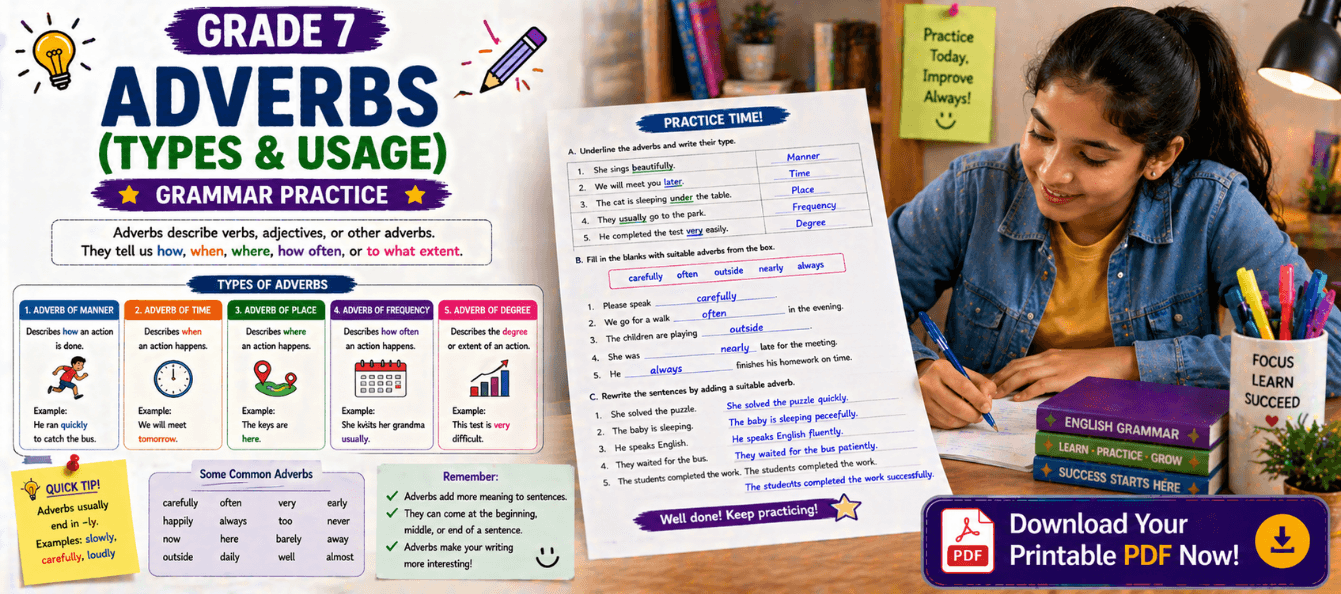
What Is the Topic?
The topic of this worksheet is Adverbs (Types & Usage). An adverb is a word that modifies a verb, an adjective, or another adverb. They often answer questions like How? When? Where? How often? and To what extent? This worksheet specifically covers five main types of adjectives—Adverbs of Manner, Time, Place, Frequency, and Degree. An Adverb of Manner describes how something is done (e.g., "confidently"), an Adverb of Time tells when it happened (e.g., "yesterday"), an Adverb of Place tells where it happened (e.g., "outside"), an Adverb of Frequency tells how often (e.g., "always"), and an Adverb of Degree tells the extent of an action (e.g., "extremely").
What’s in This Worksheet?
This Grade 7 English grammar worksheet is designed to test a student's ability to identify and use adverbs correctly through a variety of exercises:
1. Multiple Choice Questions: Students identify sentences containing specific types of adverbs, such as choosing the sentence with an Adverb of Manner vs. Time.
2. True and False: This section tests theoretical knowledge, asking students to verify rules regarding adverb placement and function.
3. Fill in the Blanks: Students complete sentences by categorizing words like "quickly" or "yesterday" into the correct type (Manner, Time, etc.).
4. Sentence Rewriting: A critical section where students correct common grammatical errors, such as changing "good" to "well" or removing incorrect formations like "fastly."
5. Paragraph Writing: A contextual exercise where students fill in blanks in a story about a cricket match using appropriate adverbs.
Definitions, Examples, Techniques, and Tips
Based on the provided exercises, here are the core concepts students need to grasp:
- Adverb of Manner: Describes how an action is done. Examples: "confidently," "slowly," "happily."
- Adverb of Time: Tells when an action happens. Examples: "yesterday," "tomorrow morning," "now."
- Adverb of Place: Tells where an action happens. Examples: "outside," "here," "everywhere."
- Adverb of Frequency: Tells how often an action occurs. Examples: "always," "rarely," "never."
- Adverb of Degree: Describes the intensity of an action or adjective. Examples: "extremely," "quite," "very."
- Techniques: To identify an adverb, look for words that modify the verb. If the sentence is "Rahul answered the question confidently," "answered" is the verb, and "confidently" tells how he answered.
- Tips: Be careful with irregular adverbs. "Good" is an adjective; "well" is the adverb. "Fast" is both an adjective and an adverb; "fastly" is incorrect. "Hard" can be an adjective or adverb (meaning with effort), while "hardly" means barely.
Why Is It Important to Learn This?
Adverbs are vital for precision in language. Without them, sentences might be factually correct but lack detail and emotion. For example, "He runs" is a complete sentence, but "He runs quickly" paints a much clearer picture. In academic settings, using adverbs correctly improves the quality of essays and reports. It helps students express themselves more clearly, avoiding ambiguity. Furthermore, understanding the distinction between similar words (like "hard" vs. "hardly") is crucial for avoiding miscommunication.
Where Will This Knowledge Help You?
The ability to use adverbs effectively will assist students in several areas:
- Storytelling: Making narratives more engaging by describing actions and settings.
- Instructional Writing: Giving clear directions on how to do something.
- Exams: Answering grammar questions specifically related to parts of speech.
- Daily Conversation: Conveying exact meanings, such as how often you do a chore or when you will arrive.
How to Use This Worksheet?
To maximize the benefits of this Adverbs worksheet, students should:
1. Attempt independently first: Try to identify the adverbs and fill in the blanks without looking up answers.
2. Review answers carefully: Compare responses with the key provided below, paying special attention to the sentence rewriting section.
3. Correct mistakes: Analyze why "fastly" is wrong or why "always" is placed before the verb in some cases.
4. Practice regularly: Try to write your own sentences using the specific types of adverbs practiced here.
The solutions provided below follow the exact worksheet order. Students should compare their answers carefully to ensure they understand the nuances of Manner, Time, Place, Frequency, and Degree.
Important Tips and Tricks
Here are some specific tips to help students navigate the common pitfalls found in this worksheet:
- "Fast" vs. "Fastly": Remember that "fastly" is not a word in standard English. Always use "fast" as both an adjective and an adverb.
- "Hard" vs. "Hardly": "Hard" implies effort (e.g., "He worked hard"). "Hardly" means scarcely or barely (e.g., "He hardly speaks"). They are not interchangeable.
- Adverb Position: Adverbs of frequency (like "always") and manner (like "carefully") typically go before the main verb or after the auxiliary verb. For example, "The bus always arrives late," not "The bus arrives always late."
- "Good" vs. "Well": Use "good" to describe nouns (adjective) and "well" to describe actions (adverb). "She sings well," not "She sings good."
Complete Answer Key
Exercise No. 1 Choose the correct answer from the options.
1. a) Rahul answered the question confidently.
2. b) Anjali will arrive tomorrow morning.
3. b) The children are playing outside now.
4. a) Kartik always drinks milk at breakfast.
5. a) Neha is extremely talented in music.
6. b) The old man walked slowly to market.
7. b) The assembly starts at 7am in the school hall.
8. a) The train stopped suddenly for us.
9. a) Rohan rarely misses his cricket practice.
10. b) The curry is quite spicy every day.
Exercise No. 2 Tick T if the statement is true or F if the statement is false.
1. Adverbs modify verbs, adjectives or adverbs. T
2. Quickly is an adverb of time. F
3. Here and there are adverbs of place. T
4. Adverbs of manner usually come before the verb. F
5. Adverbs of frequency answer how often. T
6. Adverbs of manner tell how an action is done. T
7. Adverbs of place answer the question where. T
8. An adverb can never modify an adjective. F
9. Very and quite are adverbs of degree. T
10. Always and never are adverbs of frequency. T
Exercise No. 3 Fill in the blanks with the correct word or phrase to complete each sentence.
1. An adverb telling 'how' is of Manner.
2. An adverb telling 'when' is of Time.
3. An adverb telling 'where' is of Place.
4. An adverb telling 'how often' is of Frequency.
5. An adverb telling 'how much' is of Degree.
6. The word 'quickly' is an adverb of Manner.
7. The word 'yesterday' is an adverb of Time.
8. The word 'everywhere' is an adverb of Place.
9. The word 'always' is an adverb of Frequency.
10. The word 'very' is an adverb of Degree.
Exercise No. 4 Rewrite the following sentences according to the directions given on the right.
1. She writes good in the examination. -> She writes well in the examination.
2. The bus arrives always late in the morning. -> The bus always arrives late in the morning.
3. Rahul did the work careful and neatly. -> Rahul did the work carefully and neatly.
4. He runs very fastly on the running track. -> He runs very fast on the running track.
5. She sings beautiful at the school concert. -> She sings beautifully at the school concert.
6. The children played happy in the garden. -> The children played happily in the garden.
7. He drives very fastly on the highway road. -> He drives very fast on the highway road.
8. The teacher explained the lesson clear. -> The teacher explained the lesson clearly.
9. Anjali speaks English very fluent indeed. -> Anjali speaks English very fluently indeed.
10. Kartik worked hardly to win the first prize. -> Kartik worked hard to win the first prize.
Exercise No. 5 Read the paragraph and fill in the blanks with the correct words.(Answers may vary)
1. Prompty / Punctually
2. Confidently
3. Quickly
4. Alertly / Carefully
5. Loudly
6. Finally
7. Quickly
8. Wisely
9. Finally
10. Friendly
Mastering adverbs allows students to communicate with greater precision and style. By understanding the different types and correcting common usage errors, Grade 7 students can significantly improve their writing quality. Keep practicing with these worksheets to build a strong command over English grammar and express yourself with confidence!