
Grade 7 Clauses (Independent & Dependent) [With Examples]
![Grade 7 Clauses (Independent & Dependent) [With Examples]](https://cdn5.planetspark.in/media/small_Grade_7_Clauses_Independent_and_Dependent_With_Examples_3d59edf4ca.png)

English Grammar Worksheet for Grade 7 on Clauses (Independent & Dependent)
Building a strong sentence requires more than just stringing words together; it requires an understanding of how groups of words function within a sentence. For students in Grade 7, understanding the difference between Independent and Dependent clauses is a crucial step toward mastering complex writing. A clause is the building block of a sentence, containing at least a subject and a verb. However, not all clauses are the same. Some can stand alone as complete thoughts, while others need support to make sense. This worksheet is designed to help students distinguish between these two types of clauses, enabling them to construct clear, varied, and grammatically correct sentences.
Download these English grammar worksheets and practice regularly to strengthen your language skills and build a strong foundation. You can also book a free trial to get expert guidance and improve your reading, writing, and comprehension abilities. The worksheets are designed in a simple and structured way to help K–8 students learn grammar concepts easily and use them confidently in everyday communication.
What Is the Topic?
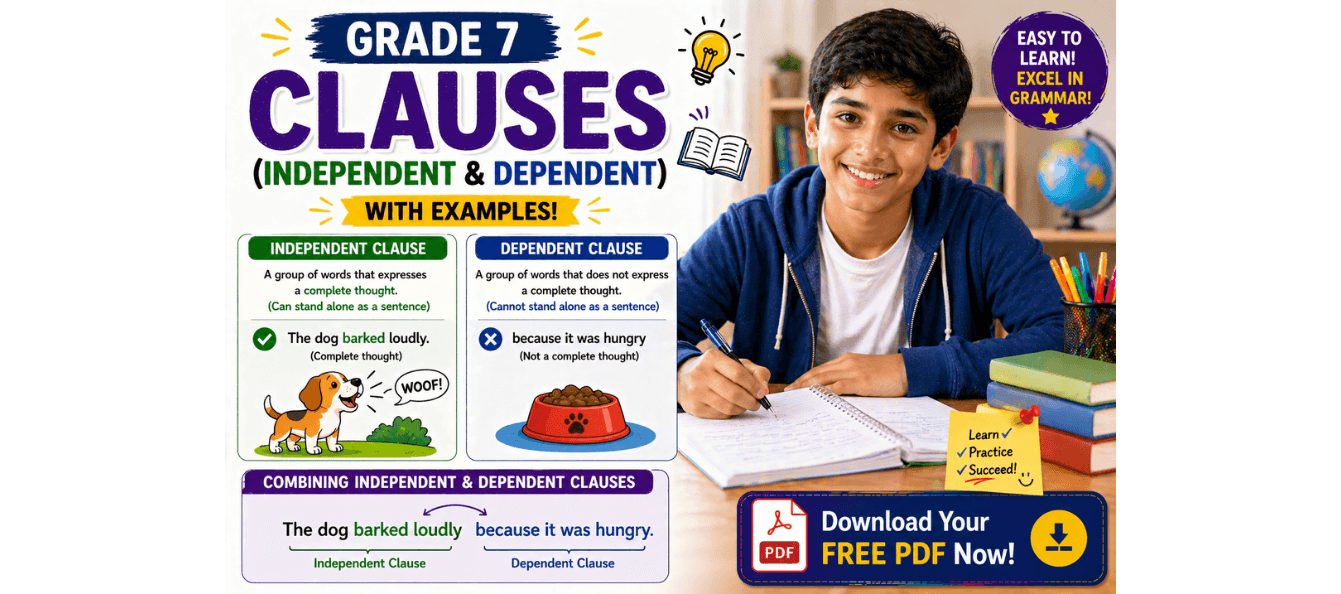
This English grammar worksheet focuses on Clauses, specifically Independent and Dependent clauses. An Independent Clause is a group of words that contains a subject and a verb and expresses a complete thought. It can stand alone as a sentence. For example, "Rahul completed his homework" is an independent clause because it tells us a complete idea. A Dependent Clause, also known as a subordinate clause, contains a subject and a verb but does not express a complete thought. It cannot stand alone and usually starts with a subordinating word like "because," "if," or "although." For example, "Because Rahul completed his homework" is a dependent clause because it leaves us waiting for more information.
What’s in This Worksheet?
This worksheet offers a structured approach to identifying and using clauses correctly. It includes:
1. Multiple Choice Questions where students must identify whether a given group of words is an Independent or a Dependent clause.
2. True and False questions that test the definitions and properties of clauses, such as their ability to stand alone and the types of verbs they contain.
3. Fill in the Blanks exercises that require students to complete definitions and rules regarding the structure and function of clauses.
4. Sentence Rewriting tasks where students must fix fragments or combine clauses to form correct sentences based on specific instructions (Independent or Dependent).
5. Paragraph Writing exercises that test the student's ability to identify the correct grammatical terms to complete a summary of clause rules.
Definitions, Examples, Techniques, and Tips
To master this topic, students must understand the core definitions provided in the worksheet. An Independent Clause expresses a complete thought and can stand alone. It is also referred to as a main clause. A Dependent Clause does not express a complete thought and cannot stand alone. It is also called a subordinate clause and relies on an independent clause to make sense.
A key technique for identifying a dependent clause is to look for subordinating words at the beginning, such as "because," "although," "if," "when," "since," and "until." If a clause starts with one of these words, it is almost certainly dependent.
Another important concept is the "finite verb." Both independent and dependent clauses must have a subject and a finite verb (a verb that shows tense). The worksheet clarifies that just because a group of words has a subject and a verb does not mean it is a sentence; it must also express a complete thought.
Tips for identifying them include the "Stand-Alone Test." Read the group of words aloud. Does it sound like a complete sentence? Does it make sense on its own? If yes, it is independent. If it leaves you asking "and then what?" or "why?", it is dependent. Also, look for the comma; in complex sentences, a comma is often used to separate a dependent clause at the beginning of the sentence from the independent clause that follows.
Why Is It Important to Learn This?
Understanding the difference between independent and dependent clauses is essential for writing grammatically correct sentences and avoiding sentence fragments. A fragment is an incomplete sentence that often consists of just a dependent clause. By mastering this topic, Grade 7 students can ensure that every sentence they write is complete. Furthermore, recognizing dependent clauses is the first step toward writing complex sentences, which add sophistication and detail to student writing. This knowledge is also vital for reading comprehension, as it helps students break down long, complicated sentences into manageable parts to understand the meaning.
Where Will This Knowledge Help You?
This knowledge is directly applicable to essay writing, creative writing, and editing. In exams, students are often asked to identify clauses or correct sentence fragments. In literature, analyzing how authors combine independent and dependent clauses helps students understand the flow and pacing of a text. In everyday communication, knowing how to use dependent clauses allows students to add nuance to their speech, explaining reasons and conditions effectively.
How to Use This Worksheet?
To get the most out of this worksheet, follow these steps:
1. Read the questions in the Multiple Choice section carefully. Look for subordinating words to spot dependent clauses.
2. In the True/False section, focus on the definitions of "complete thought" and "stand alone."
3. For the Fill in the Blanks section, use the context of the sentence structure definitions to find the right words.
4. In the Sentence Rewriting section, carefully read the instruction. If it says "Independent Clause," ensure the result is a complete thought. If it says "Dependent Clause," use a subordinating conjunction to create a clause that relies on another.
5. Use the Answer Key provided below to verify your answers and understand the reasoning.
Important Tips and Tricks
Here are some strategies to help you identify and use clauses correctly:
1. Look for the "Marker Words": Words like "because," "if," "since," and "although" are red flags that indicate a dependent clause.
2. The "So What?" Test: Read the clause. If you find yourself asking "So what?" or "And then?", it is likely a dependent clause.
3. Check for Punctuation: If a clause is at the start of a sentence followed by a comma, it is usually a dependent clause.
4. Subject-Verb Pair: Remember that every clause must have a subject and a verb. If a group of words is missing one, it is a phrase, not a clause.
5. Avoid Fragments: Never let a dependent clause sit alone as a sentence. Always attach it to an independent clause.
6. Use for Variety: Try to start sentences with dependent clauses occasionally to add rhythm to your writing (e.g., "Although it was hot, we played cricket.").
Complete Answer Key
Exercise No. 1
1. b) Rahul completed his homework.
2. a) When the school bell rang loudly.
3. b) Anjali loves reading mystery novels.
4. b) Since the traffic was very heavy.
5. a) Arjun played football in the evening.
6. a) Because it was raining very heavily.
7. b) Neha sang a classical raga.
8. a) If you finish your work early.
9. a) The train departed from the station.
10. b) Where the river meets the open sea.
Exercise No. 2
1. True
2. False (A dependent clause does not express a complete thought)
3. True
4. True
5. True
6. True
7. True
8. True
9. False ("Because she was tired" is a dependent clause)
10. True
Exercise No. 3
1. An Independent Clause can stand alone.
2. A Dependent Clause cannot stand alone.
3. A Dependent Clause starts with a subordinating word.
4. An Independent Clause has a finite verb.
5. A Dependent Clause is also called a subordinate clause.
6. An Independent Clause is also called a main clause.
7. A Dependent Clause depends on the main clause.
8. Dependent clauses use subordinating conjunctions.
9. Two independent clauses need a conjunction.
10. A Dependent Clause needs a main clause.
Exercise No. 4
1. Change to Independent Clause: He stayed at home because he was ill.
2. Change to Dependent Clause: When the rain stopped, we went out to play.
3. Change to Dependent Clause: We played cricket although it was hot.
4. Change to Independent Clause: She studied hard and passed the exam.
5. Change to Dependent Clause: He caught the bus because he ran fast.
6. Change to Independent Clause: If you work hard, you will succeed.
7. Change to Dependent Clause: While I was reading, the phone rang loud.
8. Change to Independent Clause: The match was cancelled because it rained heavily.
9. Change to Dependent Clause: I know that she is an honest girl.
10. Change to Dependent Clause: He is the boy who won the first prize.
Exercise No. 5
Answers may vary. (Suggested answers based on context: complete, complete, subordinating, finite, subordinate, comma, main, alone, conjunction, independent.)
Understanding the distinction between independent and dependent clauses is a game-changer for writing. It empowers Grade 7 students to fix sentence fragments and construct sophisticated, complex sentences with confidence. Keep practicing with these worksheets to ensure your sentence structures are always solid and your writing flows smoothly.