
Grade 7 Conditional Sentences Practice from Zero to Third Conditional
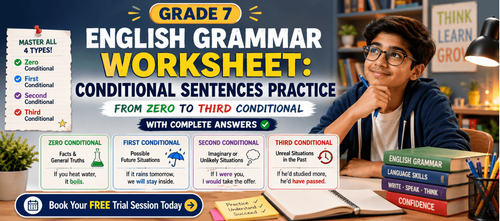

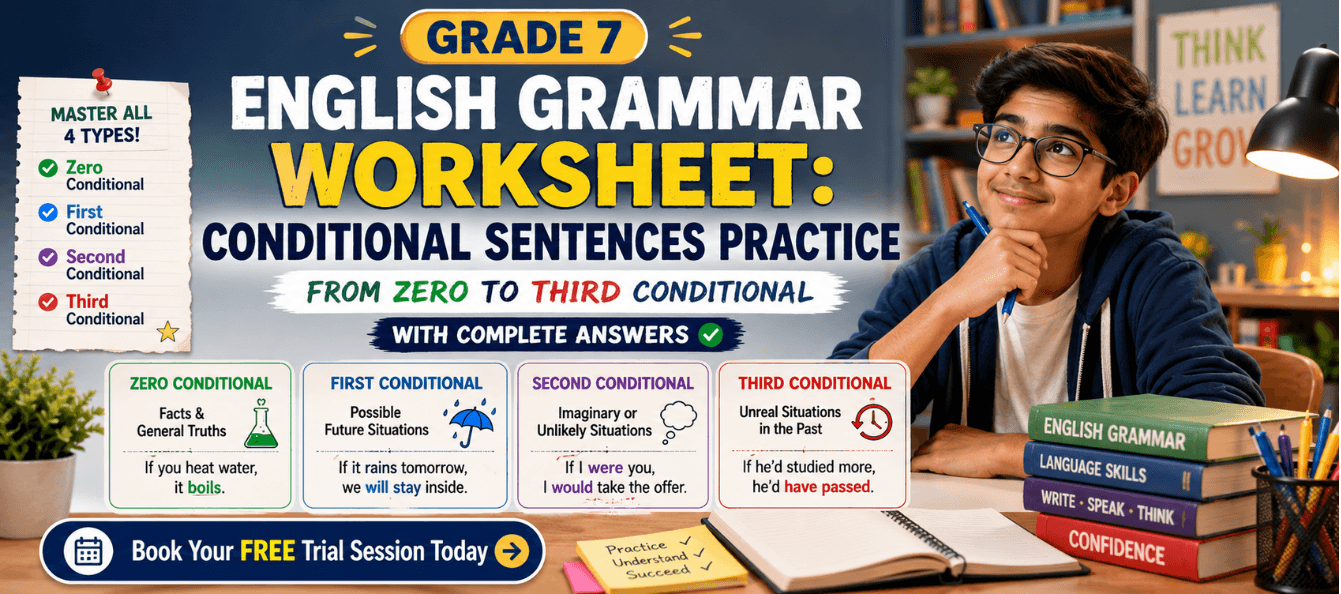
Grade 7 English Grammar Worksheet: Conditional Sentences Practice from Zero to Third Conditional with Complete Answers
Learning conditional sentences helps students talk about facts, possibilities, imaginary situations, and past events in a clear and meaningful way. This Grade 7 Conditional Sentences Practice from Zero to Third Conditional worksheet gives learners an opportunity to identify, classify, rearrange, and rewrite different types of conditional sentences. Through matching activities, multiple-choice questions, sentence rearranging tasks, sentence rewriting exercises, and picture-based practice, students can strengthen their understanding of Zero, First, Second, and Third Conditionals while improving grammar accuracy and sentence construction skills.
Download these English grammar worksheets and practice regularly to strengthen your language skills and build a strong foundation. You can also book a free trial to get expert guidance and improve your reading, writing, and comprehension abilities. The worksheets are designed in a simple and structured way to help K–8 students learn grammar concepts easily and use them confidently in everyday communication.
What Is the Topic?
This worksheet focuses on conditional sentences. Students learn to recognize and use different conditional types including Zero Conditional, First Conditional, Second Conditional, and Third Conditional. The activities help learners identify conditional patterns, understand sentence meanings, rearrange words into correct conditional structures, and rewrite sentences in different conditional forms. Students are expected to classify conditional sentences correctly and create meaningful conditional statements.
What’s in This Worksheet?
1. Match the following activity to identify different conditional sentence types.
2. Multiple-choice questions for recognizing the correct conditional type.
3. Sentence rearranging activities to form complete conditional sentences.
4. Sentence rewriting tasks that require changing one conditional type into another.
5. Picture description activity using different conditional sentence forms.
6. Practice with Zero Conditional sentences.
7. Practice with First Conditional sentences.
8. Practice with Second Conditional sentences.
9. Practice with Third Conditional sentences.
10. Exercises that strengthen grammar recognition, sentence structure, and writing skills.
Definitions, Examples, Techniques, and Tips
Definitions
• Zero Conditional describes facts and general truths.
• First Conditional describes possible future situations.
• Second Conditional describes imaginary or unlikely situations.
• Third Conditional describes unreal situations in the past.
Examples From The Worksheet
• If you heat water, it boils.
• If it rains tomorrow, we will stay inside.
• If I were you, I would take the offer.
• If he'd studied more, he'd have passed.
Techniques
• Read both parts of the sentence carefully.
• Identify whether the sentence talks about facts, future possibilities, imaginary situations, or past situations.
• Look for clue words such as will, would, and would have.
• Rearrange words logically before checking grammar.
Quick Learning Tips
• Practice identifying the type before selecting an answer.
• Read the complete sentence aloud after rearranging words.
• Check verb forms carefully.
• Compare rewritten sentences with the required conditional type.
Why Is It Important to Learn This?
Conditional sentences are an important part of English grammar. They help students express facts, possibilities, predictions, imaginary situations, and reflections about the past. Understanding conditionals improves speaking, writing, reading, and comprehension skills. It also helps students communicate ideas clearly in school assignments and everyday conversations.
Where Will This Knowledge Help You?
• School grammar tests and examinations.
• Classroom discussions and activities.
• Creative writing assignments.
• Paragraph and essay writing.
• Speaking activities and presentations.
• Everyday communication using accurate grammar.
How to Use This Worksheet?
1. Read every question carefully before answering.
2. Attempt each exercise independently.
3. Match, choose, rearrange, and rewrite sentences according to the instructions.
4. Compare your work with the answer key provided below.
5. Check each answer in the exact worksheet order.
6. Correct any mistakes you find.
7. Practice similar conditional sentences regularly.
8. Review all four conditional types frequently for better understanding.
Important Tips and Tricks
1. Identify whether the sentence expresses a fact, future possibility, imaginary situation, or past situation.
2. Pay attention to helping verbs such as will, would, and would have.
3. Read all answer options before choosing one.
4. Rearrange sentence fragments carefully before writing the final answer.
5. Follow the required conditional type exactly when rewriting sentences.
6. Avoid changing the meaning of the original sentence unnecessarily.
7. In picture-based activities, create meaningful sentences related to the image.
8. Check grammar, punctuation, and word order before finalizing answers.
Complete Answer Key
Exercise:1
Match each sentence to the correct conditional type.
1. If you heat water, it boils. – Zero
2. If I'd studied more, I'd have passed. – Third
3. If it rains tomorrow, we will stay inside. – First
4. If I were you, I would take the offer. – Second
5. If people exercise, they stay healthy. – Zero
6. If she calls, I will answer. – First
7. If he'd left early, he'd have got the train. – Third
8. If you mix red and blue, you get purple. – Zero
9. If I saw a ghost, I would run. – Second
10. If you freeze water, it turns to ice. – Zero
Exercise: 2
Choose the correct conditional type for each sentence.
1. If you drop a glass, it breaks.
Answer: c. Zero Conditional
2. If it rains, we will stay inside.
Answer: b. First Conditional
3. If I were rich, I would travel the world.
Answer: b. Second Conditional
4. If you study, you will pass.
Answer: a. First Conditional
5. If water freezes, it becomes ice.
Answer: b. Zero Conditional
6. If I had known, I would have told you.
Answer: a. Third Conditional
7. If it is sunny, we will go hiking.
Answer: a. First Conditional
8. If I saw a lion, I would hide.
Answer: c. Second Conditional
Exercise: 3
Rearrange the words to create a correct conditional sentence and label its type.
1. If you study, you will pass. (First Conditional)
2. If you heat water, it boils. (Zero Conditional)
3. If we had left earlier, we wouldn't have arrived late. (Third Conditional)
4. If I had known earlier, I would have come. (Third Conditional)
5. If it is sunny, we will go for a picnic. (First Conditional)
6. If she calls, I will answer the phone. (First Conditional)
7. If you mix blue and yellow, you get green. (Zero Conditional)
8. If I had met him, I would have helped. (Third Conditional)
9. If it is windy, kites fly well. (Zero Conditional)
10. If I saved money, I would travel. (Second Conditional)
Exercise:4
Read each sentence carefully and rewrite it in the conditional type given in brackets.
1. If you mix red and blue, you will get purple.
2. If it rains, we stay inside.
3. If I have a magic carpet, I will fly everywhere.
4. If you ate too much sugar, you would get toothaches.
5. If she studies, she will pass.
6. If you hadn't watered plants, they would have died.
7. If I saw a rainbow, I would take a photo.
8. If we leave earlier, we catch the bus.
9. If he had played outside, he would have felt happy.
10. If it snows in summer, we will be surprised.
Exercise:5
Look at the picture given below and write 4 sentences in different conditional types.
1. If it rains, the boy gets wet. (Zero Conditional)
2. If it keeps raining, the boy will need an umbrella. (First Conditional)
3. If the boy had an umbrella, he would stay dry. (Second Conditional)
4. If the boy had brought an umbrella, he would have stayed dry. (Third Conditional)
Practising conditional sentences regularly will help Grade 7 students become more confident in grammar and communication. This Conditional Sentences Practice from Zero to Third Conditional worksheet provides valuable opportunities to identify, classify, rewrite, and create conditional sentences. Keep practising these sentence structures to improve accuracy, strengthen writing skills, and build confidence in using English effectively.