
Grade 7 Conjunctions (Coordinating) [Grammar Practice]
![Grade 7 Conjunctions (Coordinating) [Grammar Practice]](https://cdn5.planetspark.in/media/small_Grade_7_Conjunctions_Coordinating_Grammar_Practice_bc1367f6fe.png)

English Grammar Worksheet for Grade 7 on Coordinating Conjunctions
Writing is not just about putting words on paper; it is about connecting thoughts and ideas in a way that makes sense to the reader. For students in Grade 7, mastering the use of conjunctions is a vital step in becoming fluent writers. Conjunctions act as the bridges between words, phrases, and sentences, allowing students to combine short, choppy statements into longer, more complex expressions. Without them, our speech and writing would feel robotic and disconnected. This worksheet focuses specifically on Coordinating Conjunctions, helping students understand how to join equal parts of a sentence correctly using the right connecting words.
Download these English grammar worksheets and practice regularly to strengthen your language skills and build a strong foundation. You can also book a free trial to get expert guidance and improve your reading, writing, and comprehension abilities. The worksheets are designed in a simple and structured way to help students learn grammar concepts easily and use them confidently in everyday communication.
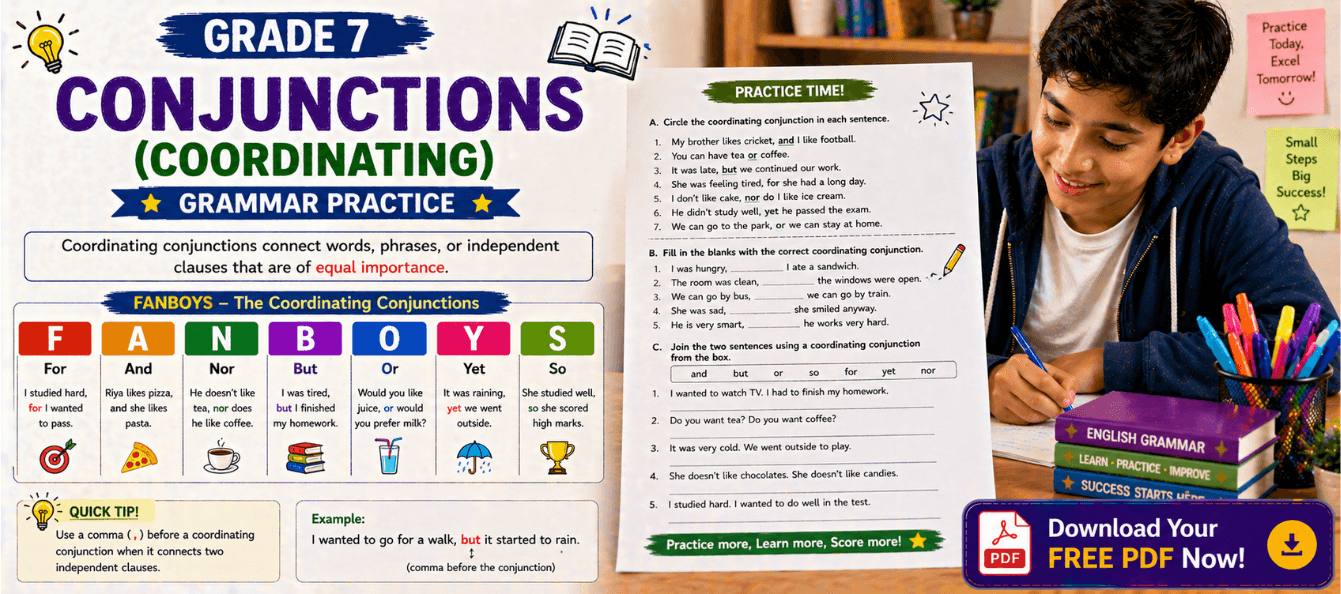
What Is the Topic?
This English grammar worksheet is centered on Coordinating Conjunctions. These are special words used to connect words, phrases, or clauses that are of equal grammatical rank. Unlike subordinating conjunctions, which create a dependency between clauses, coordinating conjunctions join things that are equal, such as two nouns, two verbs, or two complete sentences. The worksheet covers the seven coordinating conjunctions, often remembered by the acronym FANBOYS, and teaches students the specific function of each one—whether it is to add information, show a choice, or create a contrast.
What’s in This Worksheet?
This worksheet is designed to test a student's understanding through a variety of engaging and focused exercises:
1. Multiple Choice Questions that require students to select the correct coordinating conjunction to complete a sentence logically.
2. True and False questions that assess the student's knowledge of the rules regarding coordinating conjunctions, such as their ability to join equal parts and their specific meanings.
3. Fill in the Blanks exercises that ask students to complete definitions of what each conjunction does (e.g., addition, contrast, choice).
4. Sentence Rewriting tasks where students must identify the incorrect conjunction in a sentence and replace it with the correct one to fix the logic.
5. Paragraph Writing exercises that provide a narrative context, requiring students to fill in blanks with the appropriate conjunctions based on the relationship between the ideas.
Definitions, Examples, Techniques, and Tips
To excel in this worksheet, students must understand the specific role of each coordinating conjunction as defined in the exercises:
1. And: This conjunction is used to add ideas together. It connects two similar items or thoughts. For example, "Rahul likes tea and biscuits daily" shows a simple addition of two things Rahul likes.
2. But: This conjunction is used to show a contrast between two ideas. It is used when the second part of the sentence contradicts or differs from the first. For example, "Arjun ran fast but missed the bus" shows that despite running fast, the outcome was missing the bus.
3. Or: This conjunction is used to give a choice between options. It indicates that one of the options can be chosen. For example, "You can have juice or milk" presents a choice.
4. Yet: Similar to "but," "yet" is used to show a contrast or something unexpected despite a previous point. For example, "He is tired yet he continues working" highlights the unexpected nature of continuing despite tiredness.
5. So: This conjunction is used to show a result or consequence. The second part of the sentence happens because of the first. For example, "Study hard or you will fail" uses "or" for a negative condition, while "so" would be used for a direct result like "He was hungry, so he ate."
6. For: When used as a conjunction, "for" means "because." It introduces a reason.
7. Nor: This is used to introduce a negative alternative. It follows a negative statement and adds another negative element.
A useful technique for choosing the right conjunction is to analyze the relationship between the two parts of the sentence. Ask yourself: Am I adding something? Am I showing a choice? Is there a contrast? Is this a result? Answering these questions will point you to the correct conjunction.
Why Is It Important to Learn This?
Learning to use coordinating conjunctions correctly is essential for writing fluency and logical flow. Without them, students are limited to writing simple, short sentences. By mastering these words, Grade 7 students can write compound sentences that show more complex relationships between ideas. It improves reading comprehension by helping students understand how different parts of a text relate to one another. Furthermore, using the correct conjunction ensures that the intended meaning is conveyed; for example, confusing "and" with "or" can completely change the meaning of a sentence from a combination to a choice.
Where Will This Knowledge Help You?
This knowledge is applicable in almost every aspect of English language arts. In story and essay writing, conjunctions help vary sentence structure, making the writing more engaging to read. In debates and speeches, they help in structuring arguments effectively (e.g., using "yet" to introduce a counterpoint). In exams, questions frequently test sentence correction and fill-in-the-blanks using these specific rules. Even in daily conversation, using the right conjunctions makes one sound more articulate and clear.
How to Use This Worksheet?
Students should approach this worksheet by first reviewing the definitions of the seven conjunctions. Here is a step-by-step guide:
1. Read the sentences in the Multiple Choice section carefully and identify the relationship between the two parts.
2. In the True and False section, rely on the specific rules provided in the worksheet (e.g., "And" is for addition).
3. For the Sentence Rewriting section, read the sentence to determine if the logic makes sense. If it doesn't, swap the conjunction with one that fixes the relationship (e.g., change "and" to "but" if there is a contrast).
4. In the Paragraph section, look at the words before and after the blank to decide if the connection is about addition, contrast, or choice.
5. Use the Answer Key provided below to check your work and ensure your logic aligns with the rules.
Important Tips and Tricks
Here are some strategies to help you remember the functions and avoid common mistakes:
1. The FANBOYS Acronym: Remember **F**or, **A**nd, **N**or, **B**ut, **O**r, **Y**et, **S**o as the seven coordinating conjunctions.
2. Check for Contrast: If you see a sentence where the second part surprises you or contradicts the first, use "but" or "yet."
3. Check for Cause/Effect: If the second part is a direct result of the first, use "so."
4. Check for Choice: If the sentence offers an option, use "or."
5. Negative Pairing: Remember that "nor" is used to pair negative ideas, usually following "neither" or "not."
6. Don't Overuse "And": Try to use other conjunctions like "but" or "so" to make your writing more interesting and less repetitive.
Complete Answer Key
Exercise No. 1
1. b) Rahul likes tea and biscuits daily.
2. a) Arjun ran fast but missed the bus.
3. b) Study hard or you will fail the test.
4. b) Neha is poor but she is very honest.
5. a) Rohan and Pooja went to the museum.
6. a) You can have juice or milk for break.
7. b) The film was long but it was exciting.
8. a) Anjali sings and dances on the stage.
9. a) He is tired yet he continues working.
10. b) Work hard or you will not succeed.
Exercise No. 2
1. True
2. True
3. False (Coordinating conjunctions can join words, phrases, OR clauses)
4. False (Yet is used to show contrast, not result)
5. True
6. True
7. True
8. True
9. False (And is used for addition, not cause and effect)
10. True
Exercise No. 3
1. ‘And', 'but', 'or' are coordinating conjunctions.
2. Coordinating conjunctions join equal parts.
3. ‘And' is used to add ideas together.
4. ‘But' is used to show contrast between ideas.
5. ‘Or' is used to give a choice between options.
6. ‘Yet' shows unexpected despite a previous point.
7. ‘So' is used to show result or consequence.
8. ‘For' as a conjunction means because.
9. Coordinating conjunctions join independent clauses.
10. FANBOYS stands for seven coordinating conjunctions.
Exercise No. 4
1. She is poor but she is very honest.
2. Would you like tea or coffee now?
3. Rahul was tired but he kept running.
4. He studied hard yet he failed the test.
5. She did not come nor did she call.
6. The bus was late but we reached on time.
7. I can cook or I can order food online.
8. He was hungry but he ate nothing at all.
9. Anjali is sick but she will go to school.
10. It rained heavily, so the match was stopped.
Exercise No. 5
Answers may vary. (Students should select conjunctions that logically connect the sentences, such as "and" for addition, "but" for contrast, and "so" for result, based on the hints provided in the worksheet.)
Mastering coordinating conjunctions allows Grade 7 students to write with greater flexibility and precision. By understanding the nuance between "and," "but," "or," and the others, students can ensure their writing flows smoothly and their arguments are clear. Keep practicing with these worksheets to make these rules second nature.