
Grade 7 Creative Writing: Imaginative Practice Worksheet

Grade 7 Creative Writing: Imaginative Practice Worksheet
Have you ever thought about what life might be like in the future on a space station? Creative writing lets you imagine new worlds, solve big problems, and tell exciting stories. In Grade 7, you learn how to use your imagination to write stories that are both fun and meaningful. This English grammar worksheet on creative writing (imaginative thinking) helps you practice reading a science fiction story, understanding the characters and their ideas, and answering different types of questions. Whether you want to write your own futuristic tale or improve your reading skills, this topic helps you think outside the box.
Download these English grammar worksheets and practice regularly to strengthen your language skills and build a strong foundation. You can also book a free trial to get expert guidance and improve your reading, writing, and comprehension abilities. The worksheets are designed in a simple and structured way to help K–8 students learn grammar concepts easily and use them confidently in everyday communication.
What Is the Topic?
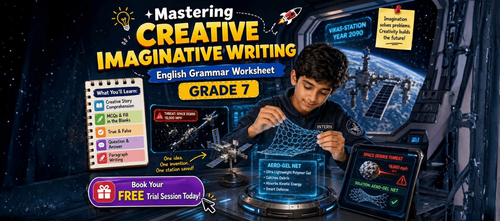
Creative writing with imaginative thinking means using your imagination to write stories that are original and interesting. This worksheet helps students learn how to read and understand a creative story. Students read a science fiction story called “The Orbital Anchor” set in the year 2090. The story is about a young intern named Aryan who works on a space station and invents a new way to stop space debris. After reading the story, students answer multiple choice questions, fill in the blanks, true and false statements, question and answer exercises, and write a short paragraph explaining how imagination saved the station. By practicing these activities, students learn how creative thinking can solve real problems.
What’s in This Worksheet?
1. Multiple choice questions to test understanding of the story “The Orbital Anchor”
2. Fill in the blanks to check memory and vocabulary from the story
3. True and false statements to help pay attention to details
4. Question and answer to write complete answers based on the story
5. Paragraph writing activity to explain how Aryan’s imagination saved the station
6. A science fiction story set in the year 2090 on a space station
7. Questions about setting, characters, invention, problem, and solution
Definitions, Examples, Techniques, and Tips
This worksheet focuses on understanding creative imaginative writing based on a short story. Here are important definitions and examples from the worksheet:
- Creative writing – Writing that comes from your imagination, not just facts.
- Imaginative thinking – Coming up with new ideas or solutions that no one has thought of before.
- Setting – Where and when the story takes place. In the story, the setting is a space station called Vikas-Station in the year 2090.
- Main character – The most important person in the story. In the story, Aryan is a nineteen-year-old structural intern.
- Invention – A new device or method. Aryan invented the Aero-Gel Net.
- Problem – The difficulty the characters face. Space debris travels at eighteen thousand miles per hour and can damage the station.
- Solution – How the problem is fixed. Aryan uses his Aero-Gel to stop the debris.
Techniques for understanding creative writing (from the worksheet):
- Pay attention to the problem and how it is solved.
- Notice how the main character thinks differently from others.
- Look for the lesson or message at the end of the story.
Through exercises such as multiple choice questions, fill in the blanks, and question and answer, students develop a clear understanding of how to read a creative story carefully and explain what happened.
Why Is It Important to Learn This?
Learning creative imaginative writing helps students become better thinkers and writers. It allows them to:
- Use their imagination to come up with new ideas
- Understand that problems can be solved in different ways
- Write stories that are engaging and original
This skill is essential for writing, reading comprehension, and creative thinking in school and everyday life. The worksheet shows that complex problems don’t always need more power – they just need smarter design. This is an important lesson for students to learn.
Where Will This Knowledge Help You?
Understanding creative imaginative writing helps students in:
- School exams where story-based questions are asked
- Writing their own stories and paragraphs
- Participating in classroom discussions about characters and plots
- Thinking creatively in science, art, and other subjects
It also improves reading comprehension as students learn to follow a story from beginning to end.
How to Use This Worksheet?
1. Attempt each question independently without help
2. Carefully read the story “The Orbital Anchor” on page 3
3. Review your answers after completing the worksheet
4. Compare your responses with the answer key provided below
5. Practice regularly to improve accuracy
The solutions follow the exact worksheet order, so students should compare their answers carefully.
Important Tips and Tricks
1. Read the passage twice – first for enjoyment, then with a pen to underline important details like character names, speeds, inventions, and solutions
2. Watch out for tricky true/false statements – for example, “Magnetic shields use very little power” is false because they drain forty percent of power
3. Use the exact words from the passage for fill-in-the-blanks – for example, “Vikas-Station is a massive solar-harvesting hub”
4. For question and answer, write complete sentences using information directly from the story
5. For paragraph writing, explain step by step how Aryan’s imagination solved the problem
6. Pay attention to what the final lesson of the story is – it is often stated at the end
7. Examiners expect you to support your answers with details from the text
Complete Answer Key
Page 3 – The Orbital Anchor (No questions on this page, just the story passage)
Page 4 – Exercise No. 1 (Multiple Choice Questions)
Read the story and choose the correct option for each question based on the text.
1. Where does Aryan work?
b) Vikas-Station
2. What is the main threat?
b) Space debris
3. What is Aryan's invention?
a) Aero-Gel Net
4. Who is Aryan's supervisor?
c) Dr. Sarita
5. Debris travels how fast?
b) Eighteen k
6. What failed the magnets?
a) A solar flare
7. How does the gel work?
b) Kinetic energy
8. What was the gel made of?
c) Polymer gel
9. The gel came from where?
c) Station vents
10. What did the story prove?
a) Smarter design
Page 5 – Fill in the Blanks
1. Vikas-Station is a massive solar-harvesting hub.
2. The orbit is filled with old satellite fragments.
3. Debris can punch through a hull like a bullet.
4. Magnetic shields drain forty percent of power.
5. Aryan developed an ultra-lightweight polymer gel.
6. The gel creates invisible webs to catch metal.
7. Dr. Sarita is a very traditionalist supervisor.
8. A solar flare disabled the station generators.
9. Aryan accessed the emergency vents to help out.
10. The gel acts as a smart defense for the station.
Page 6 – True and False
1. Aryan is an intern at the space hub. (True)
2. Space debris can travel very quickly. (True)
3. Magnetic shields use very little power. (False – they drain forty percent of power)
4. Aryan developed an Aero-Gel Net. (True)
5. The polymer gel is very heavy to use. (False – it is ultra-lightweight)
6. Dr. Sarita liked Aryan's new project. (False – she ordered him to delete it)
7. A solar flare hit the space station. (True)
8. The debris came from a weather satellite. (True)
9. Aryan asked for permission to use gel. (False – he did not ask for permission)
10. The station hull was badly damaged. (False – it remained untouched)
Page 7 – Question and Answer
1. What is the name of the orbital station?
Vikas-Station.
2. At what speed does the space debris move?
Eighteen thousand miles per hour.
3. Why are the magnetic shields problematic?
They drain forty percent of the harvested solar power.
4. What material did Aryan use for the net?
A non-magnetic, ultra-lightweight polymer gel.
5. How does the gel stop the metal fragments?
It catches the fragments, absorbs their kinetic energy, and safely slows them down.
Page 8 – Question and Answer (continued)
6. What did Dr. Sarita call the gel project?
Expensive slime.
7. What event caused the magnets to fail?
A sudden solar flare.
8. Where did the micro-debris cloud come from?
A weather satellite.
9. How was the debris seen stopping in space?
On infrared sensors, thousands of tiny white dots hit the gel and stopped instantly, their heat dissipating safely.
10. What was the final lesson of the story?
Complex problems don't always need more power – they just need a smarter design.
Page 9 – Exercise No. 5
Write a paragraph (80-100 words) explaining how Aryan's imagination saved the station.
Note: This is a writing task. The answer will be written by the student. Based on the story, the paragraph should include:
- Aryan imagined a new way to stop space debris without using heavy magnets.
- He invented the Aero-Gel Net, an ultra-lightweight polymer gel that catches debris and absorbs kinetic energy.
- When a solar flare disabled the magnetic shields and debris was coming, Aryan used his gel without permission.
- The gel stopped the debris safely, and the station remained untouched.
- His imagination proved that smarter design works better than more power.
Answers may vary as long as they explain how Aryan’s imagination directly saved the station and are based only on the story in the worksheet.
Page 10 – Get more worksheets (No questions on this page)
Practicing this English grammar worksheet for Grade 7 on creative writing (imaginative thinking) helps students become more confident in reading science fiction stories and understanding how imagination can solve real problems. With regular practice, students can improve their grammar, writing, and creative thinking skills and express their ideas effectively in both writing and speaking.