
Grade 7 Degrees of Comparison [With Examples and Answers]
![Grade 7 Degrees of Comparison [With Examples and Answers]](https://cdn5.planetspark.in/media/small_Grade_7_Degrees_of_Comparison_With_Examples_and_Answers_a674f42703.png)

Mastering Degrees of Comparison: English Grammar Worksheet for Grade 7
Comparing things is a fundamental part of how we understand the world. We are constantly deciding which is taller, faster, better, or more beautiful. In English grammar, these comparisons are made using specific forms of adjectives called the Degrees of Comparison. For a student in Grade 7, mastering these three degrees—Positive, Comparative, and Superlative—is crucial for describing differences and similarities accurately. Whether discussing the heights of mountains, the populations of cities, or the qualities of friends, the ability to use the correct degree makes communication precise and meaningful. This English grammar worksheet focuses on Degrees of Comparison, providing a structured platform for students to practice and perfect these essential rules.
Download these English grammar worksheets and practice regularly to strengthen your language skills and build a strong foundation. You can also book a free trial to get expert guidance and improve your reading, writing, and comprehension abilities. The worksheets are designed in a simple and structured way to help K–8 students learn grammar concepts easily and use them confidently in everyday communication.
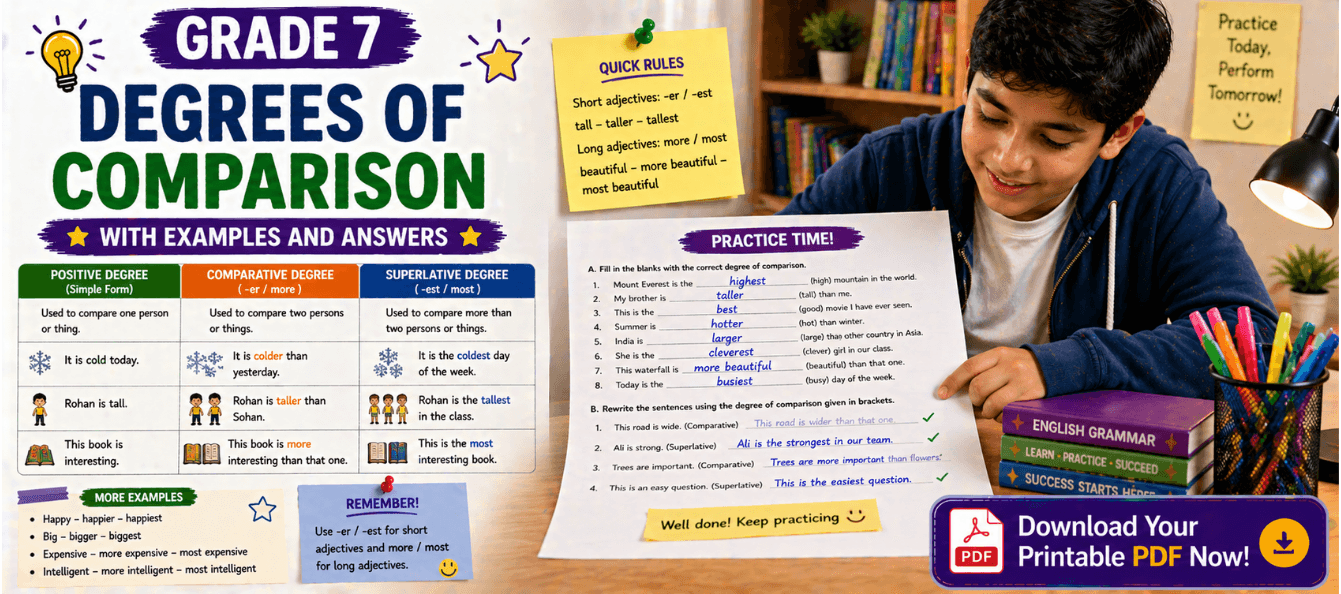
What Is the Topic?
The topic of this worksheet is Degrees of Comparison. Adjectives can change their form to show different degrees of quality. The three degrees are:
1. Positive Degree: This is the simple form of the adjective, used when no comparison is made (e.g., "tall").
2. Comparative Degree: This form is used to compare two things or people (e.g., "taller").
3. Superlative Degree: This form is used to compare more than two things or to show the highest degree of a quality (e.g., "tallest"). Students will learn the rules for changing adjectives to these degrees, such as adding "-er" and "-est" or using "more" and "most."
What’s in This Worksheet?
This Grade 7 English grammar worksheet offers a comprehensive practice session on Degrees of Comparison through various interactive exercises:
1. Multiple Choice Questions: Students identify sentences as Positive, Comparative, or Superlative based on the adjectives used.
2. True and False: This section tests knowledge of the rules, such as when to use "more" versus "-er" and the correct article usage for superlatives.
3. Fill in the Blanks: Students complete sentences with terms describing the different degrees.
4. Sentence Rewriting: A critical section where students correct sentences with errors in degree formation (e.g., "more tall" changed to "taller").
5. Paragraph Writing: A contextual exercise where students fill in blanks in a passage comparing Indian cities using the appropriate degree of adjectives based on hints like "Size," "Weather," and "Behaviour."
Definitions, Examples, Techniques, and Tips
Based on the worksheet content, here are the key concepts and examples:
- Positive Degree: Shows quality without comparison. Example: "Neha is as brave as her elder sister."
- Comparative Degree: Compares two items. Often uses "-er" for short words and "more" for longer words. Example: "Gold is more precious than silver."
- Superlative Degree: Compares more than two items. Often uses "-est" or "most." Example: "Mount Everest is the highest peak."
- Irregular Adjectives: Some adjectives change forms completely. For example, "good" becomes "better" (comparative) and "best" (superlative).
- Techniques: Identify how many items are being compared. Two items = Comparative. Three or more = Superlative. One item or equality = Positive.
- Tips: Remember to add "than" after the comparative degree (e.g., "taller than") and "the" before the superlative degree (e.g., "the tallest").
Why Is It Important to Learn This?
Understanding the Degrees of Comparison is vital for clear and accurate communication. It allows students to articulate differences between objects, people, and places effectively. Without this knowledge, descriptions become flat or grammatically incorrect. For instance, saying "Mumbai is big than Delhi" is confusing; knowing to say "Mumbai is bigger than Delhi" is correct. This skill is heavily tested in exams and is essential for writing descriptive essays or reports where comparisons are often made.
Where Will This Knowledge Help You?
Students will use this knowledge in:
- Descriptive Writing: Comparing characters, settings, or objects in stories.
- Debates and Discussions: Arguing why one option is better than another.
- Exams: Answering specific grammar questions on sentence correction or fill-in-the-blanks.
- Everyday Life: Making decisions based on comparisons, like choosing the "best" route or the "cheaper" product.
How to Use This Worksheet?
To effectively use this Degrees of Comparison worksheet, follow these steps:
1. Attempt independently first: Try to identify the degree in the multiple choice and fill in the paragraph blanks without help.
2. Review answers carefully: Check your answers against the key below to see if you applied the rules correctly.
3. Correct mistakes: Analyze the rewriting section. Understand why "more big" is incorrect and "bigger" is correct.
4. Practice regularly: Practice converting adjectives you use daily into their comparative and superlative forms.
The solutions provided below follow the exact worksheet order. Students should compare their answers carefully to ensure they have mastered the rules of comparison.
Important Tips and Tricks
Here are some tips to help you avoid common errors found in this worksheet:
- Short vs. Long Adjectives: Generally, add "-er" and "-est" to one-syllable words (e.g., tall -> taller). Use "more" and "most" for longer words (e.g., beautiful -> more beautiful).
- Double Letters: Remember to double the final consonant in some short adjectives (e.g., big -> bigger).
- Irregulars: Memorize the irregular forms: Good -> Better -> Best; Bad -> Worse -> Worst.
- "The" Article: Always use "the" before the superlative degree (e.g., "the best," "the most beautiful").
- "As...As": For positive degree comparisons showing equality, use "as [adjective] as" (e.g., "as easy as that one").
Complete Answer Key
Exercise No. 1 Choose the correct answer from the options.
1. a) Rahul is taller than Arjun in class.
2. b) Rahul is the tallest boy in class.
3. b) Mount Everest is the highest peak.
4. a) Neha is as brave as her elder sister.
5. a) This road is the longest in the city.
6. a) Gold is more precious than silver now.
7. b) Mumbai is costlier than Pune.
8. b) The Taj Mahal is the most beautiful.
9. a) Anjali runs the fastest in the school.
10. a) This question is easier than that one.
Exercise No. 2 Tick T if the statement is true or F if the statement is false.
1. Positive degree shows quality without comparison. T
2. Superlative degree compares more than two items. T
3. Comparative degree is used to compare two items. T
4. One-syllable adjectives use more for comparison. F
5. Taller is the superlative form of tall. F
6. Comparative uses er or more before the adjective. T
7. The superlative degree always uses the before it. T
8. Good becomes gooder in the comparative degree. F
9. More beautiful is the comparative of beautiful. T
10. Best is the superlative form of good. T
Exercise No. 3 Fill in the blanks with the correct word or phrase to complete each sentence.
1. Positive Degree shows quality without comparison.
2. Comparative Degree compares two things.
3. Superlative Degree compares more than two.
4. The suffix '-er' is for Comparative Degree.
5. The suffix '-est' is for Superlative Degree.
6. 'More' comes before long adjectives.
7. 'Most' is used before long words for Superlative.
8. Positive Degree uses 'as as' structure.
9. The word 'than' follows the Comparative Degree.
10. The article 'the' comes before Superlative Degree.
Exercise No. 4 Rewrite the following sentences according to the directions given on the right.
1. Rahul is more tall than Arjun. -> Rahul is taller than Arjun.
2. She is the more intelligent girl in class. -> She is the most intelligent girl in class.
3. Mumbai is more big than Pune city. -> Mumbai is bigger than Pune city.
4. This is the more beautiful painting here. -> This is the most beautiful painting here.
5. This is the good book I have ever read. -> This is the best book I have ever read.
6. Neha is more shorter than her elder sister. -> Neha is shorter than her elder sister.
7. Kartik is much strong than his close friend. -> Kartik is stronger than his close friend.
8. This is the bad meal I have ever had. -> This is the worst meal I have ever had.
9. The Ganga is the long river in India. -> The Ganga is the longest river in India.
10. Aryan runs more fast than any other boy. -> Aryan runs faster than any other boy.
Exercise No. 5 Read the paragraph and fill in the blanks with the correct words using the hints given below.
Delhi is bigger than Jaipur in terms of population and total area size. Mumbai is the largest city in India by total population living within its limits. Bengaluru is nicer than Kolkata in terms of pleasant and cool weather. Chennai is as wet as Mumbai during the heavy monsoon season every year. The roads in Pune are wider than the roads in Indore overall in condition. Lucknow is the most courteous city among all the state capitals in India for courtesy. Nagpur is noisier than Delhi in terms of daily traffic congestion on roads. Agra is one of the most visited cities by foreign tourists every single year. The markets in Kolkata are grander than the markets in Nagpur for fresh produce. India has some of the most expensive heritage sites in the entire world today for visitors.
By practicing with this worksheet, Grade 7 students can confidently use the Degrees of Comparison to add precision to their language. Understanding these rules prevents common errors and enhances both written and spoken English. Keep practicing to ensure you can compare and describe the world around you with grammatical accuracy!