
Grade 7 Direct–Indirect Transformation [Printable Grammar Worksheet]
![Grade 7 Direct–Indirect Transformation [Printable Grammar Worksheet]](https://cdn5.planetspark.in/media/small_Grade_7_Direct_Indirect_Transformation_Printable_Grammar_Worksheet_0409d5a4da.png)

English Grammar Worksheet for Grade 7 on Direct-Indirect Transformation
Reporting speech accurately is a sophisticated skill that Grade 7 students must master to become effective communicators. When we tell someone else what another person said, we cannot always use their exact words. Sometimes we need to report the meaning of what was said without using quotation marks. This process is known as Direct-Indirect Transformation or Reported Speech. It involves understanding how to change tenses, pronouns, and time expressions so that the sentence remains grammatically correct and logical. This worksheet provides a comprehensive review of these rules, ensuring students can convert direct quotes into reported speech with confidence.
Download these English grammar worksheets and practice regularly to strengthen your language skills and build a strong foundation. You can also book a free trial to get expert guidance and improve your reading, writing, and comprehension abilities. The worksheets are designed in a simple and structured way to help students learn grammar concepts easily and use them confidently in everyday communication.
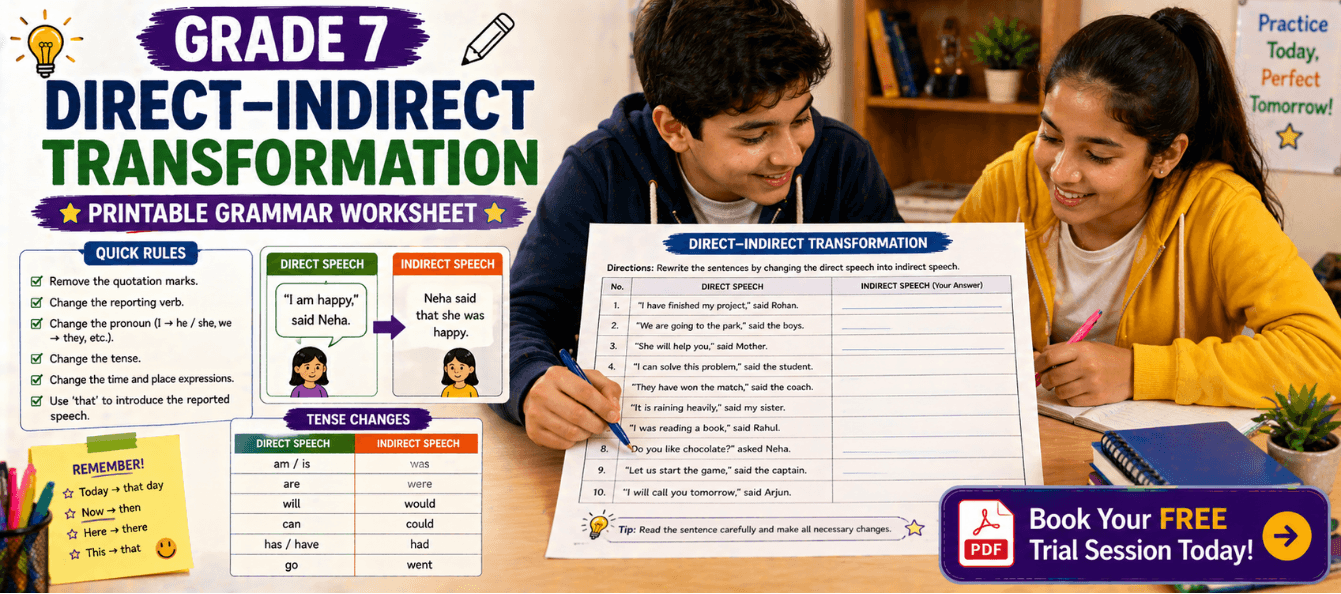
What Is the Topic?
This English grammar worksheet focuses on Direct-Indirect Transformation. Direct Speech involves quoting the exact words of a speaker, usually enclosed in quotation marks (e.g., He said, "I am tired."). Indirect Speech involves reporting the meaning of the speaker's words without using their exact phrasing. In Indirect Speech, quotation marks are removed, and the sentence structure often changes. The worksheet covers the specific rules for transforming sentences, including changing the tense of the verbs (backshifting), adjusting pronouns to match the perspective of the reporter, and altering time and place markers.
What’s in This Worksheet?
This worksheet is designed to test a student's understanding of the rules governing reported speech through a variety of exercises:
1. Multiple Choice Questions that require students to choose the correct Direct or Indirect transformation of a given sentence, applying rules for tense changes.
2. True and False questions that assess the student's knowledge of specific transformations, such as the removal of question marks and the handling of universal truths.
3. Fill in the Blanks exercises that focus on specific word changes, such as converting "am" to "was," "will" to "would," and time words like "yesterday" to "the previous day."
4. Sentence Rewriting tasks where students must actively convert sentences from Direct to Indirect speech and vice versa.
5. Paragraph Writing exercises that present a dialogue context, requiring students to fill in the blanks with appropriate reporting verbs and transformations to complete the narrative.
Definitions, Examples, Techniques, and Tips
To succeed in Direct-Indirect Transformation, students must familiarize themselves with the core rules highlighted in the worksheet. One of the most important techniques is "Backshifting," which involves changing the tense of the verb one step back into the past. For example, present simple "am" becomes past simple "was" in Indirect Speech. Similarly, "will" becomes "would," "can" becomes "could," "may" becomes "might," and "shall" becomes "should."
Another key rule is the change in pronouns. Pronouns in the reported speech must change to reflect the perspective of the person reporting the speech. For instance, "I" often changes to "he" or "she," and "my" changes to "his" or "her."
Time expressions also change to reflect that the reporting is happening at a later time. "Now" becomes "then," "yesterday" becomes "the previous day," and "last week" becomes "the previous week." Additionally, the worksheet notes that "said to" usually changes to "told" when followed by an object.
A critical tip mentioned in the True/False section is that when reporting a universal truth (e.g., "The earth moves round the sun"), the tense does not change; it remains in the present tense. Also, in reported questions, the sentence structure changes from a question format to a statement format, and question marks are removed.
Why Is It Important to Learn This?
Learning to transform direct speech into indirect speech is essential for advanced writing and storytelling. It allows students to report what others have said without breaking the flow of their own writing. In journalism, academic writing, and everyday storytelling, direct speech is used for impact, while indirect speech is used for summary and smooth transitions. For Grade 7 students, this skill is heavily tested in English grammar exams. Mastering it also demonstrates a strong grasp of tenses and sentence structure, which are foundational components of English proficiency.
Where Will This Knowledge Help You?
Proficiency in Direct-Indirect Transformation is useful in many academic scenarios. In essay writing, particularly narrative or journalistic pieces, students often need to include interviews or recounts of events. In literature, analyzing dialogue requires understanding how speech functions. In exams, sections dedicated to "Reported Speech" or "Editing/Omission" frequently feature these types of questions. Furthermore, understanding how to report speech correctly helps students avoid common errors in spoken English, such as using quotation marks unnecessarily or mixing up tenses.
How to Use This Worksheet?
To achieve the best results with this worksheet, follow these steps:
1. Identify the Reporting Verb: Look for words like "said," "told," or "asked" to understand who is speaking and how.
2. Check the Tense: Determine the tense of the verb inside the quotation marks. If the reporting verb is in the past tense (e.g., "He said"), you generally need to backshift the tense (Present to Past).
3. Change Pronouns: Adjust pronouns (I, you, we) to fit the context of the person reporting the speech.
4. Adjust Time and Place: Change words like "now," "here," "today," and "yesterday" to "then," "there," "that day," and "the previous day."
5. For Questions: Remember to convert the question into a statement structure (subject before verb) and remove the question mark.
6. Use the Answer Key below to verify your transformations and understand the logic behind any corrections.
Important Tips and Tricks
Here are some strategies to help you score full marks in this topic:
1. The "Golden Rule" of Backshifting: If the reporting verb is in the past (e.g., "He said"), shift the tense of the reported verb back one step (Present -> Past, Past -> Past Perfect).
2. Reporting Verbs: Use "told" when there is an object (e.g., "He told me"), but use "said" when there isn't (e.g., "He said that...").
3. Universal Truths: Do not change the tense if the sentence is a universal truth or a general fact (e.g., "The sun rises in the east" remains the same).
4. Modals: Remember the specific changes for modals: "can" -> "could," "may" -> "might," "will" -> "would," "shall" -> "should."
5. Questions in Reported Speech: Never use "if" or "whether" if the original question starts with "who," "what," or "where." Use "if/whether" only for Yes/No questions.
6. Remove Quotes: In Indirect Speech, never use quotation marks. Use "that" to connect the reporting clause to the reported speech (though "that" is often optional).
7. Imperatives: For commands or requests (Imperative sentences), use "to" + infinitive in indirect speech (e.g., "He said to go" -> "He told me to go").
Complete Answer Key
Exercise No. 1
1. b) He said that he was tired after work.
2. a) She said, "I like tea very much."
3. b) Rahul said that he had eaten his lunch.
4. b) Anjali said, "I will come later."
5. a) The teacher said they must study hard.
6. a) Arjun said, "I can run very fast."
7. b) Neha said that she had been reading a story.
8. a) Kartik said that he might join the club.
9. a) Pooja said she would help me then.
10. b) Diya said, "I saw the film last week."
Exercise No. 2
1. True
2. False (Pronouns do change during transformation)
3. False (The word 'that' is used in indirect speech)
4. False (The reporting verb can change, e.g., said to -> told)
5. False (Question marks are removed in indirect questions)
6. True
7. True
8. False (Exclamations change in transformation)
9. True
10. True
Exercise No. 3
1. The word 'am' becomes was in Indirect.
2. The word 'will' becomes would in Indirect.
3. The word 'shall' becomes should in Indirect.
4. The word 'may' becomes might in Indirect.
5. The word 'has' becomes had in Indirect.
6. Quotation marks are removed in Indirect Speech.
7. The word 'yesterday' becomes the previous day.
8. The phrase 'last week' becomes the previous week.
9. The word 'now' becomes then in Indirect.
10. Questions become statement clauses in Indirect.
Exercise No. 4
1. Anjali said that she was reading a book.
2. The teacher said, "The earth moves round the sun."
3. Neha told me that she would arrive late.
4. Rahul said, "I have seen the film."
5. Arjun said that he had lost his new pen.
6. Pooja said, "I can swim very well."
7. Diya said that she liked ripe mangoes.
8. Kartik said, "I will finish the project soon."
9. Rohan said, "I was playing cricket then."
10. Nisha said, "I have done the work."
Exercise No. 5
Answers may vary. (Students should fill in the blanks based on the context of reporting speech and the hints provided. Example: Rohan agreed that he understood... Anjali confirmed that she always checked... Arjun admitted/committed that he would remember... Diya admitted that she had forgotten... Kartik committed that he would practise... The class concluded that transformation was easy...)
Mastering Direct-Indirect Transformation is a powerful tool that adds sophistication to a student's writing. By understanding the rules of backshifting and pronoun changes, Grade 7 students can report information accurately and fluently. Keep practicing with these worksheets to ensure these complex grammatical structures become second nature.