
Grade 7 Direct Speech [Free PDF]
![Grade 7 Direct Speech [Free PDF]](https://cdn5.planetspark.in/media/small_Grade_7_Direct_Speech_Free_PDF_30e89c16c8.png)

Mastering Direct Speech: English Grammar Worksheet for Grade 7
Have you ever wondered how writers make stories come alive? They often use the exact words spoken by characters to draw readers into the conversation. This technique is known as Direct Speech. It is a fundamental aspect of English grammar that allows us to quote someone's words verbatim, preserving their original tone and emotion. For Grade 7 students, mastering Direct Speech is essential for writing engaging dialogues, accurately reporting news, and understanding the nuances of written English. This English grammar worksheet is designed to help students identify, construct, and punctuate Direct Speech sentences correctly. By practicing these exercises, students will learn how to differentiate between what was actually said and a mere report of the words, ensuring their writing is both accurate and vivid.
Download these English grammar worksheets and practice regularly to strengthen your language skills and build a strong foundation. You can also book a free trial to get expert guidance and improve your reading, writing, and comprehension abilities. The worksheets are designed in a simple and structured way to help K–8 students learn grammar concepts easily and use them confidently in everyday communication.
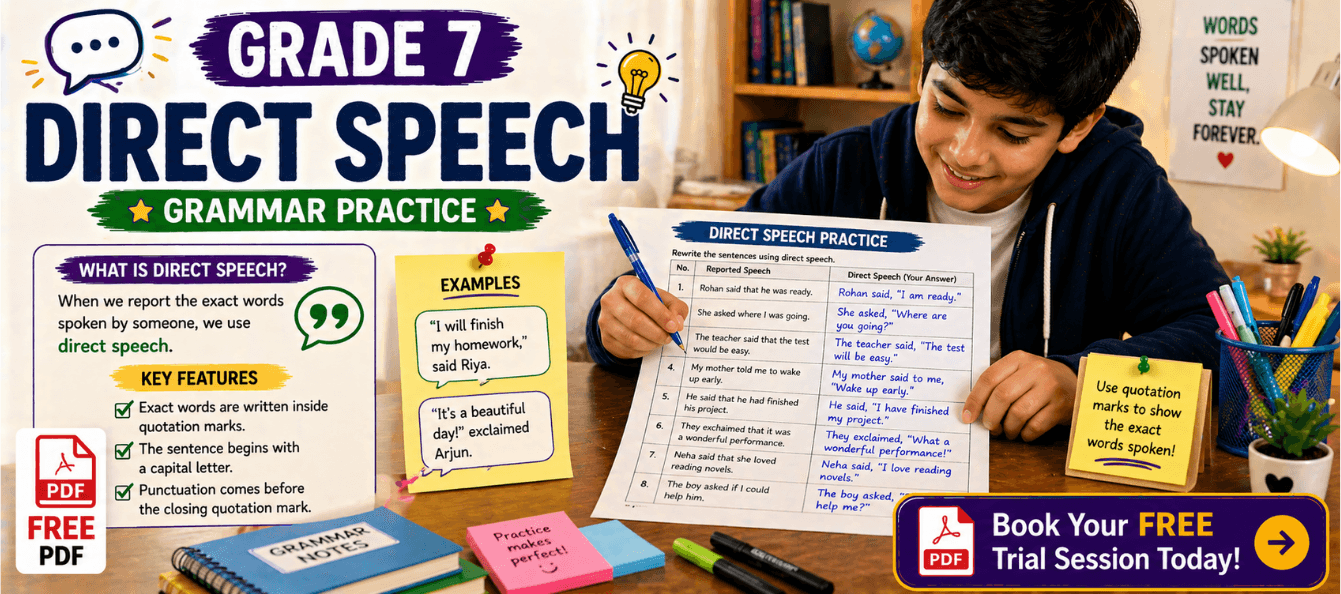
What Is the Topic?
The topic of this worksheet is Direct Speech. Direct Speech is a method of writing where we quote the exact words spoken by a person. These words are enclosed in quotation marks (" " or ' ') and are usually preceded by a reporting verb like "said," "replied," or "asked." In Direct Speech, the original tense of the speaker is preserved, and the sentence often begins with a capital letter inside the quotation marks. This is different from Indirect Speech, where the meaning is conveyed without using the exact words.
What’s in This Worksheet?
This Grade 7 English grammar worksheet provides a thorough practice session on Direct Speech through a variety of exercises:
1. Multiple Choice Questions: Students identify sentences that correctly use Direct Speech versus Indirect Speech.
2. True and False: This section tests knowledge of the rules, such as the use of quotation marks and the role of the reporting verb.
3. Fill in the Blanks: Students complete sentences using terminology related to Direct Speech, such as "quotation marks" or "punctuation."
4. Sentence Rewriting: This is a conversion exercise where students change sentences from Indirect Speech to Direct Speech.
5. Paragraph Writing: Students fill in blanks within a paragraph of dialogue using appropriate verbs and adverbs to complete the Direct Speech sentences.
Definitions, Examples, Techniques, and Tips
Based on the exercises in this worksheet, here are the essential components of Direct Speech:
- Definition: Direct Speech states the exact words of a speaker using quotation marks.
- Quotation Marks: These are the punctuation marks used at the beginning and end of the quoted words (e.g., " ").
- Reporting Verb: This verb connects the speaker to the quote (e.g., said, asked, replied). The reporting clause mentions the speaker.
- Comma: A comma is typically used to separate the reporting verb from the quote.
- Capital Letter: The first word inside the quotation marks usually starts with a capital letter.
- Tense: Direct Speech keeps the original tense intact. If the speaker said "I am going," the direct quote is "I am going," not "I was going."
- Examples: Rahul said, "I am going to school." The teacher said, "Open your books."
Why Is It Important to Learn This?
Learning Direct Speech is crucial for clear and accurate communication. It allows a writer to show the personality and voice of a character or speaker. In journalism, it provides evidence and credibility by showing exactly what was said. For students, it prevents miscommunication. Saying "He said he likes mangoes" (Indirect) conveys the information, but saying "He said, 'I like mangoes a lot'" (Direct) conveys the information along with the speaker's emphasis. Mastering this helps in writing compelling narratives and accurate reports.
Where Will This Knowledge Help You?
Students will use Direct Speech in various contexts:
- Story Writing: Creating realistic and engaging dialogues between characters.
- News Reporting: Quoting eyewitnesses or officials accurately.
- Exam Answers: Correctly identifying and converting speech is a common grammar task.
- Daily Conversation: Recounting exactly what someone said in a discussion.
How to Use This Worksheet?
To effectively master Direct Speech using this worksheet, follow these steps:
1. Attempt independently first: Try to identify Direct Speech in the multiple choice section and convert sentences in the rewriting section without looking at the answers.
2. Review answers carefully: Use the answer key provided below to check your punctuation and tense usage.
3. Correct mistakes: Pay close attention to the use of quotation marks and capital letters in the rewriting section.
4. Practice regularly: Try writing your own dialogues using Direct Speech to get comfortable with the structure.
The solutions provided below follow the exact worksheet order. Students should compare their answers carefully to ensure they have correctly applied the rules of Direct Speech.
Important Tips and Tricks
Here are some tips to help you score full marks and avoid common errors:
- Use Quotation Marks: Always enclose the exact spoken words in quotation marks.
- Comma Placement: Place a comma before the opening quotation mark when the sentence structure is "Reporting verb + Quote" (e.g., Anjali said, "I love mangoes.").
- Capitalization: Capitalize the first letter of the first word inside the quotation marks.
- Punctuation Inside: Place the full stop or question mark inside the closing quotation marks (e.g., "It is raining," said Neha.).
- Tense Retention: Do not change the tense of the verb inside the quotes; it remains exactly as the speaker said it.
Complete Answer Key
Exercise No. 1 Choose the correct answer from the options.
1. a) Rahul said, "I am going to school."
2. b) Anjali said, "I love mangoes a lot."
3. a) The teacher said, "Open your books."
4. a) Arjun said, "I play cricket daily."
5. a) Neha said, "It is raining heavily."
6. b) Kartik said, "I have finished my work."
7. b) Diya said, “The train arrived at noon.”
8. a) Aryan said, "I can solve this sum."
9. a) Pooja said, "We will visit Agra soon."
10. a) Rohan said, "I am reading a novel."
Exercise No. 2 Tick T if the statement is true or F if the statement is false.
1. Direct speech quotes the exact words of a speaker. T
2. The reporting verb links the speaker to the quote. T
3. He said is a reporting verb in direct speech. T
4. Direct speech keeps the original sentence form. T
5. Direct speech always changes the original tense. F
6. Direct speech does not use quotation marks. F
7. A comma links the reporting verb to the quote. T
8. Direct speech paraphrases what someone has said. F
9. The speaker's exact words are placed in quotes. T
10. Quotation marks are optional in direct speech. F
Exercise No. 3 Fill in the blanks with the correct word or phrase to complete each sentence.
1. Direct Speech uses quotation marks around the words.
2. The exact words of the speaker are quoted.
3. A comma separates the reporting verb and quote.
4. Direct Speech starts with a capital letter in quotes.
5. The reporting clause mentions the speaker.
6. Direct Speech keeps the original tense intact.
7. The quoted part ends with a punctuation mark.
8. Words in quotes are the exact words spoken.
9. Direct Speech preserves the feeling of speaker.
10. The pronoun 'I' refers to the speaker.
Exercise No. 4 Rewrite the following sentences according to the directions given on the right.
1. Anjali said that she was going to Agra. -> Anjali said, "I am going to Agra."
2. The teacher said that the test was easy. -> The teacher said, "The test is easy."
3. Neha said that she would come to the party. -> Neha said, "I will come to the party."
4. Rahul told me that he liked the movie. -> Rahul said, "I liked the movie."
5. Arjun said that he had finished his homework. -> Arjun said, "I have finished my homework."
6. Pooja said that she could solve the problem. -> Pooja said, "I can solve the problem."
7. Diya said that she was reading a novel. -> Diya said, "I am reading a novel."
8. Kartik said that he had visited the Red Fort. -> Kartik said, "I visited the Red Fort."
9. Rohan told us that he was feeling unwell. -> Rohan said, "I am feeling unwell."
10. Nisha said that she would join the choir. -> Nisha said, "I will join the choir."
Exercise No. 5 Read the paragraph and fill in the blanks with the correct words using the hints given below.
Rahul said, "I will always reach the bus stop on time every single morning without fail." Anjali replied, "My bus always arrives at seven in the morning sharp and on time." Rohan said, "The driver always honks twice before leaving the stop for the next one." Diya said, "I always sit near the window every single day during the ride." Kartik said, "The conductor always checks our bus passes very carefully each morning." Neha said, "I carefully carry my water bottle on the long bus ride daily." Aryan said, "The roads usually look very crowded at this early hour of the day." Pooja said, "I always enjoy the cool morning breeze during the pleasant ride." The driver said, "We will reach school well before the first bell rings today." Everyone said, "We always love our daily bus journey together as good friends always."
By practicing these exercises, Grade 7 students can master the rules of Direct Speech, enhancing their ability to write realistic dialogues and report statements accurately. Remember, the key to Direct Speech is preserving the speaker's exact words within quotation marks. Keep practicing to become a more confident and articulate writer!