
Grade 7 Expository vs. Argument Writing: Printable Exercises

Grade 7 Expository vs. Argument Writing: Printable Exercises
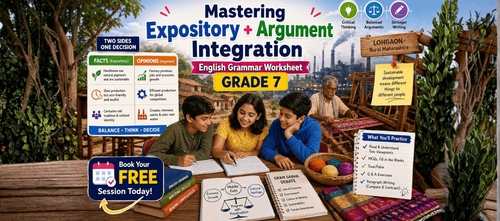
Have you ever heard two sides of an argument and felt confused about which one is right? In Grade 7, you learn how to explain facts (expository writing) and also how to present different opinions (argument writing). This English grammar worksheet on expository + argument integration helps you practice reading a story that presents two sides of a debate, understanding both viewpoints, and answering different types of questions. Whether you are writing an essay for school or discussing a real-life issue, knowing how to blend facts with arguments makes your writing stronger and more balanced.
Download these English grammar worksheets and practice regularly to strengthen your language skills and build a strong foundation. You can also book a free trial to get expert guidance and improve your reading, writing, and comprehension abilities. The worksheets are designed in a simple and structured way to help K–8 students learn grammar concepts easily and use them confidently in everyday communication.
What Is the Topic?
Expository writing explains facts and information. Argument writing presents opinions and tries to convince the reader. Integration means combining both styles in a balanced way. This worksheet helps students learn how to read a story that includes both expository details (facts about handlooms and factories) and arguments (different opinions about progress versus tradition). Students read a story called “The Loom of Lohgaon” about a village facing a difficult choice between a new factory and their traditional handloom weaving. After reading the story, students answer multiple choice questions, fill in the blanks, true and false statements, question and answer exercises, and write a paragraph comparing economic benefits with cultural importance.
What’s in This Worksheet?
1. Multiple choice questions to test understanding of the story “The Loom of Lohgaon”
2. Fill in the blanks to check memory and vocabulary from the story
3. True and false statements to help pay attention to details
4. Question and answer to write complete answers based on the story
5. Paragraph writing activity to compare economic benefits with cultural importance
6. A story about a village in rural Maharashtra facing a debate over a textile factory
7. Questions about characters, arguments, environmental impact, and possible solutions
Definitions, Examples, Techniques, and Tips
This worksheet focuses on understanding expository and argument writing based on a short story. Here are important definitions and examples from the worksheet:
- Expository writing – Writing that explains facts and information. For example, the story explains that handlooms use natural pigments and are sustainable, while factories consume water and generate chemical waste.
- Argument writing – Writing that presents opinions and tries to persuade. In the story, Sameer argues the factory represents progress, while Ababa argues the factory would strip away cultural identity.
- Integration – Combining facts and opinions in a balanced way. Arjun researches both sides and looks for a middle path.
- Sustainable development – Meeting current needs without harming future generations. The village debates what sustainable development really means.
- Gram Sabha – A village meeting where decisions are discussed. The heated debate was held at the Gram Sabha.
- Paithani sarees – Traditional silk sarees woven in Maharashtra with peacock motifs.
Techniques for expository and argument integration (from the story):
- Present facts about both sides (handloom is sustainable but slow; factory is efficient but creates waste)
- Show different characters’ opinions (Sameer supports the factory; Ababa protects the craft)
- Look for a middle path where technology aids rather than replaces
Through exercises such as multiple choice questions, fill in the blanks, and question and answer, students develop a clear understanding of how to read a balanced argument and identify facts versus opinions.
Why Is It Important to Learn This?
Learning expository and argument integration helps students think critically and write fairly. It allows them to:
- Explain facts clearly without bias
- Present different sides of an argument
- Look for balanced solutions rather than extreme positions
This skill is essential for writing essays, participating in debates, and making informed decisions in school and real life. The worksheet shows that sustainable development can mean different things to different people.
Where Will This Knowledge Help You?
Understanding expository and argument integration helps students in:
- School exams where persuasive or analytical essays are asked
- Writing balanced arguments for social studies or English
- Participating in classroom debates and discussions
- Making thoughtful decisions about real-world issues
It also improves critical thinking as students learn to compare two sides of an issue.
How to Use This Worksheet?
1. Attempt each question independently without help
2. Carefully read the story “The Loom of Lohgaon” on page 3
3. Review your answers after completing the worksheet
4. Compare your responses with the answer key provided below
5. Practice regularly to improve accuracy
The solutions follow the exact worksheet order, so students should compare their answers carefully.
Important Tips and Tricks
1. Read the passage twice – first to understand the conflict, then to underline facts about handlooms and factories separately
2. Watch out for tricky true/false statements – for example, “The industry is currently thriving” is false (dwindling profits)
3. Use the exact words from the passage for fill-in-the-blanks
4. For question and answer, write complete sentences using information directly from the story
5. For paragraph writing, compare both sides: economic benefits (jobs, stable income, progress) versus cultural importance (history, identity, soulful handcrafted sarees, sustainability)
6. Pay attention to the different characters’ roles – Sameer (pro-factory), Ababa (pro-handloom), Arjun (researcher looking for middle path)
7. Examiners expect you to present both sides fairly in expository+argument writing
Complete Answer Key
Page 3 – The Loom of Lohgaon (No questions on this page, just the story passage)
Page 4 – Exercise No. 1 (Multiple Choice Questions)
Read the story and choose the correct option for each question based on the text.
1. Where is the story set?
c) Rural Maharashtra
2. What does Ababa weave?
a) Paithani sarees
3. What motif is mentioned?
a) Peacock motifs
4. What did the factory promise?
b) Many new jobs
5. Who supports the factory?
c) Cousin Sameer
6. What is a factory downside?
a) Chemical waste
7. How is handloom described?
b) Sustainable
8. Where was the debate held?
c) Gram Sabha
9. What is Arjun's main role?
c) Fact researcher
10. What is Arjun's goal?
b) A middle path
Page 5 – Fill in the Blanks
1. The village was named Lohgaon.
2. Arjun was a precocious thirteen-year-old teenager.
3. The weavers used silk threads.
4. Handlooms provided a heartbeat for generations.
5. A massive textile conglomerate was proposed.
6. Sameer wanted a stable income.
7. Ababa protected the village craft / cultural identity.
8. The factory was very efficient / automated.
9. Industrial dyes create chemical waste.
10. The village head is the Sarpanch.
Page 6 – True and False
1. Natural pigments dye the silk. (True)
2. A shadow loomed over the village. (True)
3. Sameer is Arjun's younger brother. (False – Sameer is Arjun’s cousin)
4. The industry is currently thriving. (False – it has dwindling profits)
5. The factory garments are identical. (True)
6. The looms represent shared history. (True)
7. Arjun never studied machinery. (False – he researched environmental impact of machinery)
8. Handlooms have fast production. (False – they have slow production)
9. The Gram Sabha was very calm. (False – it was heated)
10. A middle path may exist. (True)
Page 7 – Question and Answer
1. How old is the boy named Arjun?
Thirteen years old.
2. What sounds define village life?
The rhythmic clacking of handlooms.
3. Who is the cousin of the boy Arjun?
Sameer.
4. What did the conglomerate propose?
Building a fully automated factory nearby, promising jobs and a surge in the economy.
5. How did the weavers dye the silk?
With natural pigments.
Page 8 – Question and Answer (continued)
6. What does Sameer say about profits?
He points to the dwindling profits and grueling hours spent over a single saree. He claims the factory represents progress and stable income in a globalized world.
7. What makes the handloom eco-friendly?
The handloom process is sustainable. It uses natural pigments and does not generate chemical waste like industrial dyes.
8. What is the factory's main drawback?
It consumes vast amounts of water and generates chemical waste. Also, it would produce soulless, identical garments and strip away cultural identity.
9. Who weighed the economic upliftment?
The Sarpanch.
10. What could technology aid in Lohgaon?
Technology could aid weavers rather than replacing them. A middle path where technology aids weavers.
Page 9 – Exercise No. 5
Write a paragraph (80-100 words) comparing the factory's economic benefits with the cultural importance of traditional weaving in Lohgaon.
Note: This is a writing task. The answer will be written by the student. Based on the story, the paragraph should include:
Factory’s economic benefits:
- Promises jobs and a surge in the economy
- Provides stable income in a globalized world
- Efficient production
Cultural importance of traditional weaving:
- Centuries-old tradition passed down for generations
- Each saree has a unique story woven by a human hand
- Uses natural pigments and sustainable methods
- Represents the cultural identity and history of Lohgaon
- If the looms stop, the community’s history would unravel
Answers may vary as long as they compare both the economic benefits and the cultural importance based only on the story in the worksheet.
Page 10 – Get more worksheets (No questions on this page)
Practicing this English grammar worksheet for Grade 7 on expository + argument integration helps students become more confident in presenting facts and arguments in a balanced way. With regular practice, students can improve their grammar, critical thinking, and writing skills and express balanced opinions effectively in both writing and speaking.