
Fact vs Opinion (Advanced): Reading Comprehension Exercises for Students
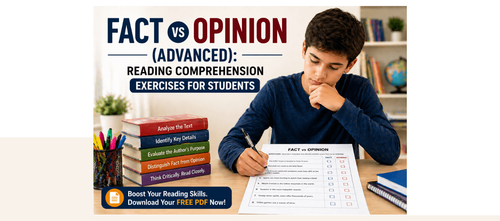

Reading Comprehension - Fact vs Opinion (Advanced) English Grammar Worksheet for Grade 7
In today's world, distinguishing between facts and opinions is a vital skill that helps students think critically and analyze information more effectively. For Grade 7 students, this worksheet on **Fact vs Opinion (Advanced)** offers an excellent opportunity to understand the difference between verifiable facts and personal beliefs. As students encounter different kinds of information daily, being able to separate these two concepts not only aids in reading comprehension but also sharpens their writing and speaking abilities. The exercises provided in this worksheet are designed to give students a solid foundation in this essential skill, enabling them to approach academic challenges with greater confidence.
Download these English grammar worksheets and practice regularly to strengthen your language skills and build a strong foundation. You can also book a free trial to get expert guidance and improve your reading, writing, and comprehension abilities. The worksheets are designed in a simple and structured way to help K–8 students learn grammar concepts easily and use them confidently in everyday communication.
Book a free trial!
### What is the topic?
The concept of **fact vs opinion** is crucial for developing strong reading and writing skills. A **fact** is a statement that can be proven true or false based on evidence or reliable sources, while an **opinion** reflects personal beliefs or feelings. This worksheet helps students grasp the distinction between these two types of statements, which can sometimes overlap or be confused. Understanding the difference not only improves comprehension but also encourages students to critically assess information they encounter in both academic and real-world contexts.
Students are expected to learn how to:
- Identify factual statements that can be supported by evidence.
- Recognize opinions that are influenced by personal beliefs and emotions.
- Differentiate between factual data and subjective viewpoints in reading and writing tasks.
Book a free trial!
### What’s in this worksheet?
This worksheet is structured to help students strengthen their understanding of the **fact vs opinion** concept through various engaging exercises. It includes:
1. **Multiple-choice questions** that test the ability to differentiate between facts and opinions.
2. **Fill-in-the-blank exercises** where students complete sentences by choosing the correct word.
3. **True and False statements** to identify factual statements from opinions.
4. **Underline-the-word** tasks where students mark words that express viewpoints.
5. **Paragraph completion** where students fill in the blanks to distinguish between facts and opinions in a passage.
Each exercise is designed to help students practice and reinforce their understanding of the topic, making it a great resource for exam preparation and enhancing reading comprehension.
Book a free trial!
### Definitions, examples, techniques, and tips
- **Fact**: A fact is a statement that can be verified with evidence or data. For example, "Pollution harms health" is a fact because it is supported by scientific research and evidence.
- **Opinion**: An opinion is a belief or judgment that cannot be proven true or false. For example, "Recycling is the best way to reduce pollution" is an opinion because it reflects a personal belief.
- **Techniques**: One technique for identifying facts is looking for supporting evidence or data in the text. Opinions, on the other hand, often use emotional language or express personal preferences.
- **Quick tip**: When reading or writing, always ask yourself: "Can this statement be proven true or false?" If yes, it's likely a fact. If no, it’s an opinion.
### Why is it important to learn this?
Understanding the difference between facts and opinions is essential for several reasons:
- It strengthens writing and speaking skills by helping students provide clear, evidence-based arguments.
- It improves reading comprehension by enabling students to identify reliable information and separate it from subjective viewpoints.
- It is academically important because many standardized tests and essays require students to identify and evaluate facts versus opinions.
By recognizing and using this distinction, students can develop more thoughtful and persuasive arguments in both written and oral communication.
Book a free trial!
### Where will this knowledge help you?
The ability to distinguish between facts and opinions will help students in several practical areas:
- **Exams**: Many reading comprehension sections in exams require students to identify whether statements are facts or opinions.
- **Writing tasks**: In writing essays or reports, students can use facts to support their arguments and clearly state their opinions.
- **Class participation**: Understanding the difference allows students to participate more effectively in class discussions and debates, offering clear and evidence-backed viewpoints.
### How to use this worksheet?
Here’s how students can make the most of this worksheet:
1. **Attempt independently first**: Try completing the exercises without any help to assess your understanding.
2. **Review answers carefully**: Go through the answers and check them against the worksheet content.
3. **Correct mistakes**: If you find any mistakes, try to understand why they occurred and correct them.
4. **Practice regularly**: Use similar worksheets and exercises to improve your ability to identify facts and opinions in various contexts.
The solutions follow the exact order of the worksheet, so students should compare their answers carefully with the key to ensure accuracy.
Book a free trial!
### Important tips and tricks
Here are some important tips to help you master the topic:
1. **Common mistakes**: One common mistake is confusing subjective statements with facts. Always check if the statement can be backed by evidence.
2. **What examiners expect**: Examiners want students to be able to clearly differentiate between facts and opinions, especially in reading comprehension sections.
3. **How to score full marks**: Focus on understanding the meaning behind each statement and whether it can be objectively proven or if it’s influenced by personal views.
4. **How to approach activity-based or writing-based tasks**: For activities that involve writing or speaking, make sure to clearly label your opinions and support them with facts when possible.
Book a free trial!
### Complete answer key
**Exercise No. 1**
1. **Which statement is a fact from the passage?**
a) polluharms
2. **What is the main difference between fact and opinion?**
a) provable
3. **Which statement is an opinion?**
a) best solution
4. **Which example shows an opinion?**
a) best method
5. **Which sentence contains a fact?**
a) reducers
6. **Which is a fact about pollution?**
a) cause harm
7. **Which of the following is an opinion?**
a) act now
8. **Which statement is a fact?**
a) highlevels
9. **Why distinguish fact and opinion?**
a) clear view
10. **Which of the following is a fact?**
a) data shows
**Exercise No. 2**
1. **A ______ can be proven true or false.**
fact
2. **An ______ reflects beliefs.**
opinion
3. **Facts are based on ______.**
evidence
4. **Opinions are influenced by ______.**
feelings
5. **Opinions are not ______.**
verified
6. **Recycling reduces ______.**
pollution
7. **It ______ affects health.**
negatively
8. **Text may be ______.**
biased
9. **Distinguish ______ and opinions.**
facts
10. **A ______ statement is provable.**
fact
**Exercise No. 3**
1. A fact can be proven. (True)
2. An opinion is always proven. (False)
3. Opinions may use feelings. (True)
4. A fact is subjective. (False)
5. All facts are easy to prove. (False)
6. Opinions show preferences. (True)
7. A fact is objective. (True)
8. Opinions reflect thoughts. (True)
9. News has only facts. (False)
10. Opinions can vary. (True)
**Exercise No. 4**
1. Pollution is harmful to health. (viewpoint: harmful)
2. Recycling helps reduce waste. (viewpoint: helps)
3. Renewable energy is the future. (viewpoint: future)
4. Global warming is due to humans. (viewpoint: due)
5. Pollution should be controlled. (viewpoint: should)
6. Air pollution causes illness. (viewpoint: causes)
7. Clean energy can reduce impact. (viewpoint: can)
8. Deforestation is serious. (viewpoint: serious)
9. People should act quickly. (viewpoint: should)
10. Water pollution harms life. (viewpoint: harms)
**Exercise No. 5**
When reading, distinguish **facts** and **opinions**. A **fact** is proven with **evidence**. An **opinion** reflects beliefs. This helps form an **objective** view and avoid being **biased** by one-sided ideas. **Context** can help identify the words that show bias. Readers should always **question** when they encounter emotional language. Bias is often seen in **subjective** words, and understanding this can make the reader more **critical** in their judgment. It’s crucial to examine **all** and consider **different** perspectives. Avoid being **swayed** by overly strong statements, as they often show a lack of **objective** reasoning. **Opinions** can be a sign of bias when they are not supported by evidence. Always question the **intention** behind a statement and look for missing **information** that might affect your interpretation. By developing a keen awareness of **bias**, readers can form a more balanced **viewpoint** and make better decisions when interpreting information. Remember to analyze the **language** used in the text and recognize the **bias** that may influence the author's point of view. Understanding these elements helps to improve critical **thinking** and prevent **biased** thinking.
By practicing these activities, Grade 7 students can build stronger grammar and comprehension skills, which will serve them well in both academic and real-world scenarios. Keep working on differentiating facts from opinions, and see how it helps in reading, writing, and even class discussions!
Book a free trial!