
Grade 7 Indirect Speech (Reported Speech) [With Examples]
![Grade 7 Indirect Speech (Reported Speech) [With Examples]](https://cdn5.planetspark.in/media/small_Grade_7_Indirect_Speech_Reported_Speech_With_Examples_8ee174784c.png)

Understanding Indirect Speech: English Grammar Worksheet for Grade 7
Communication is not just about speaking; it is also about reporting what others have said. When we tell a story or share news, we often repeat what someone told us without using their exact words. This method of conveying a message is known as Indirect Speech, or Reported Speech. For students in Grade 7, learning how to convert Direct Speech into Indirect Speech is a sophisticated skill that improves writing fluency and comprehension. It requires an understanding of verb tenses, pronouns, and time expressions. This English grammar worksheet focuses on Indirect Speech (Reported Speech), providing a structured platform for students to practice these transformations. By mastering this topic, students can write more formally and summarize conversations effectively.
Download these English grammar worksheets and practice regularly to strengthen your language skills and build a strong foundation. You can also book a free trial to get expert guidance and improve your reading, writing, and comprehension abilities. The worksheets are designed in a simple and structured way to help K–8 students learn grammar concepts easily and use them confidently in everyday communication.
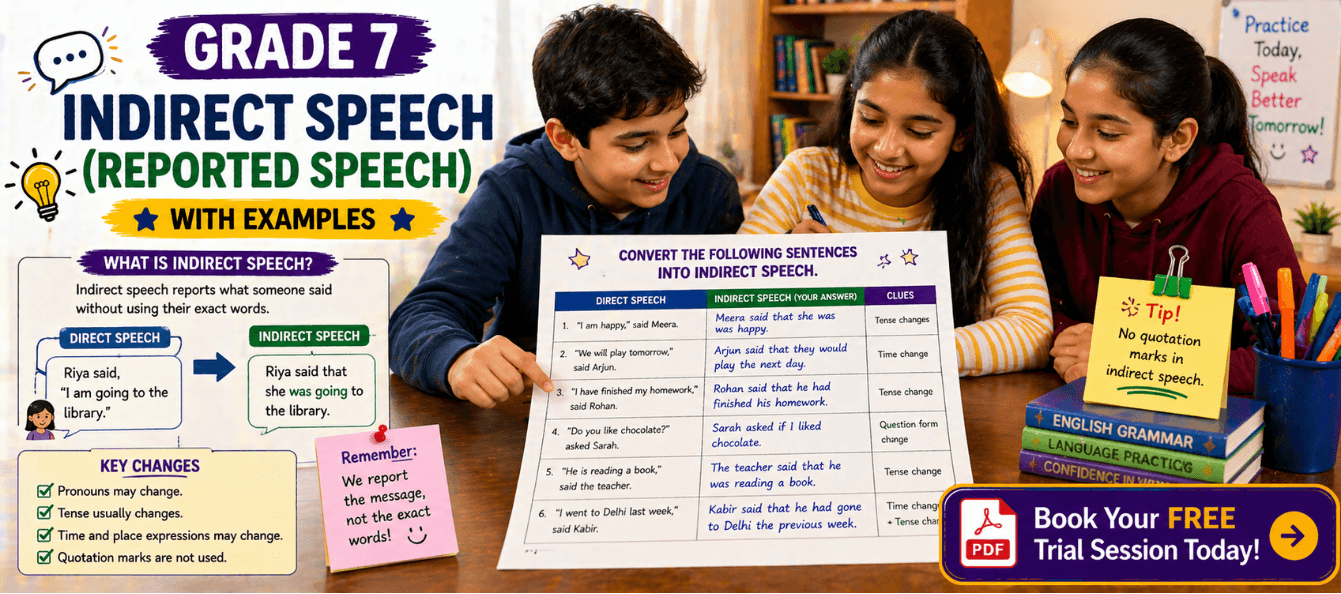
What Is the Topic?
The topic of this worksheet is Indirect Speech (Reported Speech). Indirect Speech is used to report what someone said without using their exact words. It does not use quotation marks. Instead, it integrates the spoken words into the sentence structure of the reporter. This often involves changing the tense of the verb (backshifting), adjusting pronouns to match the speaker, and changing words denoting time and place (like "now" to "then" or "here" to "there"). For example, changing "I am happy" (Direct) to "He said that he was happy" (Indirect).
What’s in This Worksheet?
This Grade 7 English grammar worksheet offers a comprehensive approach to learning Indirect Speech through varied exercises:
1. Multiple Choice Questions: Students identify sentences that are correctly written in Indirect Speech compared to Direct Speech.
2. True and False: This section tests the student's understanding of the rules, such as the use of quotation marks and the necessity of changing tenses.
3. Fill in the Blanks: Students complete sentences by filling in the correct words that result from transforming Direct Speech into Indirect Speech (e.g., changing "can" to "could").
4. Sentence Rewriting: This exercise provides sentences in Direct Speech that students must convert into Indirect Speech.
5. Paragraph Writing: A contextual exercise where students fill in blanks in a news report using appropriate reporting verbs based on hints like "Statement," "Warning," or "Declaration."
Definitions, Examples, Techniques, and Tips
Based on the worksheet content, students should understand the following:
- Definition: Indirect Speech reports the meaning of what was said without quoting the exact words.
- Backshifting Tense: Generally, the present tense changes to past tense. For example, "I live" becomes "He lived."
- Pronoun Changes: Pronouns change to reflect the perspective of the reporter. "I" becomes "he" or "she."
- Conjunctions: The word "that" is often used to link the reporting verb to the reported clause.
- Time and Place Words: Words indicating time and place often change. "Now" becomes "then," "here" becomes "there," "today" becomes "that day," and "tomorrow" becomes "the next day."
- Modals: Modal verbs also change form. "Can" becomes "could," "will" becomes "would," and "may" becomes "might."
Why Is It Important to Learn This?
Indirect Speech is crucial for coherent writing and storytelling. It allows students to summarize long conversations or dialogues without breaking the flow of the narrative. In formal writing, such as reports or journalistic articles, Indirect Speech is preferred because it is more concise and objective than listing multiple direct quotes. Mastering this topic also demonstrates a strong grasp of complex grammar rules, including tense sequences and pronoun usage, which are key components of language proficiency in Grade 7.
Where Will This Knowledge Help You?
Students will apply Indirect Speech in various contexts:
- Storytelling: When narrating a story involving dialogue between characters.
- News Reporting: When summarizing statements made by officials or eyewitnesses.
- Note-Taking: When jotting down what a teacher said in class during a lecture.
- Formal Emails: When conveying a message received from a third party.
How to Use This Worksheet?
To effectively master Indirect Speech, students should follow these steps:
1. Attempt independently first: Try to convert the sentences in the rewriting section and fill in the paragraph blanks without assistance.
2. Review answers carefully: Compare your answers with the key below to see if you correctly changed the tenses and pronouns.
3. Correct mistakes: Pay close attention to time markers (like changing "yesterday" to "the previous day") and modal verbs.
4. Practice regularly: Practice converting daily conversations you hear into Indirect Speech to reinforce the rules.
The solutions provided below follow the exact worksheet order. Students should compare their answers carefully to ensure they have applied the rules of Reported Speech accurately.
Important Tips and Tricks
Here are some tips to help you navigate the complexities of Indirect Speech:
- Step One: Identify the reporting verb and the tense used in the original direct quote.
- Step Two: Shift the tense back one step into the past (Present Simple -> Past Simple, Past Simple -> Past Perfect, etc.).
- Step Three: Change pronouns (I -> He/She, My -> His/Her) to match who is speaking.
- Step Four: Adjust time and place expressions (e.g., "now" -> "then," "here" -> "there," "today" -> "that day").
- General Truths: If the sentence expresses a general truth (e.g., "The earth revolves"), the tense does not change.
Complete Answer Key
Exercise No. 1 Choose the correct answer from the options.
1. a) Rahul said that he lived in Delhi.
2. b) Anjali told me that she liked painting.
3. a) The teacher said the earth revolves.
4. b) Arjun said that he could swim well.
5. a) Neha told Pooja that she would come.
6. b) Kartik said that he had finished it.
7. a) Diya said that she is learning dance now.
8. b) Aryan said that he might visit Jaipur.
9. a) Nisha said that she had seen the fort.
10. b) Rohan said that he was studying then.
Exercise No. 2 Tick T if the statement is true or F if the statement is false.
1. Indirect speech reports words without quotes. T
2. Indirect speech changes pronouns to suit reporter. T
3. Indirect speech always uses the present tense. F
4. Indirect speech is also called reported speech. T
5. The tense does not change in indirect speech. F
6. Quotation marks are used in indirect speech. F
7. Indirect speech keeps the exact spoken words. F
8. That often links the reporting verb to the clause. T
9. Said and told are common reporting verbs. T
10. Pronouns change to match the speaker's view. F
Exercise No. 3 Fill in the blanks with the correct word or phrase to complete each sentence.
1. The word 'this' changes to that in Indirect.
2. The word 'here' changes to there in Indirect.
3. The word 'today' changes to that day.
4. The word 'tomorrow' changes to the next day.
5. The word 'that' links the verb to the clause.
6. The pronoun 'I' changes to match the reporter.
7. The modal 'can' changes to could in Indirect.
8. The modal 'will' changes to would.
9. General truths do not change tense at all.
10. The word 'now' changes to then in Indirect.
Exercise No. 4 Rewrite the following sentences according to the directions given on the right.
1. Anjali said, “I am going to Agra.” -> Anjali said that she was going to Agra.
2. The teacher said, “The test is quite easy.” -> The teacher said that the test was quite easy.
3. Neha said, “I will come to the party today.” -> Neha said that she would come to the party that day.
4. Rahul said, “I like the movie very much.” -> Rahul said that he liked the movie very much.
5. Arjun said, “I have finished my homework.” -> Arjun said that he had finished his homework.
6. Pooja said, “I can solve the problem easily.” -> Pooja said that she could solve the problem easily.
7. Diya said, “I was reading a novel yesterday.” -> Diya said that she had been reading a novel the previous day.
8. Kartik said, “I visited the Red Fort last week.” -> Kartik said that he had visited the Red Fort the previous week.
9. Rohan said, “I am feeling very unwell today.” -> Rohan said that he was feeling very unwell that day.
10. Nisha said, “I shall join the school choir.” -> Nisha said that she would join the school choir.
Exercise No. 5 Read the paragraph and fill in the blanks with the correct words using the hints given below.
The reporter stated that a severe cyclone had struck the coast of Chennai early that very morning. She explained that the government was sending rescue teams to the worst affected areas. The minister declared that all schools would remain closed the following day for safety. A fisherman reported that his boat had been completely damaged by the strong winds. The weather office warned that heavy rainfall would continue for two more days at least. Several residents mentioned that they were moving to safer shelters with their families and belongings. The reporter announced that volunteers were distributing food packets and water to the victims. An elderly woman claimed that she had never seen such a terrible storm in her life. The relief commissioner assured that help would reach every single village by nightfall today. Everyone expected that the situation would improve very soon and life would return to normal.
By mastering Indirect Speech, Grade 7 students can significantly enhance their narrative and formal writing skills. It allows for smoother transitions and more professional reporting of information. Keep practicing with these worksheets to ensure you can confidently convert speech into its indirect form. Great job on your journey to becoming a grammar expert!