
Grade 7 Literature Skills - Bias vs Objectivity [With Examples and Answers]
![Grade 7 Literature Skills - Bias vs Objectivity [With Examples and Answers]](https://cdn5.planetspark.in/media/small_Grade_7_Literature_Skills_Bias_vs_Objectivity_With_Examples_and_Answers_cc454e1252.png)

English Grammar Worksheet for Grade 7: Bias vs Objectivity (With Examples and Answers)
Have you ever noticed how two people can talk about the same topic but present completely different views? That’s because of bias and objectivity. In Grade 7, learning the difference between these two helps students think clearly and communicate effectively. This worksheet shows how a debate team learns to balance strong opinions with fair evidence.
Download these English grammar worksheets and practice regularly to strengthen your language skills and build a strong foundation. You can also book a free trial to get expert guidance and improve your reading, writing, and comprehension abilities. The worksheets are designed in a simple and structured way to help K–8 students learn grammar concepts easily and use them confidently in everyday communication.
What Is the Topic?
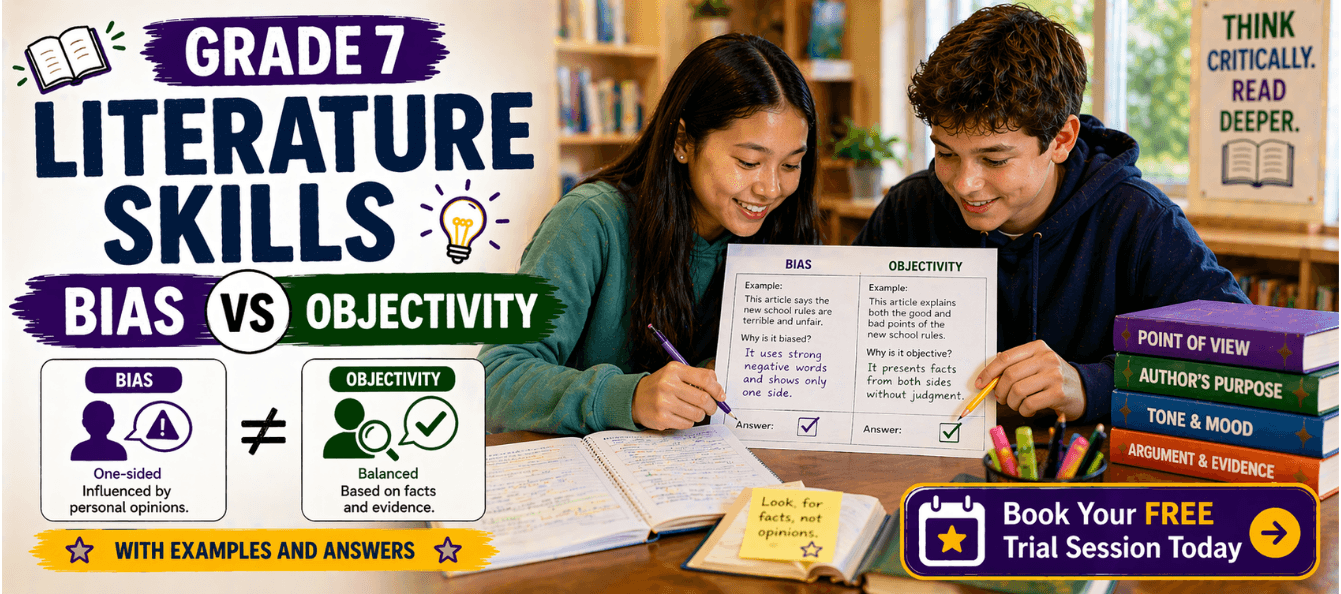
Bias is when a writer or speaker shows a one-sided opinion, while objectivity means presenting information fairly and based on evidence. In this worksheet, students learn how balanced thinking leads to stronger communication.
What’s in This Worksheet?
1. Multiple Choice Questions based on a debate story.
2. Questions that focus on identifying bias and objectivity.
3. Exercises to understand balanced arguments.
4. Activities like Fill in the Blanks, True and False, Underline the Words, and Paragraph Writing.
5. Practice in analysing viewpoints.
Definitions, Examples, Techniques, and Tips
Definition:
Bias is selecting only supportive information, while objectivity involves examining evidence honestly.
Example:
Aryan’s first draft showed bias, but later included evidence and counterarguments.
Techniques:
- Look for one-sided arguments.
- Check if evidence is used.
- Identify if opposing views are included.
Tips:
- Always support claims with evidence.
- Avoid emotional exaggeration.
- Consider both sides of an issue.
Why Is It Important to Learn This?
This skill helps students become fair thinkers and better communicators. It improves writing and speaking by making arguments stronger and more reliable.
Where Will This Knowledge Help You?
It is useful in debates, exams, essays, and discussions. It helps students present ideas clearly and fairly.
How to Use This Worksheet?
1. Read carefully.
2. Answer independently.
3. Review answers.
4. Practise regularly.
The solutions follow the exact worksheet order, so compare answers carefully.
Important Tips and Tricks
1. Identify one-sided arguments.
2. Look for evidence.
3. Check for balance.
4. Avoid guessing.
5. Read questions carefully.
Complete Answer Key
Exercise 1 – Multiple Choice Questions
1. b) bias and emotional slogans.
2. a) clear evidence.
3. b) Want fair and convincing?
4. c) Selects supportive info only.
5. a) examine evidence honestly.
6. c) balance and accuracy.
7. a) including counterarguments.
8. a) It was balanced, supported.
9. b) Objectivity made it stronger.
10. c) Style and evidence fit.
Exercise 2 – Fill in the Blanks
1. regulation
2. fact cards
3. selected
4. Coach Meera
5. objectivity / fair
6. rehearsals
7. fairness
8. scoreboard
9. audience / questions
10. questions / reasoning
Exercise 3 – True or False
1. True
2. False
3. True
4. True
5. False
6. False
7. True
8. False
9. True
10. False
Exercise 4 – Underline the key phrase and write the context
Answers will depend on personal perspective and may vary. (Hint:- Identify the "who, what, when, and where" of the scene.)
Exercise 5 – Paragraph Fill in the Blanks (Context Clues)
1. evidence
2. bias
3. fact cards / cards
4. rehearsals
5. convincing / credible
6. reasoning / argument
7. slogans / emotion
This English grammar worksheet for Grade 7 on bias vs objectivity helps you understand the importance of fair thinking and balanced arguments. Keep practising to strengthen your skills.