
Grade 7 Mixed Modals, Voice & Speech Review [With Answers]
![Grade 7 Mixed Modals, Voice & Speech Review [With Answers]](https://cdn5.planetspark.in/media/small_Grade_7_Mixed_Modals_Voice_and_Speech_Review_With_Answers_0c5563fb73.png)

English Grammar Worksheet for Grade 7 on Mixed Modals, Voice & Speech
As students progress through Grade 7, they are expected to juggle multiple grammar concepts simultaneously. Mastery of English requires not just understanding individual topics like Modals, Voice, and Speech in isolation, but also the ability to switch between them without confusion. This worksheet serves as a comprehensive review, challenging students to apply their knowledge of Modals (verbs that express necessity or possibility), Active and Passive Voice (the direction of action), and Direct and Indirect Speech (reporting what others say). Mixing these topics in one exercise tests a student's versatility and attention to detail, ensuring they are fully prepared for complex grammar questions in exams.
Download these English grammar worksheets and practice regularly to strengthen your language skills and build a strong foundation. You can also book a free trial to get expert guidance and improve your reading, writing, and comprehension abilities. The worksheets are designed in a simple and structured way to help K–8 students learn grammar concepts easily and use them confidently in everyday communication.
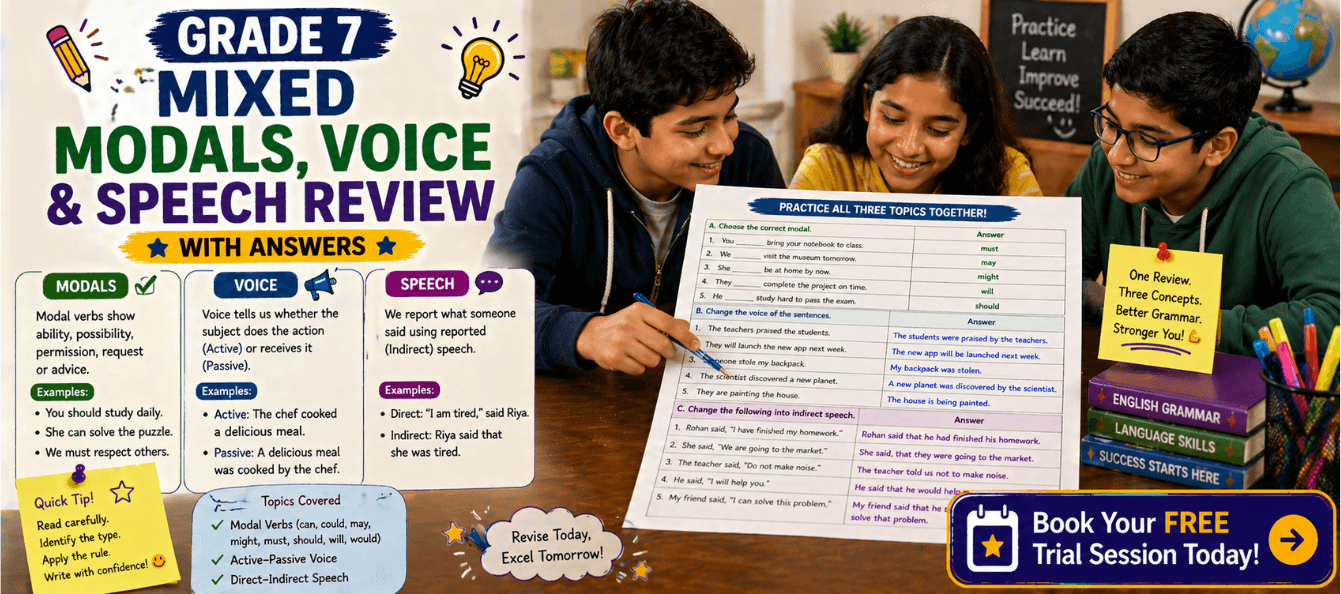
What Is the Topic?
This English grammar worksheet provides a Mixed Review of Modals, Voice, and Speech.
- Modals: These are auxiliary verbs like *can, could, should, would, must, might, may,* and *ought to*. They are used to express ideas such as ability, obligation, possibility, or advice. For example, "You should respect your elders" gives advice.
- Voice: This refers to Active and Passive voice. In Active voice, the subject performs the action (e.g., "Neha can solve this problem"). In Passive voice, the subject receives the action (e.g., "This problem can be solved by Neha").
- Speech: This covers Direct and Indirect speech transformation. It involves changing direct quotes into reported speech, which often requires changing the tense of the verbs and pronouns (e.g., changing "I must leave" to "He said that he had to leave").
What’s in This Worksheet?
This worksheet is designed as a rigorous practice test covering three major areas. It includes:
1. Multiple Choice Questions that mix questions about identifying passive voice, transforming direct speech, and selecting the correct modal for a given sentence.
2. True and False questions that verify specific grammar rules, such as how modals change in indirect speech or the structure of passive voice sentences.
3. Fill in the Blanks exercises that require students to recall specific transformation rules, such as what "must" becomes in reported speech or how to form the passive of modal verbs.
4. Sentence Rewriting tasks where students must convert sentences between Active and Passive voice, and between Direct and Indirect speech.
5. Paragraph Writing exercises that provide a text about school rules, requiring students to fill in blanks with appropriate modals and reported speech verbs based on context clues.
Definitions, Examples, Techniques, and Tips
To navigate this mixed review successfully, students must refresh the specific rules for each category:
Modals:
- Modals are followed by the base form of the verb (e.g., "can go," "should eat").
- Obligation/Necessity: Use "must," "have to," or "ought to."
- Advice/Suggestion: Use "should."
- Possibility: Use "may," "might," or "could."
- In passive voice with modals, the structure is *Modal + be + Past Participle* (e.g., "must be done," "can be solved").
Voice (Active-Passive):
- Active Voice: The subject does the action (e.g., "The principal might announce the results").
- Passive Voice: The object becomes the subject (e.g., "The results might be announced by him").
- When changing to passive, the verb changes to a form of "be" + V3 (past participle). Not all passive sentences include the doer (agent) with "by."
Speech (Direct-Indirect):
- Direct Speech: Uses the exact words of the speaker with quotation marks.
- Indirect Speech: Reports the meaning without quotes. The tense usually shifts back (backshifting).
- Specific Changes:
- "Can" changes to "could."
- "May" changes to "might."
- "Will" changes to "would."
- "Must" changes to "had to."
- "Said to" changes to "told."
A crucial tip is to identify the focus of the question immediately. Is it about *who* is doing the action (Voice)? Is it about *what* is being said or reported (Speech)? Or is it about *what is necessary or possible* (Modals)?
Why Is It Important to Learn This?
Learning to differentiate and apply these three distinct yet interconnected grammar pillars is essential for advanced English proficiency. Modals allow students to express nuanced feelings about actions (obligation vs. possibility). Voice transformation allows students to shift the focus of a sentence from the doer to the action, which is vital for formal and objective writing. Speech transformation allows for accurate reporting of information. In Grade 7, exams often feature "mixed" grammar sections where students must quickly identify which rule applies. Mastering this review ensures students do not confuse these rules under pressure.
Where Will This Knowledge Help You?
This combined knowledge is applicable in various aspects of academic and professional life. In essay writing, modals help in making strong arguments (e.g., "Governments *must* act"). Passive voice is used extensively in scientific reports and newspaper headlines to emphasize the event rather than the actor. Indirect speech is the standard form of storytelling and reporting in journalism and history. Furthermore, in competitive exams and English Olympiads, questions frequently blend these topics to test a student's overall grammatical aptitude.
How to Use This Worksheet?
Given the mixed nature of this worksheet, a focused approach is necessary:
1. Identify the Category: Read each question and first determine if it is asking about Modals, Voice, or Speech.
2. Apply the Specific Rules:
- If it is Voice: Check the subject/object relationship and the V3 form.
- If it is Speech: Look for the reporting verb tense and shift the verb in the quote accordingly.
- If it is Modals: Look at the context (is it advice, an order, or a possibility?) to choose the right word.
3. Review the True/False Section: Use this to solidify the "exception" rules, such as whether "must" changes in indirect speech.
4. Practice the Paragraph: For the paragraph exercise, read the entire text to understand the context (e.g., school rules usually imply obligation) before selecting modals.
5. Use the Answer Key below to check your conversions, especially the tricky ones like "must" to "had to."
Important Tips and Tricks
Here are some strategies to help you master this mixed review:
1. The "Modal + Be + V3" Rule: Whenever you see a modal in a passive sentence, the structure is almost always "modal" + "be" + "past participle" (e.g., "could be posted").
2. Watch "Must": Remember that in Indirect Speech, "must" often changes to "had to" (e.g., "I must go" -> "He said he had to go").
3. Modals in Indirect Speech: Some modals stay the same (could, might, should, ought to), while others change (can -> could, will -> would, may -> might). Don't change them all automatically!
4. The "Doer" in Passive: Don't feel compelled to add "by [someone]" in passive sentences unless the original active sentence specifically mentioned the doer.
5. Universal Truths: Even in indirect speech, if a modal expresses a general truth that hasn't changed (like "must obey" in rules), the context might dictate keeping the meaning of obligation rather than just the tense.
6. Context Clues: In the paragraph fill-in-the-blanks, look for words like "rules," "prohibited," or "obligation" to decide between "must," "should," or "cannot."
Complete Answer Key
Exercise No. 1
1. b) The homework must be done by all.
2. a) He said that he could swim very fast.
3. b) You should respect your elders always.
4. b) Neha can solve this problem with ease.
5. a) The principal might announce the results.
6. a) She said that she might visit Mumbai.
7. b) Students should wear uniforms on Monday.
8. a) The letter could be posted by Aryan.
9. a) Rahul said that he had to leave then.
10. b) You ought to help the needy always.
Exercise No. 2
1. True
2. False (Modals like can, may, will, might do change in indirect speech)
3. True
4. True
5. True
6. False (Passive voice does not always include the agent with "by")
7. True
8. False (Passive voice always uses a form of the verb "be")
9. True
10. True
Exercise No. 3
1. Modals are followed by 'be' and past participle.
2. The word 'must' changes to had to in Indirect.
3. The modal for obligation or duty is should (or ought to/must).
4. The passive of 'can do' is 'can be done'.
5. The modal 'could' remains could in Indirect.
6. The modal for possibility is may/might.
7. The passive of 'should obey' is should be obeyed.
8. The modal 'might' stays might in Indirect.
9. The modal for advice is should.
10. The passive of 'may invite' is may be invited.
Exercise No. 4
1. Anjali wrote the letter.
2. Cakes are baked by Pooja for the school fair.
3. Neha said, "I might visit Jaipur."
4. Rahul said, “I can solve this problem.”
5. The Chennai team won the race.
6. Arjun said that he would join the cricket camp.
7. The cricket ball broke the window.
8. The plants are watered by the gardener every day.
9. Kartik said that he might go to Nagpur tomorrow.
Exercise No. 5
Answers may vary. (Students should fill in the blanks with modals and reporting verbs that fit the context of school rules and reporting. Example answers: Every student must follow... The school uniform should be worn... The daily homework must be submitted... The teacher said that every student ought to bring... The playground must be kept... Students must not run... The principal said that latecomers would not be allowed... The library books must be returned... Rahul said that he would finish... The notice said that all parents should attend...)
Completing this mixed review demonstrates a high level of grammatical competence. By juggling the rules for Modals, Voice, and Speech, Grade 7 students prepare themselves for the complexity of higher-level English. Keep practicing these exercises to ensure you can switch effortlessly between these different concepts in any exam situation.