
Grade 7 Noun Clauses [Free PDF]
![Grade 7 Noun Clauses [Free PDF]](https://cdn5.planetspark.in/media/small_Grade_7_Noun_Clauses_Free_PDF_208aceeb01.png)

Mastering Noun Clauses: English Grammar Worksheet for Grade 7
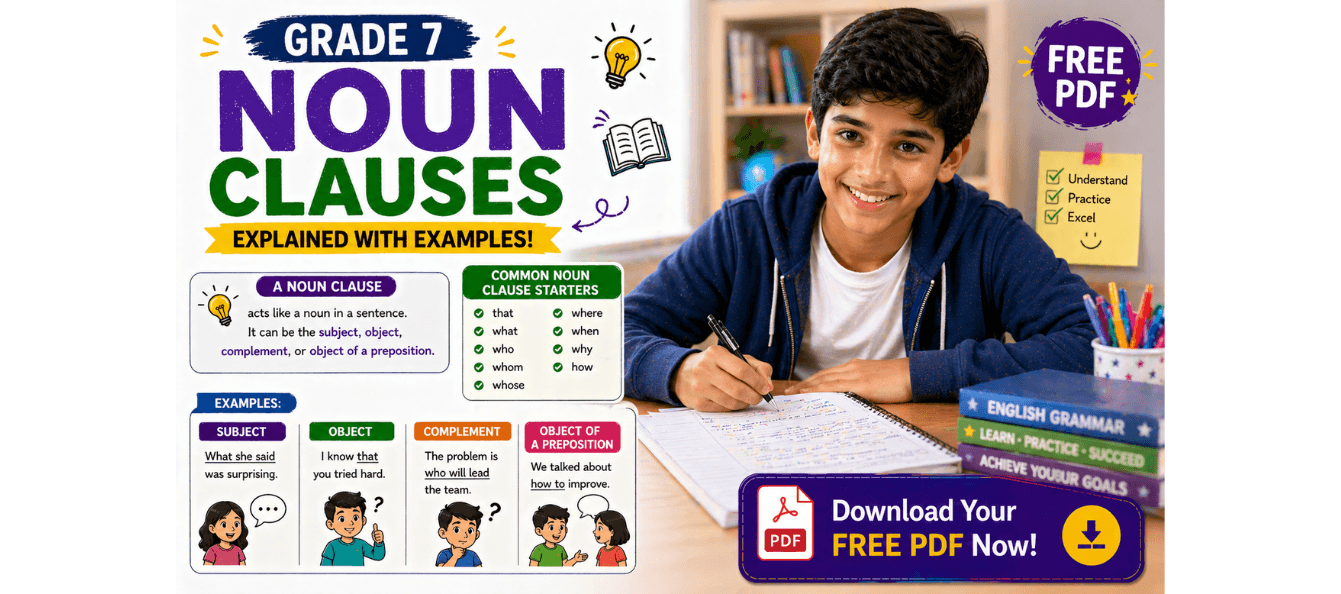
As students advance in their understanding of English grammar, they begin to encounter more complex sentence structures that go beyond simple subjects and verbs. One such advanced concept is the Noun Clause. Just as a noun acts as a person, place, or thing, a noun clause is a group of words that acts as a noun within a sentence. It can perform the functions of a subject, an object, or a complement. For Grade 7 students, mastering noun clauses is a significant step toward writing sophisticated sentences and expressing complex thoughts. This English grammar worksheet on Noun Clauses is designed to help students identify these clauses, understand their functions, and use them correctly to enhance the depth of their writing.
Download these English grammar worksheets and practice regularly to strengthen your language skills and build a strong foundation. You can also book a free trial to get expert guidance and improve your reading, writing, and comprehension abilities. The worksheets are designed in a simple and structured way to help K–8 students learn grammar concepts easily and use them confidently in everyday communication.
What Is the Topic?
The topic of this worksheet is Noun Clauses. A Noun Clause is a dependent clause that acts as a noun in a sentence. Because it is a clause, it must contain a subject and a verb. However, because it is a dependent clause, it cannot stand alone as a complete sentence. Instead, it functions within a larger sentence to do the job of a noun. For example, in the sentence "I know *that Rahul lives in Delhi*," the part in bold is a noun clause acting as the direct object of the verb "know." These clauses can begin with words like "that," "whether," "if," or wh-words like "who," "what," "where," "how," and "why."
What’s in This Worksheet?
This Grade 7 English grammar worksheet provides a comprehensive practice session on Noun Clauses through a variety of targeted exercises:
1. Multiple Choice Questions: Students must identify sentences that contain a noun clause from a pair of options.
2. True and False: This section tests the theoretical understanding of noun clauses, such as their ability to act as subjects or objects.
3. Fill in the Blanks: Students complete sentences by filling in terms related to the definition and function of noun clauses.
4. Sentence Rewriting: A correction exercise where students must fix errors in word order and subject-verb agreement within noun clauses.
5. Paragraph Writing: A conceptual exercise where students fill in blanks in a paragraph describing noun clauses using appropriate grammatical terms.
Definitions, Examples, Techniques, and Tips
Based on the exercises provided, here are the core definitions and examples students need to know:
- Definition: A Noun Clause acts as a noun in a sentence.
- Function: It can be the subject of a sentence (e.g., "*That he is honest* is obvious") or the object (e.g., "I know *what you did*").
- Starters: Noun clauses often begin with "that," "whether," "if," "who," "what," "where," etc.
- Subject and Verb: Even though it acts as a noun, a noun clause has its own subject and verb. For example, in "*Who won the prize* is a mystery," "Who won the prize" is the clause, "who" is the subject, and "won" is the verb.
- Statement Order: When a noun clause is not a question itself (e.g., "I wonder..."), the subject comes before the verb, just like in a statement (e.g., "I wonder *where she went*," not "where did she go").
Why Is It Important to Learn This?
Learning Noun Clauses is important because it allows students to combine ideas and create more fluid sentences. Instead of writing two choppy sentences, a student can use a noun clause to link them. For instance, "I heard a fact. The fact is he is honest" can be combined into "I heard *that he is honest*." This grammatical structure is frequently used in academic writing, formal speeches, and complex storytelling. Understanding noun clauses also helps students improve their reading comprehension by allowing them to break down long, complex sentences into manageable parts.
Where Will This Knowledge Help You?
Students will apply their knowledge of Noun Clauses in:
- Essay Writing: Using noun clauses to create smooth transitions and complex arguments.
- Asking Questions: Formulating indirect questions (e.g., "Can you tell me *where the station is*?") which are more polite than direct questions.
- Reading Comprehension: Analyzing complex sentences in literature and textbooks.
- Exams: Answering questions related to sentence structures and clause identification.
How to Use This Worksheet?
To effectively use this Noun Clauses worksheet, students should follow these steps:
1. Attempt independently first: Try to identify the noun clauses and correct the sentences in the rewriting section without looking at the answers.
2. Review answers carefully: Compare your answers with the key below to ensure you have the correct word order and verb forms.
3. Correct mistakes: Pay special attention to the rewriting section. Note how questions change into statements inside the noun clause (e.g., "Where is she?" becomes "Where she is").
4. Practice regularly: Try forming your own sentences using noun clauses as subjects and objects.
The solutions provided below follow the exact worksheet order. Students should compare their answers carefully to ensure they have mastered the structure and usage of Noun Clauses.
Important Tips and Tricks
Here are some tips to help you navigate the specific challenges in this worksheet:
- Word Order: Inside a noun clause, use the order of a statement (Subject + Verb), not a question. For example, write "I know *where he lives*," not "I know *where does he live*."
- Subject-Verb Agreement: If the noun clause is the subject of the sentence, the main verb of the sentence agrees with the clause as a singular unit. Example: "*What he said* was important." (Use "was," not "were").
- Starters: Remember that "that," "whether," "if," and wh-words are the flags that signal a noun clause might be starting.
- Punctuation: Noun clauses are usually not set off by commas, especially when they act as objects.
Complete Answer Key
Exercise No. 1 Choose the correct answer from the options.
1. b) I know that Rahul lives in Delhi.
2. a) Anjali asked where the library was.
3. a) Whether he will come is uncertain.
4. b) Arjun knows what the answer is.
5. a) That honesty is best policy is true.
6. a) Neha wonders how the trick was done.
7. b) I heard the reason and helped.
8. a) Who won the prize is still a mystery.
9. a) I believe that hard work pays off.
10. b) Kartik knows who stole the notebook.
Exercise No. 2 Tick T if the statement is true or F if the statement is false.
1. A noun clause acts as a subject or object. T
2. That he is honest is a noun clause. T
3. Noun clauses can replace noun phrases. T
4. I know what you did contains a noun clause. T
5. A noun clause can never begin a sentence. F
6. A noun clause contains a subject and a verb. T
7. A noun clause can be the object of a verb. T
8. Where she went is not a noun clause. F
9. Noun clauses begin with that, whether, or how. T
10. A noun clause does not have its own subject. F
Exercise No. 3 Fill in the blanks with the correct word or phrase to complete each sentence.
1. A Noun Clause acts as a noun in a sentence.
2. A Noun Clause can be the object of a verb.
3. A Noun Clause often begins with that.
4. A Noun Clause can be the subject of a sentence.
5. Whether' and 'if' can start a Noun Clause.
6. A Noun Clause answers who or what.
7. A Noun Clause replaces a noun.
8. Who', 'what', 'where' begin Noun Clauses.
9. A Noun Clause has its own subject and verb.
10. A Noun Clause follows 'know' and ask.
Exercise No. 4 Rewrite the following sentences according to the directions given on the right.
1. Where does Anjali live is a mystery. -> Where Anjali lives is a mystery.
2. That he is intelligent are obvious. -> That he is intelligent is obvious.
3. What does he want is not clear to us. -> What he wants is not clear to us.
4. I really do not know who is she. -> I really do not know who she is.
5. She asked where was the railway station. -> She asked where the railway station was.
6. I wonder how did Rahul solve the problem. -> I wonder how Rahul solved the problem.
7. Tell me what is your name please. -> Tell me what your name is please.
8. He knows where does Diya live now. -> He knows where Diya lives now.
9. Whether she will come are uncertain now. -> Whether she will come is uncertain now.
10. Why did he leave was never explained. -> Why he left was never explained.
Exercise No. 5 Read the paragraph given below and fill in the blanks with the correct words.
A Noun Clause functions as a noun within a sentence just like a regular noun does. It can serve as the object of a verb in the same way as a noun. A Noun Clause often begins with the word that in many common and everyday sentences. It can also be the object of a verb like 'know' or 'believe' quite easily. Words like 'whether' and 'if' can start a Noun Clause at the very beginning. A Noun Clause answers the question who or what in a given sentence directly. It replaces a single noun in the overall sentence structure without any difficulty at all. Words like 'who', 'what', and 'where' can begin a Noun Clause in a sentence. A Noun Clause contains its own subject and verb within it as a complete unit. A sentence with a Noun Clause is always a complex sentence by its basic structure.
By working through these exercises, Grade 7 students can master the concept of Noun Clauses, a vital tool for advanced English writing. Recognizing how these clauses function allows students to construct more sophisticated sentences and express complex ideas with clarity. Keep practicing with these worksheets to ensure a strong grammatical foundation!