
Grade 7 Passive Voice [With Examples and Answers]
![Grade 7 Passive Voice [With Examples and Answers]](https://cdn5.planetspark.in/media/small_Grade_7_Passive_Voice_With_Examples_and_Answers_c425d21b70.png)

Mastering Passive Voice: English Grammar Worksheet for Grade 7
In English grammar, the focus of a sentence can change entirely depending on who or what we want to emphasize. While Active Voice highlights the doer of the action, Passive Voice shifts the spotlight to the receiver or the result of the action. This is a crucial concept for Grade 7 students to master, as it allows them to write formally and objectively, which is especially useful in reports, scientific writing, and storytelling where the action is more important than who performed it. This English grammar worksheet focuses on Passive Voice, guiding students through the rules of transforming sentences and identifying when this voice is being used. By practicing these exercises, students will gain the ability to manipulate sentence structures for greater effect.
Download these English grammar worksheets and practice regularly to strengthen your language skills and build a strong foundation. You can also book a free trial to get expert guidance and improve your reading, writing, and comprehension abilities. The worksheets are designed in a simple and structured way to help K–8 students learn grammar concepts easily and use them confidently in everyday communication.
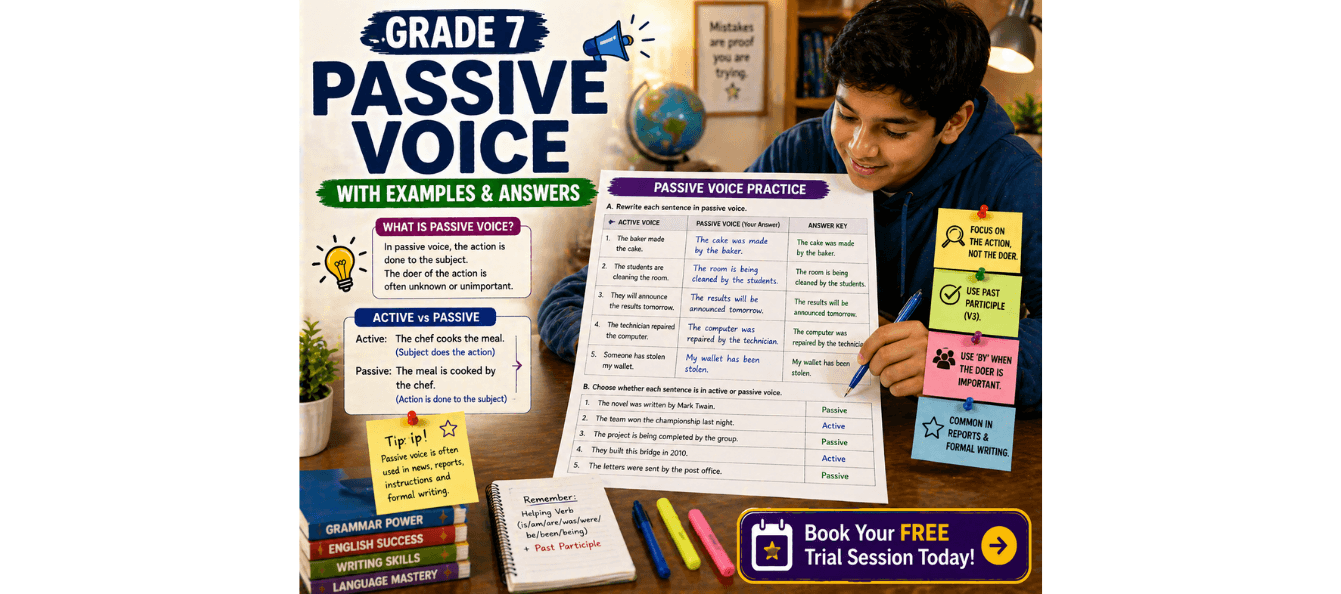
What Is the Topic?
The topic of this worksheet is Passive Voice. In the Passive Voice, the subject of the sentence is the receiver of the action rather than the doer. The structure typically involves a form of the verb "to be" (like is, am, are, was, were) followed by the past participle of the main verb. The doer of the action is often introduced at the end of the sentence using the word "by." For example, in "The letter was posted by Anjali," the focus is on the letter, not on Anjali.
What’s in This Worksheet?
This Grade 7 English grammar worksheet is structured to provide a deep dive into Passive Voice through varied exercises:
1. Multiple Choice Questions: Students must select the sentence that is written in the Passive Voice from a pair of options.
2. True and False: This section tests the ability to identify Passive Voice sentences correctly.
3. Fill in the Blanks: Students complete sentences regarding the rules of Passive Voice and complete passive sentences using the correct forms of "to be."
4. Sentence Rewriting: This is a major exercise where students convert sentences from Active Voice to Passive Voice.
5. Paragraph Writing: A fill-in-the-blank exercise where students supply the correct auxiliary verbs (was/were) to complete a paragraph written in the Passive Voice.
Definitions, Examples, Techniques, and Tips
Based on the provided exercises, here are the key concepts and examples:
- Definition: In Passive Voice, the subject receives the action.
- Structure: Object becomes Subject + Form of 'to be' + Past Participle (+ by Subject).
- Examples: "The letter was posted by Anjali," "The field was flooded by monsoon rain," "The song is sung by the school choir."
- Techniques: To change a sentence to passive, identify the object and make it the subject. Then change the verb to "to be + past participle."
- Tips: Look for the "by [someone]" phrase as a strong indicator of Passive Voice. Remember to match the "to be" verb with the new subject in number (singular/plural) and tense.
Why Is It Important to Learn This?
Passive Voice is essential for formal and academic writing. It is used when the actor is unknown, irrelevant, or when we want to emphasize the action rather than the actor. For instance, in science, we say "The mixture was heated," not "The scientist heated the mixture." Learning this voice allows Grade 7 students to vary their sentence structures, making their writing less repetitive and more sophisticated. It also helps in understanding complex texts where the subject is not the doer.
Where Will This Knowledge Help You?
Students will use Passive Voice in:
- Science Reports: Describing experiments where the procedure is the focus.
- News Reports: When the journalist does not know who committed the action or wants to focus on the event (e.g., "The bank was robbed").
- Formal Letters: Conveying information politely and objectively.
- Exams: Answering questions that specifically ask for sentence conversion or identification.
How to Use This Worksheet?
To effectively master Passive Voice using this worksheet, follow these steps:
1. Attempt independently first: Try to identify passive sentences and convert the active sentences on your own.
2. Review answers carefully: Use the answer key provided below to check your conversions and subject-verb agreement.
3. Correct mistakes: Pay close attention to the form of the past participle (e.g., "baked" vs "baking") and the auxiliary verb ("was" vs "were").
4. Practice regularly: Practice converting sentences you see in daily life into Passive Voice to get comfortable with the structure.
The solutions provided below follow the exact worksheet order. Students should compare their answers carefully to ensure they have correctly applied the rules of Passive Voice.
Important Tips and Tricks
Here are some tips to help you succeed with this worksheet:
- Find the Object: To turn a sentence passive, find the object in the active sentence and move it to the front.
- Change the Verb: The verb always changes to "to be + V3" (past participle). For example, "paints" becomes "is painted."
- Check the Number: Ensure your "to be" verb matches the new subject. "The hall" (singular) takes "was," "The banners" (plural) take "were."
- Don't Forget "By": If you need to mention the doer, place "by [original subject]" at the end.
Complete Answer Key
Exercise No. 1 Choose the correct answer from the options.
1. b) The letter was posted by Anjali.
2. a) The pudding is stirred by Pooja now.
3. b) The field was flooded by monsoon rain.
4. b) The song is sung by the school choir.
5. a) The fort was built by the emperor.
6. a) The parcel is delivered by the postman.
7. b) The windows were broken by the storm.
8. a) The medals are distributed by the principal.
9. a) The saree was woven by the weavers.
10. b) The homework is checked by the teacher.
Exercise No. 2 Tick T if the statement is Passive or F if the statement is not Passive.
1. An apple was eaten by Sneha. T
2. The poem was recited by Diya at the event. T
3. The mangoes were plucked by the farmer. T
4. The bridge was built by the Mughal rulers. T
5. The clothes were washed by him. T
6. Rahul drives the school bus every day. F
7. The injured player was taken to the hospital. T
8. He dances elegantly. F
9. Neha baked the cookies for the festival. F
10. Aryan wrote the essay on Indian monuments. F
Exercise No. 3 Fill in the blanks with the correct word or phrase to complete each sentence.
1. The subject receives the action in Passive.
2. The cake was baked by Nisha yesterday.
3. Passive Voice uses a form of the verb to be.
4. The match was cancelled by the referee.
5. The temple is visited by many devotees.
6. The doer is introduced by by in Passive.
7. The story was narrated by the grandmother.
8. The chairs were arranged by the students.
9. The trophy was lifted by the team captain.
Exercise No. 4 Rewrite the following sentences according to the directions given on the right.
1. Pooja paints a beautiful rangoli every morning. -> A beautiful rangoli is painted by Pooja every morning.
2. The principal announced the results yesterday. -> The results were announced by the principal yesterday.
3. Nisha sweeps the classroom every afternoon. -> The classroom is swept by Nisha every afternoon.
4. Arjun scored the winning goal for the team. -> The winning goal was scored by Arjun for the team.
5. The children decorated the hall for the festival. -> The hall was decorated by the children for the festival.
6. Rohan drives the tractor on the farm. -> The tractor is driven by Rohan on the farm.
7. Anjali submitted the project on time. -> The project was submitted by Anjali on time.
8. The monsoon rain filled the river to the brim. -> The river was filled to the brim by the monsoon rain.
9. The chef prepares biryani for the wedding. -> Biryani is prepared by the chef for the wedding.
10. Kartik solved the puzzle in five minutes. -> The puzzle was solved by Kartik in five minutes.
Exercise No. 5 Read the paragraph and fill in the blanks with the correct words using the hints given below.
The school hall was decorated by the students of Grade Seven with colourful paper streamers. Beautiful banners were hung from the ceiling by Rohan and his helpful friends early that morning. The stage was painted in bright and attractive colours by the art club members. Formal invitations were sent to every single parent by the school office well in advance. The microphone and speakers were tested by Aryan before the cultural show began in the evening. A stunning backdrop of the sunset was prepared by the drama team over the entire weekend. The seating arrangement for guests was managed by the prefects on duty very efficiently. Fresh marigold flowers were placed on the stage by the gardeners early that morning. The chief guest for the event was welcomed by the principal with a warm speech.
By working through these exercises, Grade 7 students can confidently use the Passive Voice to shift the focus of their sentences. Mastering this structure adds a layer of sophistication to writing and is a key skill for academic success. Keep practicing to ensure you can seamlessly switch between Active and Passive voices as needed!