
Grade 7 Phrases (Types & Usage) [Printable Grammar Worksheet]
![Grade 7 Phrases (Types & Usage) [Printable Grammar Worksheet]](https://cdn5.planetspark.in/media/small_Grade_7_Phrases_Types_and_Usage_Printable_Grammar_Worksheet_d5f3e1e17e.png)

Mastering Phrases: English Grammar Worksheet for Grade 7
Building sentences is like constructing a building; you need individual bricks, but you also need groups of bricks working together to form walls and structures. In English grammar, these "groups of words" are called phrases. Unlike a clause, a phrase does not have a subject and a verb, yet it plays a crucial role in adding meaning and detail to our sentences. For students in Grade 7, understanding the different types of phrases—such as Noun Phrases, Adjective Phrases, and Adverb Phrases—is essential for writing more fluently and accurately. This English grammar worksheet focuses on Phrases (Types & Usage), offering a structured approach to identifying and using these word groups correctly. By practicing with these exercises, students can improve their sentence structure and make their writing more sophisticated and descriptive.
Download these English grammar worksheets and practice regularly to strengthen your language skills and build a strong foundation. You can also book a free trial to get expert guidance and improve your reading, writing, and comprehension abilities. The worksheets are designed in a simple and structured way to help K–8 students learn grammar concepts easily and use them confidently in everyday communication.
What Is the Topic?
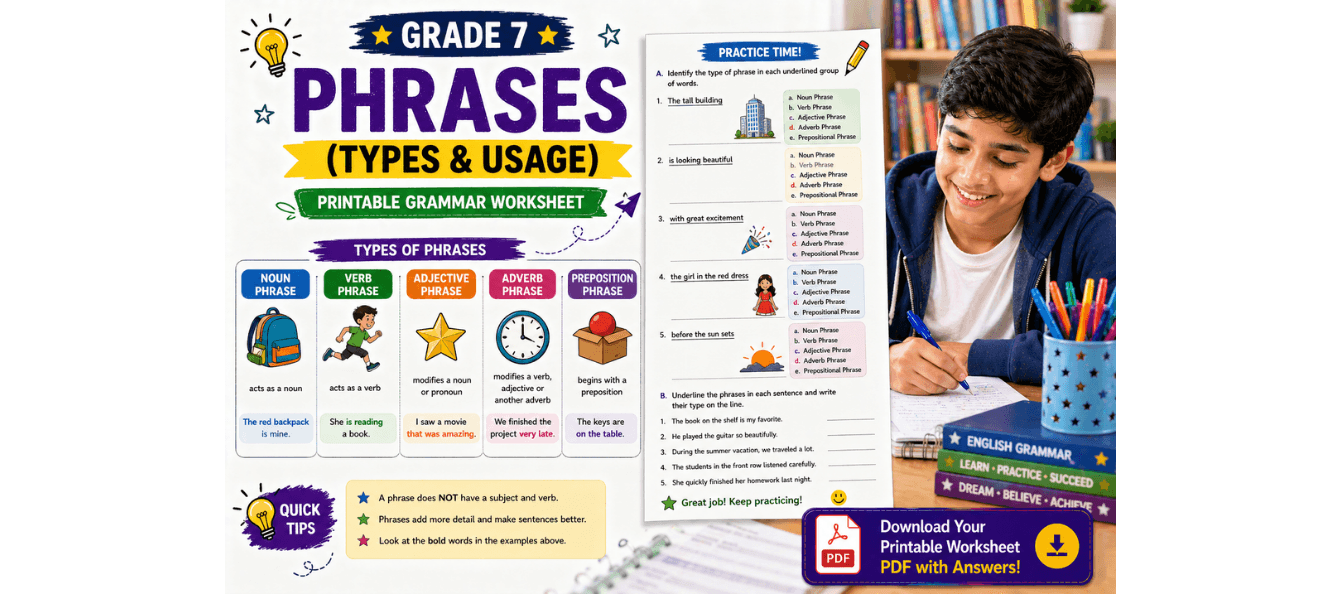
The topic of this worksheet is Phrases (Types & Usage). A phrase is a group of words that does not have a subject and a finite verb but functions as a single unit within a sentence. This worksheet covers several key types of phrases:
- Noun Phrase: Acts as a noun (subject or object), e.g., "The tall boy in the corner."
- Adjective Phrase: Modifies a noun or pronoun, usually describing a quality, e.g., "with long hair."
- Adverb Phrase: Modifies a verb, adjective, or adverb, telling how, when, or where, e.g., "with great speed."
- Prepositional Phrase: Begins with a preposition and ends with a noun or pronoun, e.g., "on the wooden chair."
Understanding these types helps students see how words cluster together to perform specific grammatical jobs.
What’s in This Worksheet?
This Grade 7 English grammar worksheet provides a comprehensive review of phrases through varied exercises:
1. Multiple Choice Questions: Students identify sentences containing specific types of phrases, such as Noun or Adverb Phrases.
2. True and False: This section tests definitions and rules, such as whether a phrase can stand alone or if it contains a finite verb.
3. Fill in the Blanks: Students complete sentences using grammatical terms related to phrases, such as "subject," "preposition," and "finite verb."
4. Sentence Rewriting: Students correct sentences to fix errors in phrase usage, such as adding articles to prepositional phrases.
5. Paragraph Writing: A fill-in-the-blank exercise where students identify the types of phrases in context (Noun, Adjective, Adverb, Prepositional).
Definitions, Examples, Techniques, and Tips
Based on the content provided in the worksheet, here are the essential concepts:
- Definition: A phrase lacks a finite verb but has meaning. For example, "with long hair" is a phrase because it doesn't have a subject doing a verb, yet it describes the girl.
- Noun Phrase: This acts as the subject or object. In the sentence "The tall boy in the corner is Rahul," "The tall boy in the corner" is the Noun Phrase.
- Adjective Phrase: This describes a noun. In "The girl with long hair is Anjali," "with long hair" acts as an Adjective Phrase modifying "girl."
- Adverb Phrase: This modifies a verb. In "Rahul ran with great speed," "with great speed" is an Adverb Phrase telling how he ran.
- Prepositional Phrase: Always starts with a preposition (on, in, at, with). Example: "on the wooden chair."
- Technique: To identify a phrase, look for a group of words without a subject-verb pair. "The book on table" is a prepositional phrase fragment needing "the" to be "on the table."
- Tip: Remember that an Adjective Phrase answers "which one?" or "what kind?", while an Adverb Phrase answers "how?", "when?", or "where?".
Why Is It Important to Learn This?
Learning about phrases is vital for sentence variety and precision. When students understand phrases, they move beyond simple sentences like "The boy is Rahul" to more complex ones like "The tall boy in the corner is Rahul." This skill is crucial for Grade 7 writing standards, where students are expected to combine ideas effectively. Knowing phrases helps in avoiding sentence fragments and run-on sentences. It also aids in reading comprehension, as breaking complex sentences into phrases helps in understanding the meaning more quickly.
Where Will This Knowledge Help You?
Knowledge of phrases is useful in:
- Essay Writing: Creating descriptive and detailed sentences.
- Grammar Exams: Identifying parts of sentences and correcting errors.
- Literature Analysis: Understanding how authors build imagery and description.
- Professional Communication: Writing clear and sophisticated reports or emails.
How to Use This Worksheet?
Students should follow these steps to master Phrases (Types & Usage):
1. Attempt independently first: Try to identify the phrases in the Multiple Choice section without guessing.
2. Review answers carefully: Check your True/False responses against the rules provided in the worksheet.
3. Correct mistakes: In the rewriting section, look for missing articles or words that break the phrase structure (e.g., changing "on table" to "on the table").
4. Practice regularly: Try to write your own sentences using specific types of phrases, like an Adverb Phrase describing how you walk to school.
The solutions provided below follow the exact worksheet order. Students should compare their answers carefully to ensure they have correctly identified and formed the phrases.
Important Tips and Tricks
Here are some tips to score full marks based on the worksheet exercises:
- Check for Finite Verbs: If a group of words has a subject and a finite verb, it is a clause, not a phrase.
- Adjective vs. Adverb: Remember that Adjective Phrases modify nouns, while Adverb Phrases modify verbs.
- Preposition Position: Prepositional phrases always start with a preposition (in, on, at, with) and end with a noun.
- Sentence Correction: In the rewriting section, ensure Noun Phrases have determiners (a, an, the) where needed (e.g., "The man in blue shirt" becomes "The man in the blue shirt").
- Head Words: Identify the "head" of the phrase (the main noun, adjective, or adverb) to understand what the phrase is doing in the sentence.
Complete Answer Key
Exercise No. 1 Choose the correct answer from the options.
1. b) The tall boy in the corner is Rahul.
2. a) The girl with long hair is Anjali.
3. b) Rahul ran with great speed on track.
4. b) The cat sat on the wooden chair.
5. a) A bag of books was found near gate.
6. a) Arjun wore a coat of many colours.
7. b) Neha spoke to the child.
8. a) Diya walked happily along the river.
9. a) The first chapter of the book is great.
10. b) Kartik lives in a house of stone.
Exercise No. 2 Tick T if the statement is true or F if the statement is false.
1. A phrase does not contain a subject and a verb. T
2. An adjective phrase modifies a verb in a sentence. F
3. A phrase always has a finite verb in it. F
4. Gerund phrases function as nouns in a sentence. T
5. An adverb phrase can modify an adjective. T
6. A noun phrase acts as a subject or object. T
7. A phrase can stand alone as a complete sentence. F
8. The boy in the blue shirt is a noun phrase. T
9. A prepositional phrase begins with a preposition. T
10. Participial phrases begin with a participle. T
Exercise No. 3 Fill in the blanks with the correct word or phrase to complete each sentence.
1. A phrase lacks a finite verb.
2. A Noun Phrase acts as the subject.
3. An Adjective Phrase modifies a noun.
4. An Adverb Phrase modifies a verb or adjective.
5. A Prepositional Phrase begins with a preposition.
6. A phrase has no subject-verb pair.
7. An Adjective Phrase is headed by an adjective.
8. An Adverb Phrase is headed by an adverb.
9. A Noun Phrase is centred around a noun.
10. A Participial Phrase starts with a participle.
Exercise No. 4 Rewrite the following sentences according to the directions given on the right.
1. The book on table is mine. -> The book on the table is mine.
2. She spoke in soft manner to the teacher. -> She spoke in a soft manner to the teacher.
3. Girl with red hair is very smart indeed. -> The girl with red hair is very smart indeed.
4. The man in blue shirt is my uncle. -> The man in the blue shirt is my uncle.
5. The temple on hill is very ancient. -> The temple on the hill is very ancient.
6. He drove in careless manner on the road. -> He drove in a careless manner on the road.
7. Lady with long hair is our new teacher. -> The lady with long hair is our new teacher.
8. She danced in graceful manner on the stage. -> She danced in a graceful manner on the stage.
9. The flowers in garden are blooming now. -> The flowers in the garden are blooming now.
10. The cat under tree is sleeping quietly. -> The cat under the tree is sleeping quietly.
Exercise No. 5 Read the paragraph given below and fill in the blanks with the correct words.
A noun phrase acts as the subject or object in a given sentence just like a regular noun does. It can serve as the subject of a verb in the same way as a noun. A Noun Phrase often begins with the word that in many common and everyday sentences. It can also be the object of a verb like 'know' or 'believe' quite easily. Words like 'whether' and 'if' can start a Noun Clause at the very beginning. A Noun Clause answers the question who or what in a given sentence directly. It replaces a specific noun in the overall sentence structure without any difficulty at all. Words like 'who', 'what', and 'where' can begin a Noun Clause in a sentence. A Noun Clause contains its own subject and verb within it as a complete unit. A sentence with a Noun Clause is always a complex sentence by its basic structure.
Mastering phrases is a significant achievement in the journey of learning English grammar. By understanding how Noun, Adjective, and Adverb Phrases function, Grade 7 students can write with greater clarity and style. This worksheet provides the necessary practice to recognize and use these building blocks effectively. Keep practicing, and you will find your writing becoming more polished and professional!