
Grade 7 Prepositions (Time, Place, Direction) [With Examples]
![Grade 7 Prepositions (Time, Place, Direction) [With Examples]](https://cdn5.planetspark.in/media/small_Grade_7_Prepositions_Time_Place_Direction_With_Examples_5fa64fb449.png)

English Grammar Worksheet for Grade 7 on Prepositions of Time, Place and Direction
Have you ever tried to give someone directions without using words like "at," "on," or "in"? It is nearly impossible to describe where something is or when something happened without these tiny but powerful words. Prepositions are the glue that holds our sentences together, providing essential context about time, place, and direction. For students in Grade 7, mastering prepositions is essential for clear communication. Whether you are describing your daily schedule, giving the location of a landmark, or explaining how to get from one place to another, using the correct preposition ensures your listener understands exactly what you mean. This worksheet focuses on the three main categories of prepositions: Time, Place, and Direction.
Download these English grammar worksheets and practice regularly to strengthen your language skills and build a strong foundation. You can also book a free trial to get expert guidance and improve your reading, writing, and comprehension abilities. The worksheets are designed in a simple and structured way to help K–8 students learn grammar concepts easily and use them confidently in everyday communication.
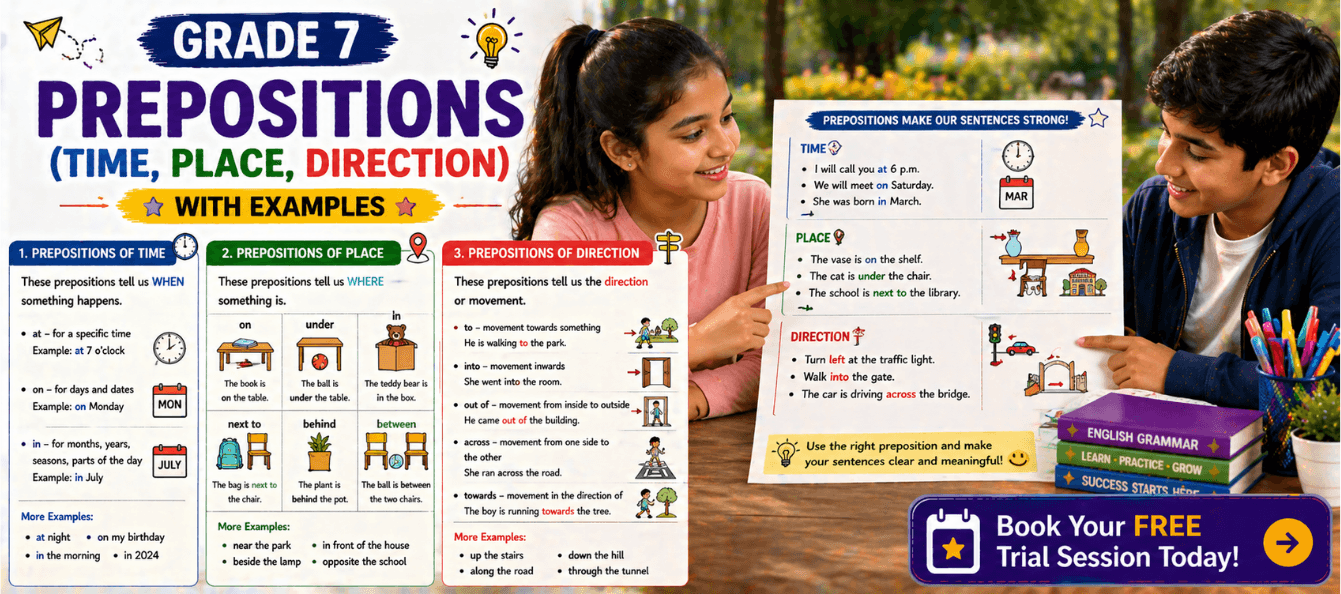
What Is the Topic?
This English grammar worksheet covers Prepositions of Time, Place, and Direction.
- Prepositions of Time: These words tell us when something happens. Common examples include "at," "on," and "in." "At" is used for specific times of the day (e.g., at six o'clock, at night). "On" is used for days and dates (e.g., on Monday, on 26th Jan). "In" is used for longer periods like months, years, or seasons (e.g., in 2015, in the evening).
- Prepositions of Place: These words tell us where something or someone is located. "At" is used for specific points or locations (e.g., at the station, at the end of the road). "In" is used for enclosed spaces, cities, or countries (e.g., in Mumbai, in the room). "On" is used for surfaces (e.g., on the table, on the wall).
- Prepositions of Direction: These words show movement towards or away from a place. Examples include "towards" (movement in a specific direction) and "into" (movement entering something).
What’s in This Worksheet?
This worksheet provides a comprehensive review of prepositions through various types of exercises:
1. Multiple Choice Questions where students must select the correct preposition of time, place, or direction to complete a sentence.
2. True and False questions that test the rules of usage, such as distinguishing between "in," "on," and "at" for different contexts.
3. Fill in the Blanks exercises that require students to complete sentences with the correct prepositions based on the context of time or place.
4. Sentence Rewriting tasks where students must identify and correct errors in preposition usage within a sentence.
5. Paragraph Writing exercises that involve a travel narrative, requiring students to fill in the blanks with appropriate prepositions of time, place, and direction to make the story logical.
Definitions, Examples, Techniques, and Tips
To excel in this topic, students must understand the specific rules associated with each type of preposition as outlined in the worksheet.
Prepositions of Time:
- At: Used for precise times. Examples: at six o'clock, at noon, at night.
- On: Used for days and dates. Examples: on Monday, on 15th August.
- In: Used for months, years, seasons, or parts of the day. Examples: in 2015, in the evening, in July.
Prepositions of Place:
- At: Used for a specific point or address. Examples: at the bus stop, at the door.
- In: Used for larger areas (cities, countries) or enclosed spaces. Examples: in the city, in the box, in Mumbai.
- On: Used for surfaces. Examples: on the table, on the floor.
Prepositions of Direction:
- Towards: Indicates movement in the direction of something. Example: He walked towards the market.
- Into: Indicates movement from the outside to the inside of something. Example: The bird flew into the cage.
A useful technique for choosing the right preposition is to visualize the scenario. Is the action happening at a specific dot on a map (use at)? Is it inside a box or a large city boundary (use in)? Is it resting on top of a surface (use on)? For direction, imagine the path; is it entering a space (use into) or just heading in a general way (use towards)?
Why Is It Important to Learn This?
Using the correct preposition is vital for clarity and precision in English. A small mistake can completely change the meaning of a sentence. For example, saying "The meeting is in Monday" is grammatically incorrect and confusing, whereas "on Monday" is correct. In descriptive writing, prepositions allow students to paint a vivid picture of a scene by accurately locating objects and describing movements. For Grade 7 students, this knowledge is heavily tested in grammar sections and is essential for writing coherent narratives and reports.
Where Will This Knowledge Help You?
Proficiency in prepositions is useful in everyday life as well as academics. When writing stories or essays, prepositions help set the scene. In travel writing or giving directions, they are indispensable. In reading comprehension, understanding the relationship between objects in a sentence often relies on knowing the prepositions used. Furthermore, in emails and formal letters, using correct time prepositions (like "on Monday" instead of "in Monday") reflects a strong command of the language.
How to Use This Worksheet?
To get the most out of this worksheet, follow these steps:
1. Identify the Context: For each blank or question, determine if it is asking about *Time* (When?), *Place* (Where?), or *Direction* (Where to?).
2. Apply the Rules: Use the specific rules for "at," "on," and "in" based on your context identification.
3. Check the Sentence Structure: In the Sentence Rewriting section, read the whole sentence to see if the preposition fits logically with the noun that follows it.
4. Visualize: For the Paragraph Writing section, imagine the journey described to help you decide if the movement is "into" a building or "towards" a landmark.
5. Use the Answer Key provided below to check your work and understand any corrections.
Important Tips and Tricks
Here are some strategies to help you remember the rules and avoid common errors:
1. The A-T-O Rule for Time: At for exact time (at 5 pm), On for days (on Sunday), In for longer periods (in December).
2. The A-I-O Rule for Place: At for a point (at the corner), In for an enclosed space (in the car), On for a surface (on the roof).
3. "Towards" vs "To": Use "towards" when the movement is in the direction of something but not necessarily reaching it yet.
4. "Into" vs "In": "Into" implies motion (entering), while "in" implies a static position (being inside).
5. Specific Locations: Always use "at" for specific addresses or locations like "at the station" or "at the end of the road."
6. "Between" vs "Among": Remember that "Between" is typically used for two distinct items, while "Among" is used for groups or crowds.
7. Watch Out for "On": Don't use "on" for months or years (e.g., it is "in 2015," not "on 2015").
Complete Answer Key
Exercise No. 1
1. b) Rahul wakes up early daily.
2. a) The book is on the wooden study table.
3. b) Neha walked towards the busy market.
4. b) The school reopens on the fifteenth.
5. a) Anjali lives in the city of Lucknow.
6. a) The train is heading towards Delhi.
7. b) We celebrate Republic Day on 26 Jan.
8. a) The cat is sleeping above the bed now.
9. a) The bird flew into the open cage.
10. b) Arjun studies at night every single day.
Exercise No. 2
1. True
2. True
3. True
4. True
5. True
6. False ("On" is used for specific days, not longer periods like months)
7. False ("At" is used for specific points, "In" is used before the names of large cities)
8. False ("Into" shows movement from outside to inside)
9. True
10. False ("Between" is typically used for two things or places, not three or more)
Exercise No. 3
1. We use 'at' for specific times of day.
2. We use 'in' for months and years.
3. We use 'on' for days and dates.
4. We use 'in' for cities and countries.
5. We use 'at' for specific points like bus stops.
6. We use 'on' for surfaces like tables.
7. 'Towards' shows movement in a certain way.
8. 'Into' indicates movement inside something.
9. We use 'at' with times like noon.
10. 'Under' is a preposition of place.
Exercise No. 4
1. She will arrive on Monday morning soon.
2. Rahul lives in Mumbai with his family.
3. The book is on the table by the window.
4. The cat jumped off the wooden table.
5. We go to school by the bus every day.
6. Anjali was born in 2015 in Delhi city.
7. He walked into the room and sat down.
8. Neha goes to school by the bus daily.
9. The ball rolled into the deep hole quickly.
10. The shop is at the end of the road.
Exercise No. 5
Answers may vary. (Suggested answers based on context: Last summer, Aarav travelled to Jaipur with his entire family... They started the long journey at five in the morning... The train arrived at the station exactly... Aarav sat at the window seat... They reached Jaipur on Monday afternoon... The hotel was located in the old city area... In the cool evening... Aarav walked towards the grand gateway... The guide pointed to the intricate carvings... They returned to the hotel...)
Mastering prepositions allows Grade 7 students to communicate with precision and style. Whether describing when an event took place or exactly where an object is located, the correct preposition makes all the difference. Keep practicing with these worksheets to ensure your writing is accurate and your descriptions are vivid.