
Grade 7 Pronoun Types and Usage Practice Exercises
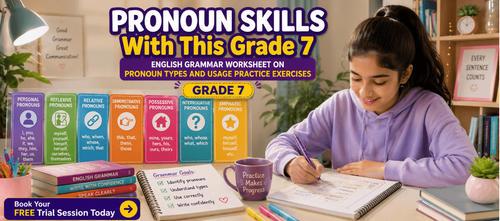

Pronoun Skills with This Grade 7 English Grammar Worksheet on Pronoun Types and Usage Practice Exercises
Pronouns help us avoid repeating nouns and make our sentences smoother and easier to understand. Learning different types of pronouns is an important part of English grammar because students use them every day while speaking, reading, and writing. This Grade 7 English grammar worksheet on Pronoun Types and Usage Practice Exercises gives students engaging activities to improve their grammar skills step by step.
The worksheet includes identifying pronouns, labeling their types, sorting pronouns into categories, completing sentences, correcting errors, and paragraph writing. These exercises help students understand how pronouns work in real-life sentences and improve sentence formation and grammar accuracy.
Download these English grammar worksheets and practice regularly to strengthen your language skills and build a strong foundation. You can also book a free trial to get expert guidance and improve your reading, writing, and comprehension abilities. The worksheets are designed in a simple and structured way to help K–8 students learn grammar concepts easily and use them confidently in everyday communication.
What Is the Topic?
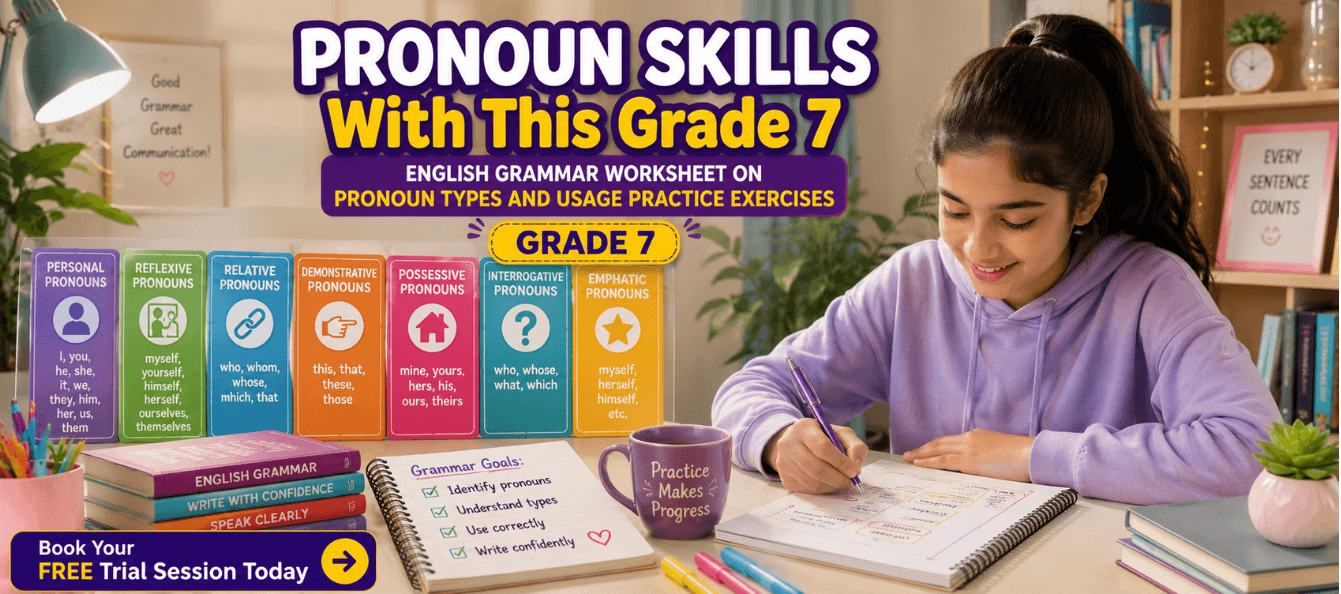
Pronouns are words used instead of nouns. They help make sentences shorter, clearer, and less repetitive. This worksheet focuses on different types of pronouns including personal, reflexive, emphatic, relative, demonstrative, interrogative, and possessive pronouns.
Students learn how to:
1. Identify pronouns in sentences
2. Understand different pronoun types
3. Use pronouns correctly in context
4. Correct pronoun mistakes
5. Write meaningful sentences and paragraphs using pronouns
The worksheet gives structured grammar practice that strengthens sentence understanding and improves communication skills.
What’s in This Worksheet?
1. Underline the pronouns and identify their types in complete sentences.
2. Sort pronouns into the correct categories.
3. Complete fill in the blanks using suitable pronouns.
4. Rewrite incorrect sentences using the correct pronouns.
5. Write a paragraph using different types of pronouns.
6. Practice grammar through sentence correction, classification, sentence completion, and paragraph writing.
7. Improve grammar accuracy for school assignments and examinations.
Definitions, Examples, Techniques, and Tips
Personal pronouns replace names of people or things.
Examples from the worksheet:
I
he
she
they
we
him
it
Reflexive pronouns refer back to the subject.
Examples from the worksheet:
myself
yourself
himself
herself
ourselves
themselves
Emphatic pronouns add emphasis to the subject.
Example:
She herself completed the project.
Relative pronouns connect one part of a sentence to another.
Examples:
who
whom
which
Demonstrative pronouns point to specific things.
Examples:
this
that
these
those
Interrogative pronouns are used in questions.
Examples:
who
whose
what
Possessive pronouns show ownership.
Examples:
mine
yours
hers
theirs
Quick learning tips:
1. Read the full sentence before identifying the pronoun.
2. Reflexive pronouns usually end with “self” or “selves.”
3. Demonstrative pronouns point toward people or things.
4. Interrogative pronouns are commonly used in questions.
5. Possessive pronouns show ownership without using nouns repeatedly.
Why Is It Important to Learn This?
Pronouns are used in almost every sentence in English. Learning pronouns correctly helps students improve grammar, writing, reading, and speaking skills.
This topic helps students:
1. Avoid repeating nouns
2. Write better sentences
3. Speak more clearly
4. Improve grammar accuracy
5. Build confidence in English communication
Pronouns are also important for grammar tests, worksheets, paragraph writing, and school examinations.
Where Will This Knowledge Help You?
Students can use pronoun knowledge in many situations such as:
1. Grammar tests and examinations
2. Writing essays, stories, and paragraphs
3. Reading comprehension activities
4. Classroom speaking activities
5. Everyday English communication
6. Correcting grammar mistakes while writing
7. Completing worksheets accurately
How to Use This Worksheet?
1. Read every sentence carefully before answering.
2. Attempt all questions independently first.
3. Underline and identify pronouns correctly.
4. Sort pronouns into the proper categories.
5. Complete all fill in the blanks carefully.
6. Rewrite incorrect sentences using correct grammar.
7. Compare answers carefully in the exact worksheet order.
8. Practice regularly to improve confidence and grammar accuracy.
Important Tips and Tricks
1. Always check whether the pronoun matches the sentence meaning.
2. Reflexive pronouns should refer back to the subject.
Example:
We enjoyed ourselves.
3. Relative pronouns connect parts of a sentence properly.
Example:
This is the student who won the prize.
4. Possessive pronouns show ownership clearly.
Example:
This bag is mine.
5. Use object pronouns correctly after action verbs.
Example:
I saw him at the station.
6. While correcting sentences, check pronoun agreement carefully.
7. In paragraph writing, use different pronoun types naturally.
8. Examiners look for correct grammar, sentence structure, and proper pronoun usage.
Complete Answer Key
Exercise 1
1. That is the book _I_ was talking about.
Personal
2. _Who_ opened the window?
Interrogative
3. This is the girl _who_ won the prize.
Relative
4. They helped _themselves_ to the snacks.
Reflexive
5. She _herself_ completed the project.
Emphatic
6. These are _mine_, not yours.
Possessive
7. _I_ asked him about the movie.
Personal
8. _Whose_ bag is this?
Interrogative
9. He is the one _whom_ we met.
Relative
10. _We_ decided to keep it.
Personal
Exercise 2
PERSONAL
he
they
I
she
you
it
REFLEXIVE
herself
yourself
themselves
myself
himself
ourselves
RELATIVE
who
which
whom
DEMONSTRATIVE
these
this
that
those
POSSESSIVE
mine
theirs
hers
yours
INTERROGATIVE
what
whose
EMPHATIC
herself
Exercise 3
1. They invited _themselves_ to the party.
2. _Who_ opened the door?
3. This is the student _who_ won the prize.
4. I gave the book to _him_.
5. This bag is _mine_.
6. We enjoyed _ourselves_ at the picnic.
7. _What_ is your favorite color?
8. He _himself_ painted the wall.
9. The pencil belongs to _her_.
10. _Those_ are my shoes.
Exercise 4
1. Each of the boys must bring his book.
2. Who is coming to the party?
3. That is the man who helped me.
4. I hurt myself while playing.
5. I myself will handle it.
6. This bag is mine.
7. Whose book is this?
8. He himself has done it.
9. This is the girl whose name is Riya.
10. I saw him at the station.
Exercise 5
Yesterday, my friends and I visited a park near our school. We carried our snacks and games with us. My cousin joined us because he wanted to play football. The boy who brought the football was very kind. We enjoyed ourselves throughout the day. Our teacher herself gave us chocolates for keeping the park clean. The water bottles were ours, and the cricket bat was theirs. Everyone enjoyed the picnic because it was exciting and memorable.
Practicing pronouns regularly helps students improve grammar accuracy and sentence-building skills. This Grade 7 English grammar worksheet on Pronoun Types and Usage Practice Exercises gives students meaningful practice through identification, sorting, correction, fill in the blanks, and paragraph writing activities. With regular practice, students can become more confident in using pronouns correctly while speaking and writing.