
Grade 7 Simple, Compound & Complex Sentences [With Examples]
![Grade 7 Simple, Compound & Complex Sentences [With Examples]](https://cdn5.planetspark.in/media/small_Grade_7_Simple_Compound_and_Complex_Sentences_With_Examples_1fb8a461be.png)

English Grammar Worksheet for Grade 7 on Simple, Compound & Complex Sentences
Writing clear and varied sentences is a fundamental skill for students in Grade 7. As students progress in their academic journey, they move beyond simple statements to express more complex thoughts and relationships between ideas. Understanding the different types of sentences—Simple, Compound, and Complex—allows young writers to add depth, flow, and sophistication to their writing. Whether it is for storytelling, essay writing, or answering exam questions, the ability to structure sentences correctly is crucial. This worksheet provides a focused review of these three sentence types, helping students to identify them correctly and use them effectively in their own work.
Download these English grammar worksheets and practice regularly to strengthen your language skills and build a strong foundation. You can also book a free trial to get expert guidance and improve your reading, writing, and comprehension abilities. The worksheets are designed in a simple and structured way to help students learn grammar concepts easily and use them confidently in everyday communication.
What Is the Topic?
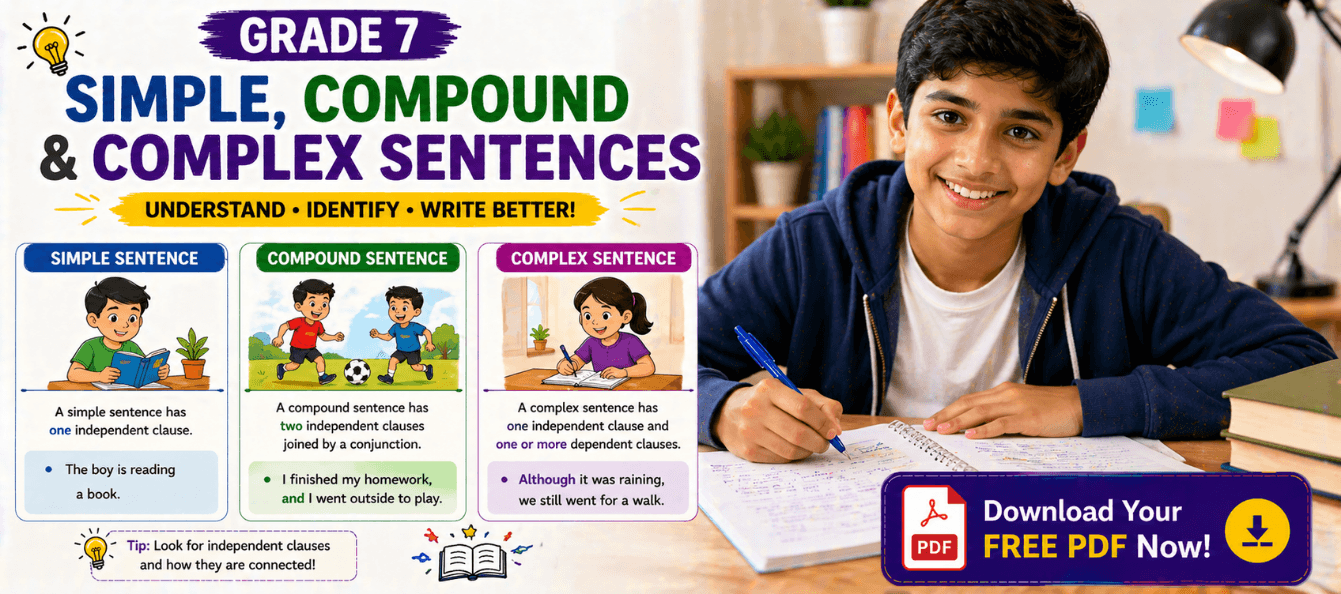
This English grammar worksheet focuses on the three main types of sentence structures used in English: Simple, Compound, and Complex sentences. A Simple Sentence consists of a single independent clause that expresses a complete thought. It has one subject and one predicate, though it can have a compound subject or verb. A Compound Sentence is formed by joining two independent clauses of equal importance using a coordinating conjunction like "and," "but," or "or," or a semicolon. A Complex Sentence contains one independent clause and at least one dependent clause, which relies on the main clause to make sense. Mastering these structures helps students understand how to combine ideas logically.
What’s in This Worksheet?
This worksheet offers a comprehensive mix of exercises designed to test and reinforce the student's understanding of sentence structures. It includes:
1. Multiple Choice Questions where students must identify whether a sentence is Simple, Compound, or Complex.
2. True and False questions that verify the student's knowledge of specific rules regarding clauses and conjunctions.
3. Fill in the Blanks exercises that require students to complete definitions of sentence types using appropriate grammatical terms.
4. Sentence Rewriting tasks where students are directed to convert a simple sentence into a compound or complex one, and vice versa.
5. Paragraph Writing exercises that test the student's ability to apply these concepts in a larger context by filling in missing structural words.
Definitions, Examples, Techniques, and Tips
To successfully complete this worksheet, students need to grasp the core definitions of the terms involved. The worksheet reinforces that a Simple Sentence has exactly one independent clause. An example from the worksheet is "Rahul plays cricket every evening." Even though it is short, it is a complete thought. A Compound Sentence joins two independent clauses. For instance, "Rahul plays cricket and studies daily" connects two actions with the conjunction "and."
A Complex Sentence uses subordinating conjunctions to link an independent clause with a dependent one. A key technique discussed in the True/False section is recognizing that dependent clauses cannot stand alone. For example, in "Because it was late, Diya continued," the part "Because it was late" is dependent. It relies on the second part to make sense.
One helpful tip is to look for the conjunctions. Words like "and," "but," "or," "so," and "yet" (often remembered as FANBOYS) usually signal a Compound Sentence. Words like "because," "although," "since," "when," and "if" usually signal a Complex Sentence because they introduce a dependent clause. If a sentence has no such conjunctions joining two parts, it is likely a Simple Sentence.
Why Is It Important to Learn This?
Learning to distinguish between and construct these different sentence types is vital for writing maturity. Relying only on simple sentences can make writing sound choppy or repetitive. Compound sentences allow students to show the relationship between two related ideas of equal importance, such as cause and effect or contrast. Complex sentences enable students to emphasize one idea over another or to provide background information. For a Grade 7 student, this knowledge is essential for reading comprehension, as it helps in breaking down complicated texts found in stories and textbooks.
Where Will This Knowledge Help You?
Proficiency in sentence structures helps in almost every area of the curriculum. In English exams, students are frequently asked to transform sentences or identify sentence types. In essay and narrative writing, varying sentence structure keeps the reader engaged and improves the flow of the text. In subjects like Science and History, being able to write complex sentences allows students to explain processes and cause-effect relationships clearly. Furthermore, understanding these rules helps in editing one's own work to fix errors like run-on sentences or sentence fragments.
How to Use This Worksheet?
To get the most benefit from this worksheet, students should follow a systematic approach:
1. Start by reading the definitions in the True/False and Fill-in-the-Blanks sections to refresh your memory of the rules.
2. In the Multiple Choice section, look for the verbs and conjunctions first to determine the sentence type before selecting an option.
3. For the Sentence Rewriting section, carefully read the direction (e.g., "Change to Compound Sentence") and ensure you use the correct type of conjunction to join the clauses.
4. For the Paragraph exercise, read the entire passage first to understand the context before choosing the correct connecting words.
5. Use the Answer Key provided below to verify your answers and understand the logic behind each correct response.
Important Tips and Tricks
Here are some strategies to help you master sentence structures and avoid common mistakes:
1. Count the Clauses: A quick way to identify the sentence type is to count the subject-verb pairs. One pair usually means Simple. Two equal pairs joined by "and/but" means Compound. Two pairs where one depends on the other means Complex.
2. Spot the Markers: Look for subordinating conjunctions (because, although, if) as instant indicators of a Complex Sentence.
3. Check for Semicolons: A semicolon between two parts of a sentence often indicates a Compound Sentence without a conjunction.
4. Stand-Alone Test: Cover up part of the sentence. If both parts make sense on their own, it is Compound. If one part does not make sense, it is Complex.
5. Avoid Run-Ons: When joining two independent clauses, always use a coordinating conjunction or a semicolon; never just a comma (this is called a comma splice).
6. Subject Agreement: Ensure that when you combine sentences, the subjects and verbs in both clauses agree with each other and with the tense of the sentence.
Complete Answer Key
Exercise No. 1
1. b) Rahul plays cricket every evening. (Simple)
2. a) Anjali sang and Arjun played tabla. (Compound)
3. b) Neha stayed home because she was ill. (Complex)
4. b) The dog barked loudly at the stranger. (Simple)
5. a) Kartik studied hard, so he passed. (Compound)
6. a) When the bell rang, the students stood. (Complex)
7. b) Diya likes to read books. (Simple)
8. a) Pooja likes tea, but Aryan likes milk. (Compound)
9. a) Although it was cold, Rohan went out. (Complex)
10. b) The train arrived late at the station. (Simple)
Exercise No. 2
1. True
2. True
3. False (Complex sentences have main AND dependent clauses)
4. False (Simple sentences CAN have compound subjects)
5. True
6. True
7. True
8. False (A compound sentence has two subjects and predicates, one for each clause)
9. False (A simple sentence can have many words)
10. True
Exercise No. 3
1. A Simple Sentence has one independent clause.
2. A Compound Sentence has two independent clauses.
3. A Complex Sentence has one independent clause.
4. Compound sentences use coordinating conjunctions.
5. Complex sentences use subordinating conjunctions.
6. A Simple Sentence has one subject-verb pair.
7. ‘And', 'but', 'or' join compound (or independent) sentences.
8. Because', 'although' join complex (or independent) sentences.
9. Compound sentences use a semicolon between parts.
10. A Complex Sentence has a dependent clause too.
Exercise No. 4
1. Change to: Compound Sentence
Answers may vary. (Possible answer: The sun rose, and the birds began to sing.)
2. Change to: Complex Sentence
Answers may vary. (Possible answer: He likes tea whereas she likes coffee instead.)
3. Change to: Compound Sentence
Answers may vary. (Possible answer: It rained, so the match was cancelled.)
4. Change to: Complex Sentence
Answers may vary. (Possible answer: Although she was ill, she went to school.)
5. Change to: Compound Sentence
Answers may vary. (Possible answer: Rahul studied hard, so he passed the exam.)
6. Change to: Simple Sentence
Answers may vary. (Possible answer: I have a pen and a notebook.)
7. Change to: Complex Sentence
Answers may vary. (Possible answer: Because he ran fast, he caught the morning bus.)
8. Change to: Complex Sentence
Answers may vary. (Possible answer: While Neha sang, Kartik played the guitar.)
9. Change to: Compound Sentence
Answers may vary. (Possible answer: Anjali was tired, but she finished her work.)
10. Change to: Complex Sentence
Answers may vary. (Possible answer: He is the boy who is wearing a cap.)
Exercise No. 5
Answers may vary. (Students should use the hints provided to fill in the blanks: Exactly, Coordinating, Subordinate, Connector, Comma, Single, Secondary, Punctuation.)
Mastering sentence types is a powerful tool for any student. By practicing these transformations and identifications, Grade 7 students can improve the clarity and impact of their writing. Keep working through these exercises to build a strong intuitive sense of English grammar, which will serve you well in all your future writing tasks.