
Grade 7 Summary Writing: English Grammar Worksheet (Free PDF)

Grade 7 Summary Writing: English Grammar Worksheet (Free PDF)
Have you ever read a wonderful story and wanted to tell someone what it was about in just a few sentences? That is exactly what writing a summary means. In Grade 7, you learn how to find the most important parts of a story and write them in your own words. This English grammar worksheet on writing summaries helps you practice reading a short story, understanding its main ideas, and answering different types of questions. Whether you are retelling a story to a friend or studying for an exam, knowing how to write a good summary makes your communication clear and effective.
Download these English grammar worksheets and practice regularly to strengthen your language skills and build a strong foundation. You can also book a free trial to get expert guidance and improve your reading, writing, and comprehension abilities. The worksheets are designed in a simple and structured way to help K–8 students learn grammar concepts easily and use them confidently in everyday communication.
What Is the Topic?
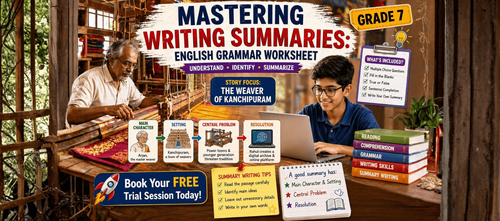
Writing a summary means retelling the main points of a story or article in a short and clear way. A good summary includes the main character, the setting, the central problem, and how the problem is resolved. This worksheet helps students learn how to write a good summary. Students read a short story called “The Weaver of Kanchipuram” and then answer multiple choice questions, fill in the blanks, true and false statements, sentence completion exercises, and write a short summary paragraph. By practicing these activities, students understand how to identify important details and leave out unnecessary information.
What’s in This Worksheet?
1. Multiple choice questions to test understanding of the story “The Weaver of Kanchipuram”
2. Fill in the blanks to check memory and vocabulary from the story
3. True and false statements to help pay attention to details
4. Sentence completion to finish important ideas from the story
5. Paragraph writing activity to write a summary of the story
6. A short story example about a weaver named Arjan and his grandson Rahul
7. Questions about setting, characters, craft, threat, solution, and theme
Definitions, Examples, Techniques, and Tips
This worksheet focuses on understanding and writing summaries based on a short story. Here are important definitions and examples from the worksheet:
- Summary – A short retelling of the main points of a story.
- Setting – Where the story takes place. In the story, the setting is Kanchipuram.
- Main character – The most important person in the story. In the story, Arjan is the master weaver.
- Central problem – The main difficulty the character faces. In the story, power looms produce sarees faster, and the younger generation prefers coding to weaving.
- Resolution – How the problem is solved. In the story, Rahul uses his computer skills to create a digital archive and online platform.
Techniques for writing a good summary (from the worksheet):
- Include the main character and setting.
- Include the central problem.
- Include how the problem is resolved.
Through exercises such as multiple choice questions, fill in the blanks, and sentence completion, students develop a clear understanding of how to read a story carefully and write a summary.
Why Is It Important to Learn This?
Learning to write summaries helps students communicate clearly. It allows them to:
- Share the main points of a story without getting lost in small details
- Understand what they read by identifying important information
- Organize their thoughts in a logical way
This skill is essential for writing and speaking in school and everyday life. It also builds a strong reading comprehension foundation for future learning. The worksheet shows that even a story about weaving can teach us about technology, tradition, and working together.
Where Will This Knowledge Help You?
Understanding how to write summaries helps students in:
- School exams where short answer questions are asked
- Writing answers, book reports, and paragraphs
- Participating in classroom discussions about stories
- Retelling stories clearly to friends and family
It also improves reading comprehension as students learn to find the most important parts of any story.
How to Use This Worksheet?
1. Attempt each question independently without help
2. Carefully read the short story “The Weaver of Kanchipuram” on page 3
3. Review your answers after completing the worksheet
4. Compare your responses with the answer key provided below
5. Practice regularly to improve accuracy
The solutions follow the exact worksheet order, so students should compare their answers carefully.
Important Tips and Tricks
1. Read the passage twice – first for understanding, then with a pen to underline important details like characters, setting, problem, and solution
2. Watch out for tricky true/false statements – for example, “Electric motors preserved hand weaving” is false because they threatened it
3. Use the exact words from the passage for fill-in-the-blanks – for example, “Arjan worked with fine silk threads”
4. For paragraph writing, follow the structure given – include the main character and setting, the central problem, and how the problem is resolved
5. Pay attention to what the main threat is and how the characters solve it – these are common exam questions
6. When the worksheet has an open-ended writing task, write your answer based only on the story provided
7. Examiners expect you to include only the most important information in a summary – leave out small details
Complete Answer Key
Page 3 – The Weaver of Kanchipuram (No questions on this page, just the story passage)
Page 4 – Exercise No. 1 (Multiple Choice Questions)
Choose the most appropriate option based on the story “The Weaver of Kanchipuram”
1. Where is the story set?
b) Kanchipuram
2. What makes handloom unique?
c) Soulful flaws
3. How long has Arjan woven?
c) Fifty years
4. What is the main threat?
b) Power looms
5. What is Rahul's skill?
a) Computer code
6. Who visited the workshop?
b) A historian
7. What is Arjan's craft?
a) Silk weaving
8. What did Rahul propose?
c) Digital archive
9. How did Arjan feel finally?
c) At peace
10. What is the story's theme?
a) Art & tech.
Page 5 – Fill in the Blanks
1. Arjan worked with fine silk threads.
2. The town air hummed with the rhythmic clatter of looms.
3. Masterpieces mirrored the vibrant sunsets of Tamil Nadu.
4. Arjan's hands moved with precision.
5. The grandson is named Rahul.
6. Heritage was threatened by electric motors.
7. Hand-woven silk has beautiful imperfections.
8. Rahul proposed a digital archive.
9. Survival needed a bridge between the wooden loom and the silicon chip.
10. Arjan felt a sense of peace.
Page 6 – True and False
1. Sunsets inspired the silk. (True)
2. The air in the town was dry and crisp. (False – it hummed with clatter of looms)
3. Arjan used cotton threads. (False – he used silk)
4. Rahul watched from a corner. (True)
5. Three silks were interlocked. (True)
6. Arjan made a wooden bridge. (False – the bridge was between loom and chip)
7. Myths were part of the art. (True)
8. Rahul connected weavers globally. (True)
9. Marketing was quite old-age. (False – new-age marketing helped)
10. Electric motors preserved hand weaving. (False – they threatened heritage)
Page 7 – Sentence Completion
1. The town is described as a bustling town.
2. Arjan's masterpieces were like vibrant sunsets of Tamil Nadu.
3. Younger weavers felt great envy.
4. Power looms are known for speed.
5. The 'korvai' is a type of border pattern.
Page 8 – Sentence Completion (continued)
6. Electric motors created a threat to heritage.
7. The visiting historian was a textile historian.
8. Hand-woven silk is known for beautiful imperfections / soulful flaws.
9. Rahul saw his grandfather demonstrating interlocking of three silks.
10. New-age marketing helped to attract young villagers back to the looms.
Page 9 – Exercise No. 5
Write a summary of the story ‘The Weaver of Kanchipuram’ in 80-100 words. Include: The main character and setting, the central problem and how the problem is resolved.
Note: This is a writing task. The answer will be written by the student. Based on the worksheet, the summary should include:
- Main character: Arjan, the master weaver
- Setting: Kanchipuram, a bustling town known for weaving
- Central problem: Power looms produce sarees faster, younger generation prefers coding, Arjan fears heritage is being silenced
- Resolution: A textile historian visits and explains the value of hand-woven silk. Rahul, Arjan’s grandson, proposes a digital archive of designs and an online platform to connect weavers with global collectors. Together, they build a bridge between tradition and technology.
Answers may vary as long as they include all three required parts and are based only on the story in the worksheet.
Page 10 – Get more worksheets (No questions on this page)
Practicing this English grammar worksheet for Grade 7 on writing summaries helps students become more confident in reading comprehension and expressing main ideas clearly. With regular practice, students can improve their grammar and writing skills and share the key points of any story effectively in both writing and speaking.