
Grade 8 Adjective Order and Usage Worksheet for Better Writing


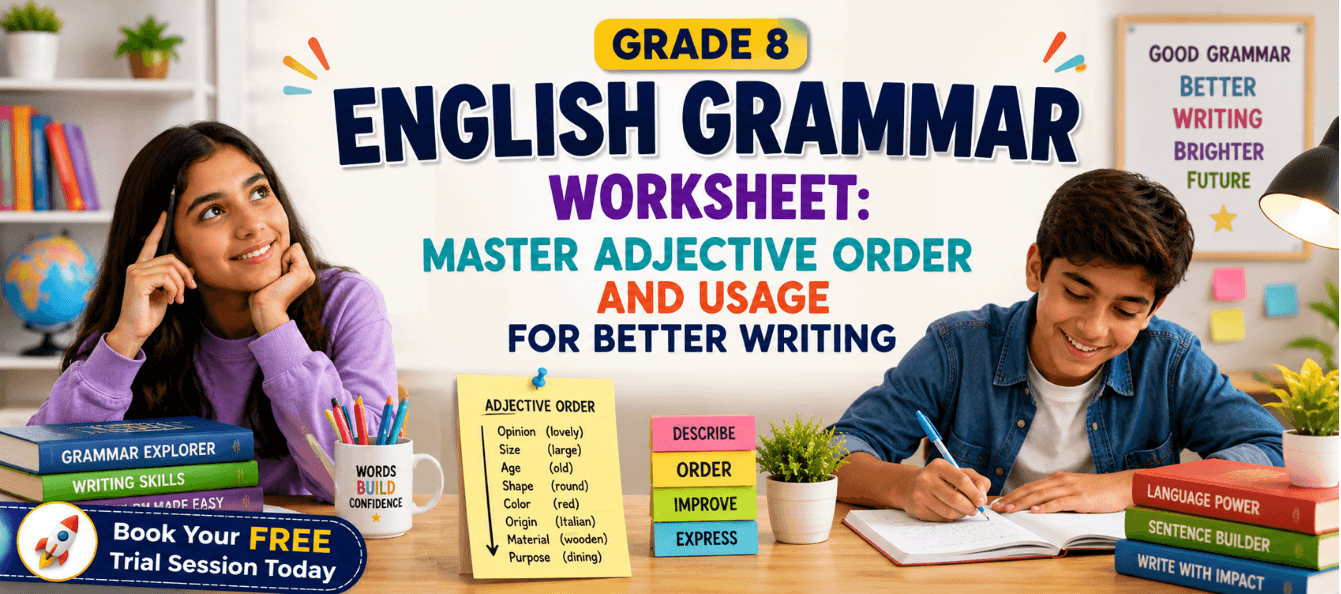
Grade 8 English Grammar Worksheet: Master Adjective Order and Usage for Better Writing
Adjectives help make sentences more descriptive, interesting, and meaningful. They tell us more about people, places, animals, and things. In Grade 8, learning adjective order and usage is important because multiple adjectives are often used together in a sentence. Using them in the correct order makes writing clearer and more natural. This worksheet provides engaging practice through underlining activities, multiple-choice questions, fill-in-the-blanks, and sentence-writing tasks. By completing these exercises, students can strengthen their grammar skills and become more confident writers and speakers.
Download these English grammar worksheets and practice regularly to strengthen your language skills and build a strong foundation. You can also book a free trial to get expert guidance and improve your reading, writing, and comprehension abilities. The worksheets are designed in a simple and structured way to help K–8 students learn grammar concepts easily and use them confidently in everyday communication.
What Is the Topic?
This Grade 8 worksheet focuses on adjectives, their order, and their correct use in sentences. Adjectives describe nouns and provide additional information about them. When more than one adjective is used before a noun, they are usually arranged in a particular order so that the sentence sounds natural and grammatically correct.
Students are expected to:
• Identify adjectives in sentences.
• Recognize whether adjectives follow the correct order.
• Select correctly ordered adjective sequences.
• Complete sentences using properly arranged adjectives.
• Write original sentences using adjectives in the correct order.
What’s in This Worksheet?
1. Underline the adjectives in given sentences and examine whether they follow the correct order.
2. Multiple-choice questions that require students to choose the sentence with the correct adjective order.
3. Fill-in-the-blank exercises where students complete sentences using correctly ordered adjectives.
4. Sentence-writing activities that encourage students to create their own examples using specific adjectives.
5. Practice opportunities that strengthen grammar accuracy, sentence construction, and writing skills.
6. Activities that help students apply adjective order rules in practical contexts.
7. Exercises designed to improve understanding of descriptive language and sentence fluency.
Definitions, Examples, Techniques, and Tips
Definitions
• Adjectives are words that describe nouns.
• Adjectives provide details about appearance, size, color, material, age, origin, and other qualities.
Examples From the Worksheet
• beautiful long red dress
• old wooden Italian chair
• three large brown bears
• tiny old green cottage
• shiny round silver coin
• lovely big blue ocean
• fresh juicy red strawberries
• frightened small grey kitten
• elegant black leather boots
• huge ancient stone temple
Techniques
• Read all adjectives carefully before the noun.
• Check whether the adjectives sound natural when spoken aloud.
• Compare answer choices carefully before selecting one.
• Practice arranging descriptive words before the noun logically.
Quick Learning Tips
• Identify every adjective before finding the noun.
• Read the complete noun phrase together.
• Look for descriptions of size, color, shape, material, age, and origin.
• Practice writing descriptive noun phrases regularly.
• Review examples from the worksheet for better understanding.
Why Is It Important to Learn This?
Learning adjective order and usage helps students communicate clearly and effectively. Correct adjective order makes sentences easier to understand and more pleasant to read. It also improves writing quality by allowing students to describe people, places, objects, and experiences accurately.
This skill supports academic success because descriptive writing appears in classroom assignments, examinations, creative writing tasks, and everyday communication. Strong grammar habits also improve confidence when speaking and writing.
Where Will This Knowledge Help You?
• School examinations that test grammar and sentence structure.
• Creative writing activities that require detailed descriptions.
• Paragraph and essay writing assignments.
• Classroom discussions and presentations.
• Reading comprehension tasks involving descriptive language.
• Everyday communication where clear descriptions are needed.
• Story writing and narrative exercises.
How to Use This Worksheet?
1. Read each question carefully before answering.
2. Attempt every exercise independently before checking solutions.
3. Compare your answers with the answer key in the exact worksheet order.
4. Review any mistakes and understand why a different answer is correct.
5. Practice similar adjective combinations to strengthen your understanding.
6. Revisit challenging questions and complete them again for reinforcement.
7. Use the sentence-writing section to develop confidence in creating your own examples.
8. Ensure that answers are checked carefully according to the same sequence as presented in the worksheet.
Important Tips and Tricks
1. Identify all adjectives before identifying the noun they describe.
2. Read adjective groups together rather than one word at a time.
3. Avoid changing the order randomly when several adjectives appear before a noun.
4. Pay close attention to multiple-choice options because only one sequence is fully correct.
5. For fill-in-the-blank questions, ensure all adjectives fit naturally before the noun.
6. In sentence-writing activities, use every given adjective meaningfully.
7. Check spelling and punctuation when writing complete sentences.
8. Read completed sentences aloud to confirm they sound natural.
9. Focus on accuracy rather than speed during grammar practice.
10. Review examples from earlier exercises before attempting writing tasks.
Complete Answer Key
Exercise:1
Underline all the adjectives and check if they follow the correct order.
1. She wore a _beautiful_ _long_ _red_ dress. – Correct
2. He bought an _old_ _wooden_ _Italian_ chair. – Incorrect
3. We saw _three_ _large_ _brown_ bears. – Correct
4. They live in a _tiny_ _old_ _green_ cottage. – Correct
5. I found a _shiny_ _round_ _silver_ coin. – Correct
6. The artist painted a _lovely_ _big_ _blue_ ocean. – Correct
7. We picked _fresh_ _juicy_ _red_ strawberries. – Correct
8. He rescued a _frightened_ _small_ _grey_ kitten. – Correct
9. She wore _elegant_ _black_ _leather_ boots. – Correct
10. They saw a _huge_ _ancient_ _stone_ temple. – Correct
Exercise: 2
Which is correct?
1. ✓ a. She wore a lovely red silk dress.
2. ✓ c. He drove an old black German car.
3. ✓ a. They saw three large brown horses.
4. ✓ a. I found a shiny round golden coin.
5. ✓ b. A noisy Italian big city.
6. ✓ a. A cute little white rabbit.
7. ✓ c. She adopted a quiet small French poodle.
8. ✓ c. He bought an antique square wooden table.
Exercise: 3
Fill in the blank with correctly ordered adjectives.
1. She wore a beautiful red silk scarf to the party.
2. They visited a charming old French village.
3. He bought a sturdy wooden chair.
4. They found a large ancient statue.
5. He gifted her a small metal box.
6. We adopted a cute little white kitten.
7. She drew a picture of a vast blue ocean.
8. I picked a sweet ripe mango.
9. We sat on a soft round cushion.
10. She saw a tiny little bird.
Exercise:4
Write a sentence using the adjectives in the correct order.
1. lovely
She received a lovely red bouquet from her friend.
2. plastic
The child played with a small plastic toy.
3. tiny
We found a tiny white shell on the beach.
4. wooden
He placed the books on a sturdy wooden shelf.
5. old
They visited an old stone castle during their trip.
Practicing adjective order and usage regularly helps Grade 8 students write more clearly and confidently. By completing activities such as identifying adjectives, choosing correct sequences, filling in blanks, and writing original sentences, students develop stronger grammar skills and improve their descriptive writing abilities. Continued practice with adjective order will make communication more natural, accurate, and effective in both academic work and everyday situations.