
Grade 8 Analytical Vocabulary Sentences Practice PDF
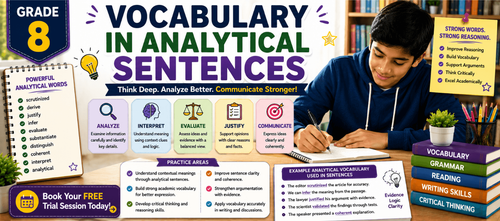

Strengthen Critical Thinking with This Grade 8 Vocabulary in Analytical Sentences Worksheet
Analytical vocabulary helps students explain ideas clearly, evaluate information logically, and support opinions with evidence. This Grade 8 Vocabulary in Analytical Questions Worksheet strengthens reasoning, interpretation, and academic communication skills through engaging vocabulary exercises and analytical writing activities.
Students learn how words such as “scrutinized,” “justify,” “infer,” “evaluate,” and “coherent” improve analytical thinking and make arguments more logical and precise. Through contextual exercises, learners practice interpreting information, analyzing evidence, and using advanced academic vocabulary naturally in discussions and writing tasks.
Download these English grammar worksheets and practice regularly to strengthen your language skills and build a strong foundation. You can also book a free trial to get expert guidance and improve your reading, writing, and comprehension abilities. The worksheets are designed in a simple and structured way to help K–8 students learn grammar concepts easily and use them confidently in everyday communication.
What Is the Topic?
Vocabulary in analytical questions focuses on words commonly used in reasoning, interpretation, debates, research, and evidence-based writing. This worksheet helps students improve analytical thinking and strengthen academic vocabulary through contextual learning.
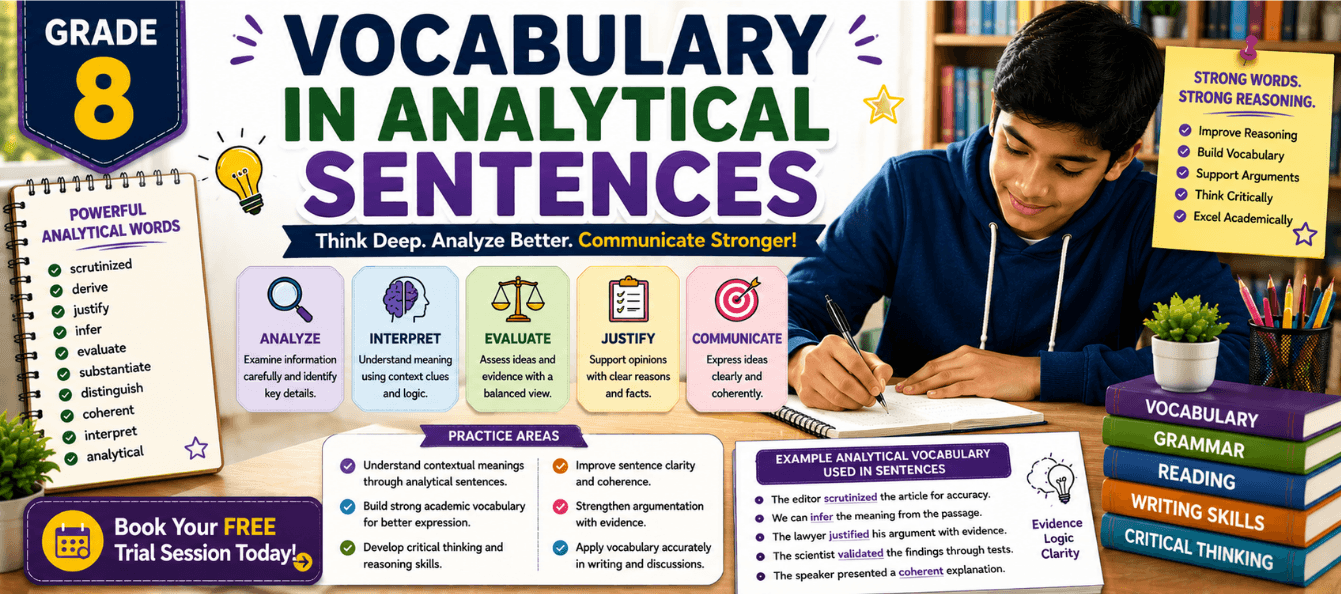
Students practice vocabulary such as:
- scrutinized
- derive
- justify
- infer
- evaluate
- substantiate
- distinguish
- coherent
- interpret
- analytical
The worksheet encourages students to carefully examine information, interpret meaning logically, and communicate ideas using strong analytical vocabulary.
What’s in This Worksheet?
1. Multiple choice questions based on analytical vocabulary
2. Fill in the blanks activities using reasoning-based words
3. True and False exercises focused on analytical language
4. Underline-the-word activities using analytical vocabulary
5. Sentence rewriting tasks using advanced analytical terms
6. Reading-based vocabulary interpretation exercises
7. Writing practice focused on reasoning and evidence
Definitions, Examples, Techniques, and Tips
This worksheet helps students understand how analytical vocabulary improves logical thinking and academic communication. Students learn how advanced reasoning words strengthen explanations, arguments, and interpretations.
Examples included in the worksheet are:
- “The editor carefully scrutinized the article.”
- “Readers must infer hidden meanings from the poem.”
- “The lawyer used evidence to substantiate the argument.”
- “The report presented a coherent explanation.”
Students also practice vocabulary such as:
- synthesize
- correlate
- deduce
- validate
- formulate
- speculate
- concise
- objective
- rational
- empirical
The worksheet helps students:
- Improve analytical thinking
- Strengthen reasoning skills
- Build academic vocabulary
- Support arguments logically
- Interpret information more accurately
Why Is It Important to Learn This?
Analytical vocabulary helps students explain opinions clearly, examine evidence carefully, and understand complex ideas more effectively. Strong reasoning vocabulary also improves academic writing and discussion skills.
This grammar and vocabulary skill improves:
- Reading comprehension
- Analytical writing
- Debate and discussion skills
- Critical thinking
- Evidence-based reasoning
- Academic communication
Students who understand analytical vocabulary usually become more confident thinkers and stronger communicators.
Where Will This Knowledge Help You?
Understanding analytical vocabulary helps students in many academic and real-life situations, including:
- School grammar assessments
- Reading comprehension exercises
- Debate competitions
- Essay and paragraph writing
- Research and project work
- Presentation activities
- Higher-level English assignments
These skills also help students organize thoughts clearly and communicate ideas more logically.
How to Use This Worksheet?
1. Read each sentence carefully before selecting a vocabulary word.
2. Use context clues to understand analytical vocabulary naturally.
3. Focus on logic, reasoning, and evidence while answering.
4. Attempt all exercises independently before checking answers.
5. Compare your responses carefully with the answer key below.
6. Practice using analytical vocabulary in discussions and writing regularly.
7. Read rewritten sentences aloud to improve fluency and understanding.
The solutions follow the exact worksheet order, so students should compare their answers carefully.
Important Tips and Tricks
1. Analytical vocabulary strengthens logical thinking and reasoning.
2. Words like “evaluate,” “infer,” and “justify” are common in academic writing.
3. Evidence-based arguments sound stronger and more convincing.
4. Always read the full sentence before selecting a vocabulary word.
5. In underline-the-word activities, focus only on the word that does not match sentence meaning.
6. Context clues help students interpret analytical vocabulary more accurately.
7. Rewriting tasks strengthen vocabulary application skills.
8. Reading informational and opinion-based texts helps improve analytical vocabulary naturally.
Complete Answer Key
Exercise No. 1
Multiple Choice Questions
1. scrutinized
2. derive
3. justify
4. infer
5. evaluate
6. substantiate
7. distinguish
8. coherent
9. interpret
10. analytical
Exercise No. 2
Fill in the Blanks
1. synthesize
2. correlate
3. deduce
4. validate
5. formulate
6. speculate
7. categorize
8. concise
9. objective
10. rational
Exercise No. 3
True or False
1. True
2. False
3. False
4. True
5. True
6. False
7. True
8. False
9. True
10. True
Exercise No. 4
Underline the Analytical Word
1. disconnected
2. explicit
3. superficial
4. consistent
5. ambiguous
6. empirical
7. illogical
8. lengthy
9. neutral
10. verified
Exercise No. 5
Rewrite Using Analytical Vocabulary (Sample Answers)
1. The teacher analyzed the essay carefully.
2. The student summarized the chapter briefly for the class.
3. The scientist synthesized findings from different experiments.
4. The speaker justified her opinion with strong reasons.
5. The journalist interpreted the meaning of the survey results.
6. The teacher asked students to formulate a clear plan for the project.
7. The editor carefully critiqued the weak argument in the article.
8. The principal assessed the performance after observing all groups.
9. The debater gave a persuasive argument that convinced the audience.
10. The teacher asked the student to elaborate on the answer in greater detail.
Practicing this Grade 8 Vocabulary in Analytical Questions Worksheet helps students strengthen reasoning skills, improve analytical vocabulary, and develop stronger academic communication abilities. With regular practice, students can interpret information more accurately, support arguments confidently, and build more effective analytical writing skills.