
Grade 8 Argumentative Writing Vocabulary Practice Worksheet
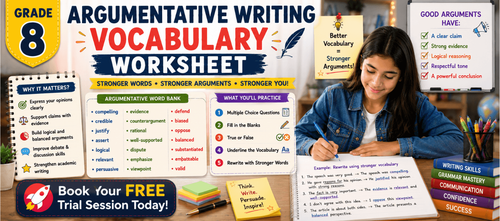

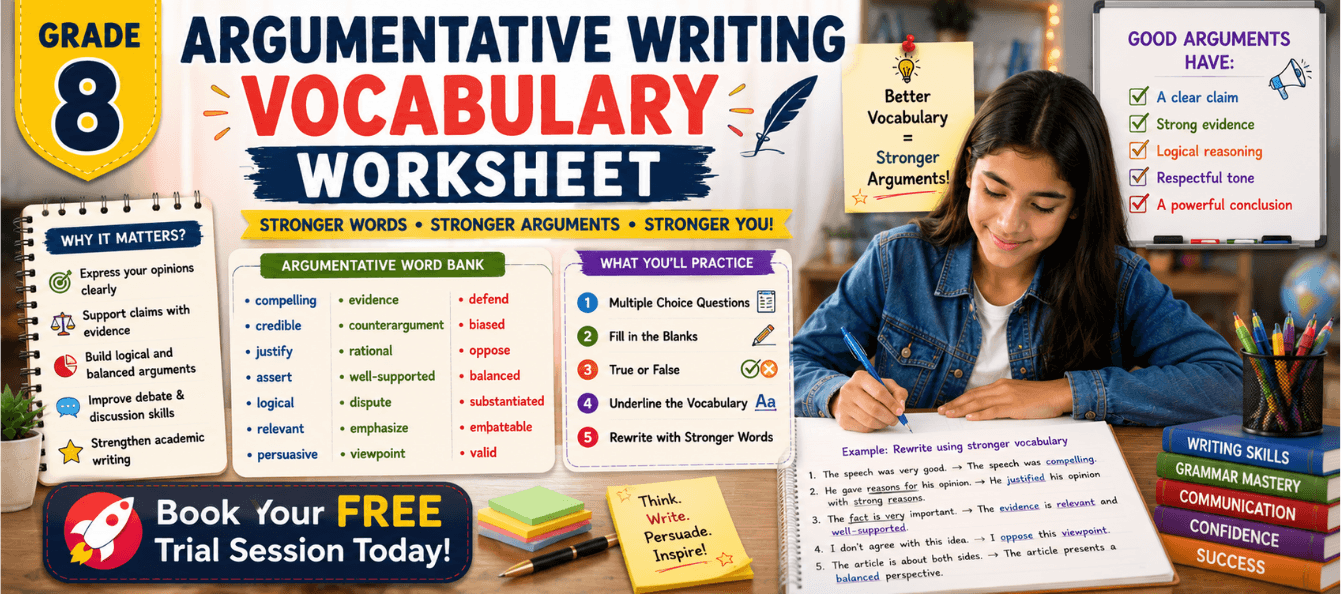
Practice Strong Debate Vocabulary with This Grade 8 Vocabulary Worksheet for Argumentative Writing
Argumentative writing becomes more effective when students use clear reasoning, persuasive vocabulary, and logical explanations to support their opinions. This Grade 8 Vocabulary Worksheet for Argumentative Writing helps students strengthen debate and opinion-writing skills through engaging vocabulary exercises and sentence-based activities.
Students learn how words such as “compelling,” “credible,” “justify,” “logical,” and “persuasive” improve argumentative writing and help writers communicate opinions more confidently. Through contextual activities, learners practice supporting claims with evidence, presenting balanced viewpoints, and using stronger academic vocabulary naturally in discussions and essays.
Download these English grammar worksheets and practice regularly to strengthen your language skills and build a strong foundation. You can also book a free trial to get expert guidance and improve your reading, writing, and comprehension abilities. The worksheets are designed in a simple and structured way to help K–8 students learn grammar concepts easily and use them confidently in everyday communication.
What Is the Topic?
Vocabulary in argumentative writing focuses on words commonly used in debates, opinion essays, discussions, persuasive speeches, and analytical writing tasks. This Grade 8 worksheet helps students understand how argumentative vocabulary improves clarity, reasoning, and communication.
Students practice vocabulary such as:
- compelling
- justify
- credible
- dispute
- assert
- logical
- persuasive
- evidence
- viewpoint
- defend
The worksheet encourages students to use these words naturally while reading argumentative sentences, completing vocabulary tasks, and rewriting ideas using stronger academic language.
What’s in This Worksheet?
1. Multiple choice questions based on argumentative vocabulary
2. Fill in the blanks activities using persuasive and logical vocabulary
3. True and False exercises focused on argumentative word usage
4. Underline-the-word activities using debate vocabulary
5. Sentence rewriting tasks using stronger argumentative vocabulary
6. Reading-based vocabulary activities connected to opinion writing
7. Writing practice focused on persuasion, reasoning, and evidence
Definitions, Examples, Techniques, and Tips
This worksheet helps students understand how strong vocabulary improves argumentative writing and debate skills. Students learn how persuasive and logical language helps support opinions effectively.
Examples included in the worksheet are:
- “The debate included a highly compelling argument.”
- “Students used facts to justify their opinion.”
- “The article used credible scientific sources.”
- “The evidence supported the writer’s viewpoint strongly.”
Students also practice vocabulary such as:
- reinforce
- balanced
- biased
- reasonable
- criticism
- coherent
- substantiated
- articulate
- defensible
- valid
The worksheet helps students:
- Improve persuasive writing
- Build logical reasoning skills
- Support arguments using evidence
- Develop stronger debate vocabulary
- Express opinions clearly and confidently
Why Is It Important to Learn This?
Argumentative vocabulary helps students explain opinions clearly and support ideas with logical reasoning. Strong persuasive vocabulary improves essay writing, debates, and analytical thinking.
This grammar and vocabulary skill improves:
- Opinion writing
- Debate skills
- Persuasive essays
- Analytical thinking
- Classroom discussions
- Academic communication
Students who understand argumentative vocabulary often become more confident speakers and writers.
Where Will This Knowledge Help You?
Understanding argumentative vocabulary helps students in many academic and real-life situations, including:
- Debate competitions
- Opinion essay writing
- Classroom discussions
- Presentation activities
- Reading comprehension exercises
- Persuasive speech writing
- Higher-level analytical writing
These skills also help students communicate ideas more logically and support opinions more effectively.
How to Use This Worksheet?
1. Read each argumentative sentence carefully before selecting vocabulary words.
2. Use context clues to understand unfamiliar persuasive vocabulary.
3. Focus on how evidence and reasoning support arguments.
4. Attempt all exercises independently before checking answers.
5. Compare your responses carefully with the answer key below.
6. Practice using argumentative vocabulary in discussions and essays regularly.
7. Read debate-style paragraphs aloud to improve fluency and confidence.
The solutions follow the exact worksheet order, so students should compare their answers carefully.
Important Tips and Tricks
1. Strong argumentative vocabulary helps opinions sound more logical and convincing.
2. Persuasive writing should include evidence and clear reasoning.
3. Words like “justify,” “defend,” and “reinforce” help support arguments effectively.
4. Balanced arguments consider more than one viewpoint.
5. In underline-the-word activities, focus only on persuasive vocabulary words.
6. Logical arguments connect ideas clearly and avoid unrelated details.
7. Practice supporting opinions with evidence in classroom discussions.
8. Reading opinion articles regularly helps students improve persuasive vocabulary.
Complete Answer Key
Exercise No. 1
Multiple Choice Questions
1. compelling
2. justify
3. credible
4. dispute
5. assert
6. logical
7. emphasize
8. debatable
9. well-supported
10. relevant
Exercise No. 2
Fill in the Blanks
1. persuasive
2. reinforce
3. balanced
4. evidence
5. oppose
6. biased
7. defend
8. reasonable
9. viewpoint
10. criticism
Exercise No. 3
True or False
1. False
2. True
3. True
4. False
5. True
6. False
7. True
8. False
9. True
10. True
Exercise No. 4
Underline the Argumentative Vocabulary
1. assertive
2. debatable
3. objective
4. coherent
5. compelling
6. substantiated
7. critical
8. defensible
9. valid
10. articulate
Exercise No. 5
Rewrite Using Stronger Vocabulary (Sample Answers)
1. The speaker presented a persuasive argument that influenced many listeners.
2. Facts and examples helped reinforce the writer’s viewpoint.
3. The lawyer justified why the decision was correct.
4. The article clearly emphasized the importance of healthy eating.
5. The student shared a logical viewpoint during the debate.
6. The scientist used evidence to support the conclusion.
7. The explanation followed rational reasoning throughout the discussion.
8. The campaign used persuasive language that convinced many people.
9. The writer defended the argument against criticism during the discussion.
10. The report explained the issue using rational reasoning.
Practicing this Grade 8 Vocabulary Worksheet for Argumentative Writing helps students strengthen persuasive vocabulary, improve debate skills, and build confidence in opinion-based writing. With regular practice, students can organize arguments clearly, support ideas effectively, and communicate viewpoints more confidently in academic discussions and essays.