
Grade 8 English Worksheet on Vocabulary in Narrative Contexts
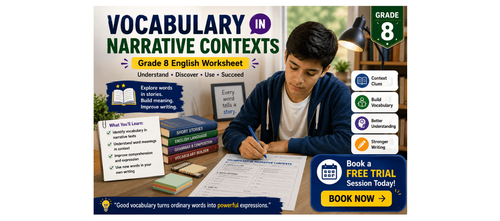

Strengthen Storytelling Skills With This Grade 8 English Grammar Worksheet on Vocabulary in Narrative Context
Stories become more meaningful and engaging when writers use strong vocabulary to describe characters, settings, emotions, and events. This Grade 8 English grammar worksheet on Vocabulary in Narrative Context helps students understand how narrative vocabulary improves storytelling, imagination, and reading comprehension. Through engaging grammar and vocabulary activities, learners practice using descriptive words connected to suspense, dialogue, courage, setting, and dramatic events.
The worksheet introduces important vocabulary words such as crept, suspense, twisting, resonant, boldness, describes, realistic, kindness, and dramatic. Students learn how these words help create imagery, build mood, and improve storytelling. These activities encourage learners to read carefully and use narrative vocabulary confidently in writing and speaking tasks.
With multiple-choice questions, fill in the blanks, true and false activities, vocabulary review, and sentence-writing tasks, this worksheet supports vocabulary development in a structured and creative way. The exercises are useful for grammar practice, narrative comprehension, and exam preparation.
Download these English grammar worksheets and practice regularly to strengthen your language skills and build a strong foundation. You can also book a free trial to get expert guidance and improve your reading, writing, and comprehension abilities. The worksheets are designed in a simple and structured way to help K–8 students learn grammar concepts easily and use them confidently in everyday communication.
What Is the Topic?
Vocabulary in Narrative Context focuses on understanding and using words that support storytelling. This topic helps students improve comprehension by teaching them how vocabulary creates suspense, develops characters, describes settings, and builds emotional connection in stories.
In this Grade 8 English grammar worksheet, students learn how to analyze narrative sentences using meaningful vocabulary words. Learners practice identifying descriptive words, understanding suspense, recognizing realistic dialogue, and interpreting how vocabulary shapes characters and events.
Students are also expected to understand how narrative vocabulary improves imagery and storytelling. By practicing vocabulary in narrative contexts regularly, learners strengthen reading fluency, imagination, and sentence construction skills.
What’s in This Worksheet?
1. Multiple-choice questions that help students select the best narrative vocabulary word for each sentence.
2. Fill in the blanks activities that use vocabulary connected to suspense, courage, dramatic scenes, dialogue, and settings.
3. True and false statements that check understanding of narrative vocabulary, storytelling, dialogue, and imagery.
4. Vocabulary review exercises that focus on identifying descriptive words related to characters, actions, and events.
5. Sentence-writing activities that encourage students to create meaningful sentences using words such as tiptoe, suspense, courage, setting, dialogue, kindness, and dramatic.
6. Structured grammar and vocabulary activities that support narrative comprehension and creative expression.
7. Exercises that help students prepare for grammar-based and comprehension-based exam questions.
Definitions, Examples, Techniques, and Tips
Vocabulary in narrative context refers to the words used in stories to describe characters, actions, settings, emotions, and events. These words help readers imagine scenes clearly and understand the mood of a story.
The worksheet includes examples such as:
“Riya crept into the quiet room.”
“The narrator describes the scene.”
“The plot becomes dramatic.”
These examples help students understand how vocabulary supports storytelling and imagery.
Students also practice vocabulary words such as:
• suspense
• dramatic
• realistic
• kindness
• courage
• setting
• dialogue
• twisting
The worksheet teaches students how descriptive words improve stories and help readers connect with characters and events.
One useful technique while solving narrative vocabulary exercises is to focus on the mood and action of the sentence before selecting an answer. Students should think about which vocabulary word creates the strongest meaning.
Another helpful strategy is to pay attention to imagery and emotional clues. Narrative vocabulary often helps readers visualize scenes and understand character feelings.
Students should also practice writing their own narrative sentences because sentence-building improves vocabulary retention and storytelling confidence.
Why Is It Important to Learn This?
Learning vocabulary in narrative context helps students improve storytelling and comprehension skills. Strong narrative vocabulary allows learners to describe actions, emotions, and settings more effectively.
This topic also teaches students how descriptive words influence mood, suspense, and character development. These skills are useful in reading comprehension tasks, creative writing, and classroom discussions.
By practicing narrative vocabulary regularly, students become more confident while reading stories and writing imaginative responses. Learners also improve their ability to understand plot development, dialogue, and story structure.
For Grade 8 students, understanding vocabulary in narrative context also strengthens communication skills and improves creative expression.
Where Will This Knowledge Help You?
1. In reading comprehension sections during school exams.
2. While writing stories, paragraphs, and creative essays.
3. During classroom discussions related to stories and characters.
4. In grammar activities connected to descriptive vocabulary and dialogue.
5. While identifying suspense, mood, and imagery in passages.
6. During creative writing and storytelling exercises.
7. In improving overall vocabulary, imagination, and communication skills.
How to Use This Worksheet?
1. Read each sentence carefully before selecting an answer.
2. Attempt all multiple-choice questions independently using context clues.
3. Use the word bank carefully while solving the fill in the blanks section.
4. Review every true and false statement properly before selecting the answer.
5. Focus on descriptive words related to actions, settings, suspense, and characters.
6. Practice writing clear and meaningful sentences in the sentence-writing section.
7. Compare your answers carefully with the answer key after completing the worksheet.
8. The solutions follow the exact worksheet order, so students should review answers step by step.
9. Correct mistakes carefully and practice difficult vocabulary regularly for improvement.
Important Tips and Tricks
1. Read the full sentence carefully before selecting a narrative vocabulary word.
2. Use descriptive clues to understand the mood and action of the sentence.
3. Pay attention to suspense and setting while reading stories.
4. Realistic dialogue helps readers connect with characters.
5. Dramatic vocabulary creates stronger emotional impact in stories.
6. Kindness and courage are often used to shape character development.
7. Examiners usually expect students to understand descriptive vocabulary correctly.
8. Practice narrative sentence writing regularly to improve storytelling skills.
9. While writing sentences, use vocabulary naturally and clearly.
10. Reading more stories regularly improves narrative vocabulary and imagination.
Complete Answer Key
Exercise No. 1
1. crept
2. suspense
3. twisting
4. resonant
5. boldness
6. describes
7. surprising
8. realistic
9. kindness
10. dramatic
Exercise No. 2
1. crept
2. suspense
3. twisting
4. resonant
5. boldness
6. describes
7. surprising
8. realistic
9. kindness
10. dramatic
Exercise No. 3
1. Narratives use descriptive words. – True
2. Plot words never affect mood. – False
3. Natural dialogue sounds real. – True
4. Stories do not need vocabulary. – False
5. Suspense can build interest. – True
6. Dialogue can reveal character. – True
7. Characters may show courage. – True
8. A narrator can describe events. – True
9. Setting words create imagery. – True
10. Kindness can shape character. – True
Exercise No. 4
1. tiptoes
2. dramatic
3. distant
4. setting
5. courage
6. suspense
7. plot
8. story event
9. dialogue
10. character
Exercise No. 5 – Sample Sentence Answers
1. Tiptoe – Riya had to tiptoe through the quiet hallway.
2. Suspense – The story created suspense before the ending.
3. Courage – Raj showed courage during the difficult situation.
4. Setting – The forest setting made the story more interesting.
5. Dialogue – The dialogue between the friends sounded realistic.
6. Kindness – Meera showed kindness to the new student.
7. Dramatic – The movie had a dramatic final scene.
8. Narrator – The narrator describes the events clearly.
9. Character – The main character learns an important lesson.
10. Plot twist – The plot twist surprised all the readers.
This Grade 8 English grammar worksheet on Vocabulary in Narrative Context helps students strengthen vocabulary understanding, storytelling skills, and reading comprehension through engaging grammar activities. Regular practice with narrative vocabulary improves confidence in creative writing, sentence analysis, and understanding story structure. By solving these structured exercises, learners become more skilled at identifying descriptive language, suspense, dialogue, and character development in stories.
Book a free trial!