
Grade 8 Informational Text Vocabulary Exercises PDF
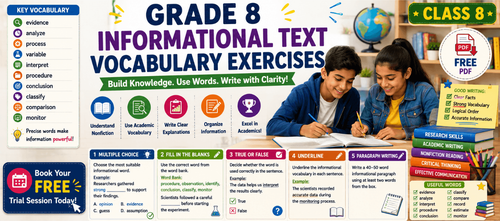

Understand Research-Based Writing with This Grade 8 Informational Text Vocabulary Exercises PDF
Informational writing becomes stronger when students use accurate vocabulary, factual explanations, and clear organization to explain ideas effectively. This Grade 8 Informational Text Vocabulary Exercises PDF helps students build academic vocabulary skills through research-based reading, informational writing, and paragraph-building activities.
Students learn how words such as “evidence,” “analyze,” “procedure,” “conclusion,” and “monitor” improve clarity and precision in informational texts. Through engaging exercises, learners practice understanding factual vocabulary, interpreting informational content, and writing organized paragraphs using academic language naturally.
Download these English grammar worksheets and practice regularly to strengthen your language skills and build a strong foundation. You can also book a free trial to get expert guidance and improve your reading, writing, and comprehension abilities. The worksheets are designed in a simple and structured way to help K–8 students learn grammar concepts easily and use them confidently in everyday communication.
What Is the Topic?
Vocabulary in informational texts focuses on words commonly used in reports, research articles, scientific explanations, data analysis, and factual writing. This Grade 8 worksheet helps students understand how informational vocabulary improves clarity, structure, and communication in academic writing.
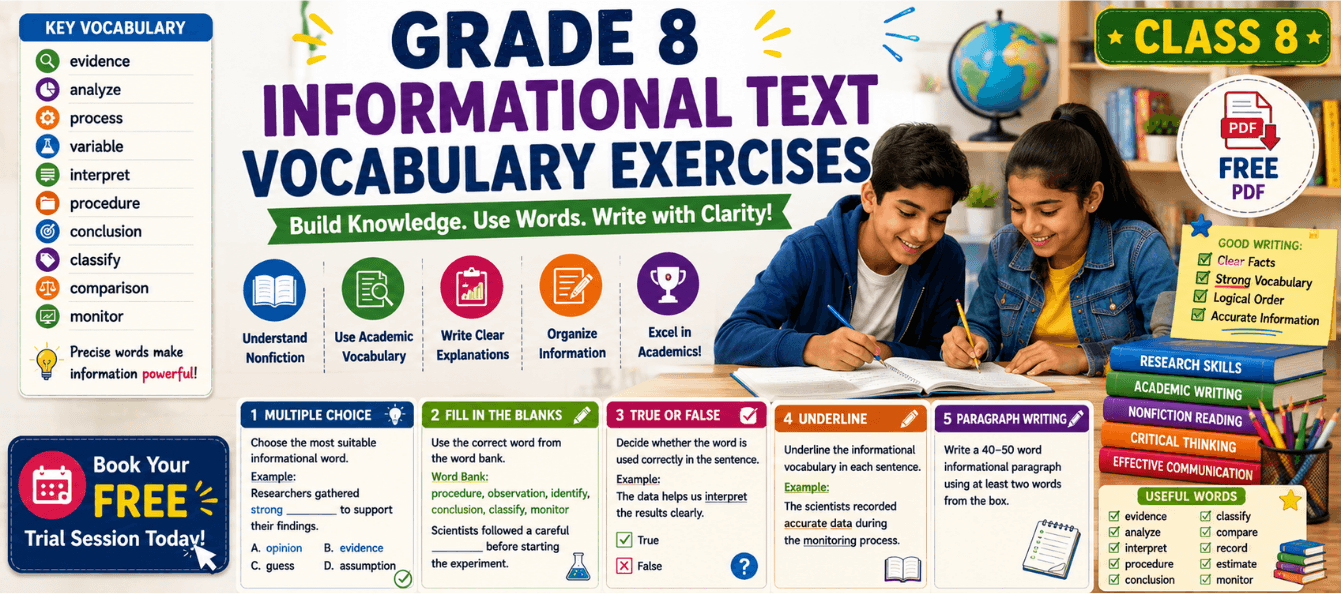
Students practice informational vocabulary such as:
- evidence
- analyze
- variable
- process
- interpret
- procedure
- conclusion
- classify
- comparison
- monitor
The worksheet encourages students to use these words naturally while reading factual passages, completing vocabulary tasks, and writing informational paragraphs.
What’s in This Worksheet?
1. Multiple choice questions based on informational vocabulary
2. Fill in the blanks activities using research-based vocabulary
3. True and False exercises focused on informational word usage
4. Underline-the-word activities using academic informational vocabulary
5. Informational paragraph writing tasks with vocabulary word banks
6. Reading-based activities connected to factual writing
7. Writing practice focused on organization, clarity, and research vocabulary
Definitions, Examples, Techniques, and Tips
This worksheet helps students understand how informational vocabulary improves factual writing and academic communication. Students learn how precise vocabulary helps explain information clearly and logically.
Examples included in the worksheet are:
- “Scientists collected strong evidence during the experiment.”
- “Researchers carefully analyze survey results.”
- “The scientist followed a careful procedure.”
- “Doctors continue to monitor the patient’s recovery.”
Students also practice vocabulary such as:
- observation
- identify
- estimate
- structure
- reference
- percentage
- documented
- analytical
- scientific
- informative
The worksheet helps students:
- Improve informational writing
- Build academic vocabulary
- Understand factual texts more clearly
- Organize ideas logically
- Develop research and analytical skills
Why Is It Important to Learn This?
Informational vocabulary helps students explain facts, research, and ideas more accurately. Strong academic vocabulary improves clarity, organization, and understanding in school assignments and formal writing tasks.
This grammar and vocabulary skill improves:
- Research writing
- Report writing
- Reading comprehension
- Scientific explanations
- Analytical thinking
- Academic communication
Students who understand informational vocabulary usually become more confident readers, writers, and researchers.
Where Will This Knowledge Help You?
Understanding informational vocabulary helps students in many academic and real-life situations, including:
- School exams and assessments
- Science and social studies reports
- Reading comprehension activities
- Research projects
- Presentation and discussion tasks
- Academic writing assignments
- Higher-level informational writing
These skills also help students organize information more effectively and communicate ideas clearly.
How to Use This Worksheet?
1. Read each informational sentence carefully before selecting vocabulary words.
2. Use context clues to understand unfamiliar academic vocabulary.
3. Focus on how factual vocabulary changes the meaning of informational texts.
4. Attempt all exercises independently before checking answers.
5. Compare your responses carefully with the answer key below.
6. Practice using informational vocabulary in your own writing regularly.
7. Read informational paragraphs aloud to improve understanding and fluency.
The solutions follow the exact worksheet order, so students should compare their answers carefully.
Important Tips and Tricks
1. Informational vocabulary helps explain facts clearly and accurately.
2. Academic writing becomes stronger when ideas are organized logically.
3. Words like “analyze,” “monitor,” and “conclusion” are common in research-based writing.
4. Use context clues to understand difficult informational vocabulary naturally.
5. In underline-the-word activities, focus only on important informational vocabulary words.
6. Strong factual writing avoids unclear or emotional language.
7. Practice reading informational articles regularly to improve vocabulary skills.
8. Organized paragraphs help readers understand information more easily.
Complete Answer Key
Exercise No. 1
Multiple Choice Questions
1. evidence
2. analyze
3. process
4. variable
5. interpret
6. category
7. structure
8. method
9. estimate
10. record
Exercise No. 2
Fill in the Blanks
1. procedure
2. observation
3. identify
4. calculate
5. reference
6. conclusion
7. classify
8. percentage
9. comparison
10. monitor
Exercise No. 3
True or False
1. False
2. True
3. True
4. False
5. True
6. True
7. True
8. False
9. True
10. True
Exercise No. 4
Underline the Informational Vocabulary
1. accurate, documented, monitoring
2. chronological, verified, archives
3. analytical, detailed, diagrams
4. scientific, observations, informative
5. overview, references, charts
Exercise No. 5
Informational Paragraph Writing (Sample Answers)
1. Effects of Pollution on Rivers
Researchers observed significant pollution in many rivers near industrial areas. Factories released harmful chemicals into the water, affecting fish and plant life. Scientists compiled detailed reports showing that polluted rivers reduce clean water supplies and damage ecosystems. Environmental groups continue to evaluate possible solutions for river conservation.
2. How Weather Forecasts Are Prepared
Meteorologists collect accurate weather information using satellites, radars, and weather stations. Scientists examined cloud patterns, wind speed, and rainfall data before preparing forecasts. The compiled information helps experts predict storms and temperature changes. Detailed weather reports allow communities to prepare for dangerous weather conditions safely.
3. Importance of Balanced Nutrition
Doctors and nutrition experts have researched the effects of balanced diets on human health. A nutritious meal includes vitamins, proteins, and minerals that help the body function properly. Several studies reported significant improvements in energy and concentration among students who regularly followed healthy eating habits.
4. Recent Scientific Discovery
Scientists recently discovered a new species of deep-sea fish during an ocean research mission. Researchers observed unusual glowing patterns on the fish while exploring underwater caves. The team compiled detailed findings and examined the species carefully before publishing an informative report about the important scientific discovery.
5. How Recycling Helps the Environment
Recycling reduces waste and protects natural resources by reusing materials such as paper, plastic, and glass. Environmental groups reported significant decreases in landfill waste in cities with strong recycling programs. Scientists also observed cleaner surroundings and reduced pollution levels in communities that regularly practiced recycling habits.
Practicing this Grade 8 Informational Text Vocabulary Exercises PDF helps students strengthen academic vocabulary, improve informational writing skills, and develop better understanding of factual texts. With regular practice, students can organize ideas more effectively, communicate research clearly, and build stronger academic writing abilities.