
Grade 8 Meaning Precision Vocabulary Practice Exercises

Master Stronger Word Choice with These Grade 8 Meaning Precision Vocabulary Practice Exercises
Choosing the right word can completely improve the clarity, impact, and accuracy of writing. These Grade 8 Meaning Precision Vocabulary Practice Exercises help students strengthen vocabulary usage, improve word precision, and communicate ideas more effectively through engaging sentence-based activities.
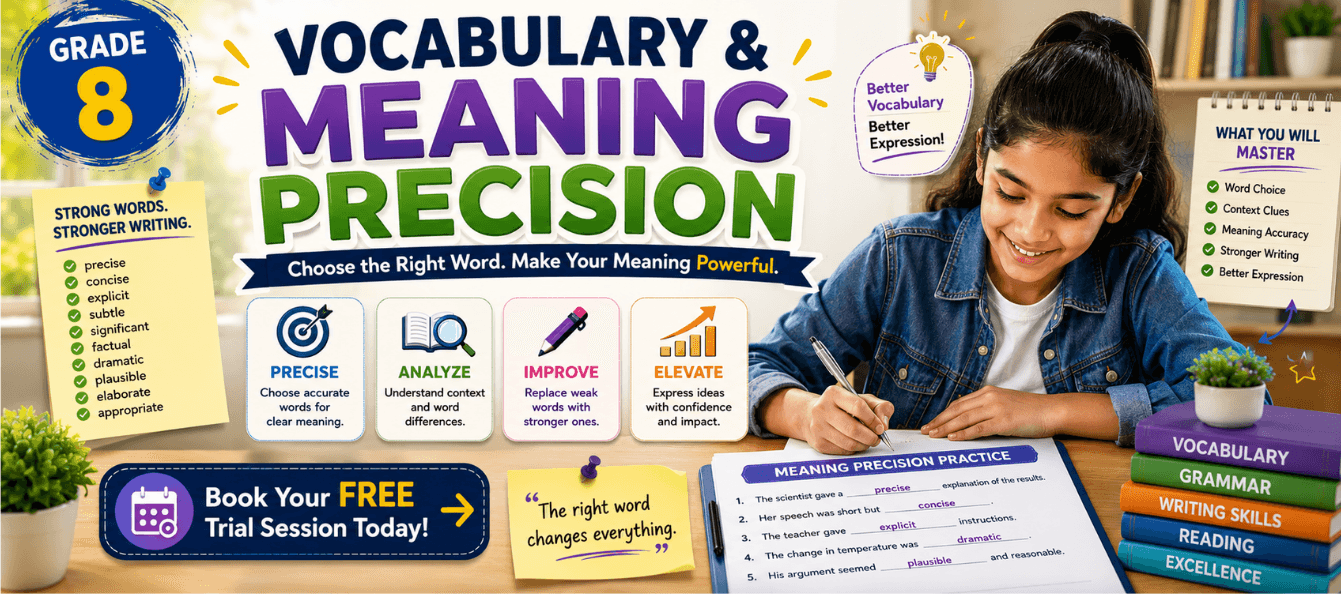
Students learn how words such as “precise,” “concise,” “subtle,” “explicit,” and “dramatic” create clearer and more meaningful communication. Through contextual vocabulary exercises, learners practice selecting accurate words, identifying weak vocabulary, and rewriting sentences using stronger and more precise language.
Download these English grammar worksheets and practice regularly to strengthen your language skills and build a strong foundation. You can also book a free trial to get expert guidance and improve your reading, writing, and comprehension abilities. The worksheets are designed in a simple and structured way to help K–8 students learn grammar concepts easily and use them confidently in everyday communication.
What Is the Topic?
Meaning precision focuses on selecting vocabulary that communicates ideas clearly, accurately, and effectively. This worksheet helps students understand how precise vocabulary improves sentence quality, reading comprehension, and academic writing.
Students practice vocabulary such as:
- precise
- concise
- significant
- subtle
- explicit
- technical
- factual
- dramatic
- plausible
- elaborate
The worksheet encourages students to analyze sentence meaning carefully before selecting the most accurate vocabulary word.
What’s in This Worksheet?
1. Multiple choice questions based on meaning precision
2. Fill in the blanks activities using precise vocabulary
3. True and False exercises focused on vocabulary accuracy
4. Underline-the-imprecise-word activities
5. Sentence rewriting tasks using stronger vocabulary
6. Reading-based vocabulary interpretation activities
7. Writing practice focused on precise word usage
Definitions, Examples, Techniques, and Tips
This worksheet helps students understand how precise vocabulary improves communication and writing clarity. Students learn how stronger word choice creates more accurate and meaningful sentences.
Examples included in the worksheet are:
- “The scientist gave a precise explanation of the results.”
- “Her speech was short but concise.”
- “The teacher gave explicit instructions before the test.”
- “The storm caused a dramatic drop in temperature.”
Students also practice vocabulary such as:
- depict
- ambiguous
- erroneous
- emphasize
- abolish
- feasible
- diligent
- eloquent
- obsolete
- linger
The worksheet helps students:
- Improve vocabulary precision
- Strengthen academic writing
- Replace weak vocabulary with stronger words
- Build reading comprehension skills
- Communicate ideas more accurately
Why Is It Important to Learn This?
Meaning precision helps students avoid vague or unclear language in writing and speaking. Accurate vocabulary improves clarity, strengthens communication, and helps ideas sound more professional and effective.
This grammar and vocabulary skill improves:
- Essay writing
- Reading comprehension
- Editing and proofreading
- Academic communication
- Sentence construction
- Analytical thinking
Students who understand meaning precision usually become more confident and skilled writers.
Where Will This Knowledge Help You?
Understanding precise vocabulary helps students in many academic and real-life situations, including:
- School grammar assessments
- Essay and paragraph writing
- Debate and presentation activities
- Reading comprehension exercises
- Competitive exams
- Academic discussions
- Higher-level English assignments
These skills also help students communicate ideas more clearly in both formal and informal situations.
How to Use This Worksheet?
1. Read each sentence carefully before selecting vocabulary words.
2. Focus on which word gives the clearest and most accurate meaning.
3. Use context clues to understand unfamiliar vocabulary naturally.
4. Attempt all exercises independently before checking answers.
5. Compare your responses carefully with the answer key below.
6. Practice replacing weak words with stronger vocabulary regularly.
7. Read rewritten sentences aloud to improve fluency and understanding.
The solutions follow the exact worksheet order, so students should compare their answers carefully.
Important Tips and Tricks
1. Precise vocabulary improves clarity and communication.
2. Strong writers avoid vague or weak words whenever possible.
3. Words like “concise” and “explicit” communicate ideas more accurately than general vocabulary.
4. Always consider sentence context before selecting a word.
5. In underline-the-word activities, focus only on weak or imprecise vocabulary.
6. Replacing weak words strengthens both writing and speaking.
7. Reading advanced texts regularly helps improve vocabulary precision.
8. Practice rewriting simple sentences using stronger vocabulary words.
Complete Answer Key
Exercise No. 1
Multiple Choice Questions
1. precise
2. concise
3. significant
4. subtle
5. explicit
6. technical
7. distinct
8. factual
9. dramatic
10. appropriate
Exercise No. 2
Fill in the Blanks
1. concise
2. depict
3. precise
4. vague
5. ambiguous
6. plausible
7. erroneous
8. emphasize
9. elaborate
10. abolish
Exercise No. 3
True or False
1. True
2. False
3. True
4. True
5. False
6. True
7. False
8. False
9. True
10. False
Exercise No. 4
Underline the Imprecise or Weak Words
1. general
2. unclear
3. broad
4. simple
5. ordinary
6. basic
7. rough
8. limited
9. common
10. incomplete
Exercise No. 5
Rewrite Using More Precise Vocabulary (Sample Answers)
1. Despite repeated losses, the player continued to persevere.
2. The traveler remained frugal during the trip.
3. Many offices stopped using the obsolete software.
4. The smell of paint continued to linger in the room for hours.
5. The villagers survived on meagre food during the drought.
6. The judge was admired for his integrity and fairness.
7. The team believed the plan was feasible.
8. Riya was diligent about every detail of the project.
9. The meeting ended abruptly without any warning.
10. The speaker gave an eloquent speech at the event.
Practicing these Grade 8 Meaning Precision Vocabulary Practice Exercises helps students strengthen vocabulary accuracy, improve sentence clarity, and develop stronger communication skills. With regular practice, students can choose words more effectively, avoid vague language, and build confidence in academic writing and speaking.