
Grade 8 Narrative Writing Vocabulary Worksheet for Kids
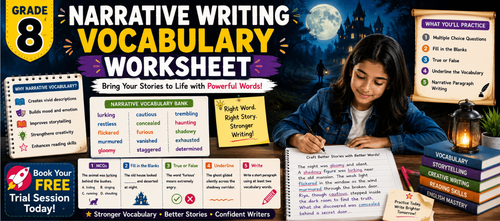

Learn Creative Storytelling with This Grade 8 Narrative Writing Vocabulary Worksheet for Kids
Narrative writing becomes more exciting when students use vivid vocabulary, descriptive details, and expressive language to build interesting stories. This Grade 8 Narrative Writing Vocabulary Worksheet for Kids helps students strengthen storytelling skills through engaging narrative-based vocabulary activities and paragraph writing tasks.
Instead of using simple or repetitive words, students learn how vocabulary such as “lurking,” “gloomy,” “shadowy,” “furious,” and “cautious” creates suspense, emotion, and atmosphere in stories. Through contextual exercises, learners improve their ability to describe settings, actions, emotions, and characters more effectively in narrative writing.
Download these English grammar worksheets and practice regularly to strengthen your language skills and build a strong foundation. You can also book a free trial to get expert guidance and improve your reading, writing, and comprehension abilities. The worksheets are designed in a simple and structured way to help K–8 students learn grammar concepts easily and use them confidently in everyday communication.
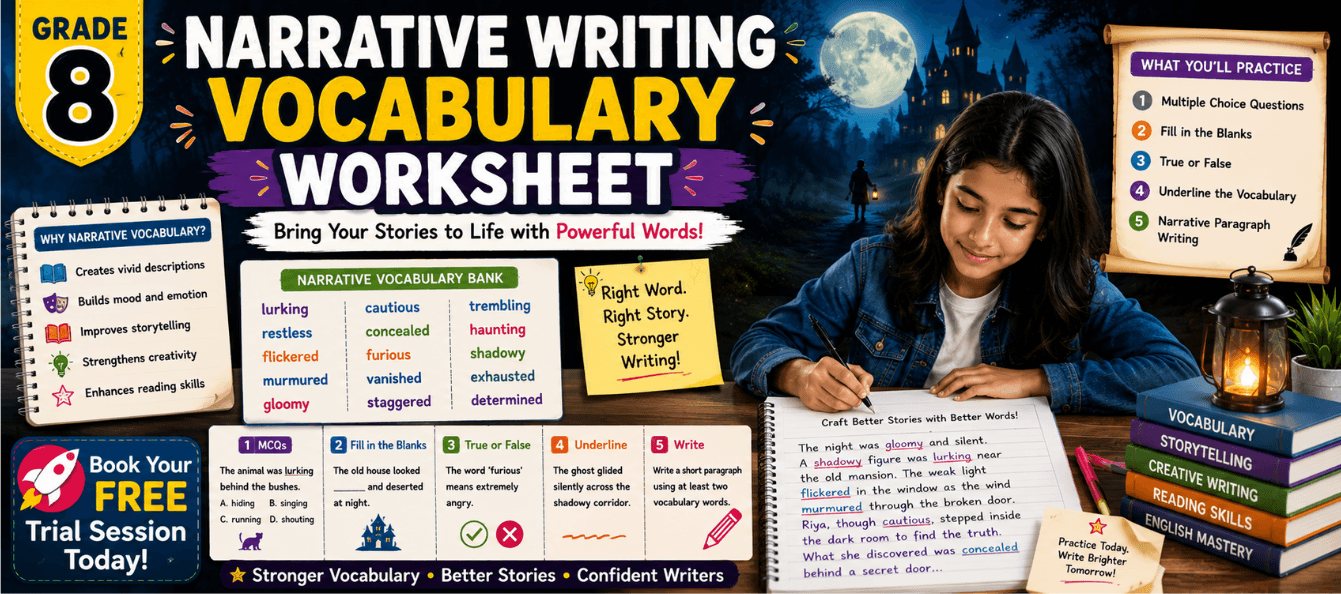
What Is the Topic?
Vocabulary in narrative writing focuses on using descriptive and expressive words to make stories more detailed, emotional, and engaging. This Grade 8 worksheet helps students understand how strong vocabulary improves storytelling and creates vivid mental images for readers.
Students practice narrative vocabulary such as:
- lurking
- gloomy
- cautious
- shadowy
- trembling
- exhausted
- anxious
- concealed
- startled
- determined
The worksheet encourages students to use these words naturally while reading mini stories, completing vocabulary tasks, and writing original narrative paragraphs.
What’s in This Worksheet?
1. Multiple choice questions based on narrative story contexts
2. Fill in the blanks activities using descriptive vocabulary
3. True and False exercises focused on narrative word usage
4. Underline-the-word activities using strong narrative vocabulary
5. Narrative paragraph writing tasks with vocabulary word banks
6. Reading-based vocabulary activities connected to storytelling
7. Writing practice focused on suspense, emotion, and description
Definitions, Examples, Techniques, and Tips
This worksheet helps students understand how descriptive vocabulary improves storytelling. Students learn how strong narrative words create atmosphere, emotion, suspense, and detailed imagery.
Examples included in the worksheet are:
- “A figure was lurking near the entrance.”
- “The weak flame flickered in the darkness.”
- “The travelers entered the gloomy village.”
- “The hikers remained cautious during the journey.”
Students also practice vocabulary such as:
- restless
- murmured
- vanished
- staggered
- haunting
- bewildered
- frantic
- desperate
- hesitant
- fearless
The worksheet helps students:
- Improve descriptive writing
- Create suspense and emotion in stories
- Build stronger narrative paragraphs
- Use expressive vocabulary naturally
- Develop creative storytelling skills
Why Is It Important to Learn This?
Narrative vocabulary helps students write stories that feel vivid, emotional, and realistic. Strong vocabulary allows readers to imagine characters, settings, and events more clearly while making writing more engaging.
This grammar and vocabulary skill improves:
- Story writing
- Creative expression
- Reading comprehension
- Descriptive paragraph writing
- Vocabulary development
- Imaginative thinking
Students who use strong narrative vocabulary often become more confident and creative writers.
Where Will This Knowledge Help You?
Understanding narrative vocabulary helps students in many academic and creative situations, including:
- Story writing assignments
- Creative writing competitions
- English grammar assessments
- Reading comprehension activities
- Classroom storytelling tasks
- Speech and presentation activities
- Higher-level descriptive writing tasks
These skills also help students become more expressive communicators and imaginative thinkers.
How to Use This Worksheet?
1. Read each mini story carefully before selecting vocabulary words.
2. Use context clues to understand unfamiliar narrative vocabulary.
3. Think about the mood and emotions created by different words.
4. Attempt all exercises independently before checking answers.
5. Compare your responses carefully with the answer key below.
6. Practice using descriptive vocabulary in your own stories regularly.
7. Read narrative paragraphs aloud to improve storytelling fluency.
The solutions follow the exact worksheet order, so students should compare their answers carefully.
Important Tips and Tricks
1. Strong narrative vocabulary helps readers imagine scenes more clearly.
2. Descriptive words create suspense, mood, and emotion in stories.
3. Use context clues to understand difficult vocabulary naturally.
4. Narrative writing becomes stronger when emotions and actions are described vividly.
5. In underline-the-word activities, focus only on descriptive vocabulary words.
6. Avoid repeating simple words like “good,” “bad,” or “scary” too often.
7. Practice writing short stories using advanced narrative vocabulary regularly.
8. Reading storybooks helps students learn creative vocabulary naturally.
Complete Answer Key
Exercise No. 1
Multiple Choice Questions
1. lurking
2. restless
3. flickered
4. murmured
5. gloomy
6. concealed
7. furious
8. cautious
9. vanished
10. staggered
Exercise No. 2
Fill in the Blanks
1. trembling, haunting
2. sprinted, drifted
3. isolated, shadowy
4. bewildered, tense
5. muttered, sorrowful
Exercise No. 3
True or False
1. False
2. True
3. False
4. True
5. True
6. True
7. False
8. True
9. False
10. True
Exercise No. 4
Underline the Narrative Vocabulary
1. weary, frantic
2. fierce, narrow
3. eerily, shattered, deserted
4. glided, gracefully, exhausted
5. desperate, hesitant
Exercise No. 5
Narrative Paragraph Writing (Sample Answers)
1. Exploring an Abandoned Building After Sunset
Rohan felt curious as he entered the abandoned building after sunset. The shadowy hallway looked frightening, and every sound made him anxious. Suddenly, a hidden door creaked open beside the staircase. Although startled, he remained determined to discover what had been concealed inside the mysterious room.
2. Difficult Journey Through a Forest During Heavy Rain
The travelers were exhausted after walking through the forest during the heavy rainstorm. Thick mud covered the narrow path, and strong winds shook the trees loudly above them. Despite feeling anxious, the group remained determined to reach the nearby shelter before darkness completely surrounded the forest.
3. Discovering a Hidden Object in an Old Classroom
While cleaning the old classroom after school, Meera noticed a concealed box beneath a broken desk. She felt curious and slowly opened it with trembling hands. Inside, she discovered faded photographs and an old silver key. The unexpected discovery left her startled but excited about the hidden mystery.
4. Team Escaping from a Dangerous Situation
The rescue team kept sprinting through the rocky tunnel as water rushed behind them. Everyone looked exhausted after hours of climbing through the dark cave. Although anxious about the dangerous situation, the fearless group continued moving forward until they finally reached safety outside the mountain passage.
5. Mysterious Stranger Arriving in a Quiet Village
Late one evening, a shadowy stranger arrived in the quiet village during heavy fog. The villagers watched silently as the mysterious traveler walked slowly toward the market square. Although several people appeared anxious, the fearless stranger calmly asked for shelter before disappearing into the old abandoned inn nearby.
Practicing this Grade 8 Narrative Writing Vocabulary Worksheet for Kids helps students strengthen storytelling skills, improve descriptive vocabulary, and build confidence in creative writing. With regular practice, students can create more vivid stories, express emotions clearly, and develop stronger narrative writing abilities.