
Grade 8 Phrases Identification Challenge with Answer Key

Mastering Phrases: Grade 8 English Grammar Worksheet – Advanced Identification Challenge with Answer Key
Learning how to identify different types of phrases is an important step in improving grammar skills. This Grade 8 English grammar worksheet on Phrases – Advanced Identification helps students recognize noun phrases, prepositional phrases, infinitive phrases, participial phrases, gerund phrases, adjectival phrases, and adverbial phrases through engaging activities. The worksheet includes matching exercises, multiple-choice questions, sentence rearranging, sentence rewriting, and picture description tasks. By completing these activities, students can strengthen their understanding of phrase structures and improve sentence construction skills.
Download these English grammar worksheets and practice regularly to strengthen your language skills and build a strong foundation. You can also book a free trial to get expert guidance and improve your reading, writing, and comprehension abilities. The worksheets are designed in a simple and structured way to help K–8 students learn grammar concepts easily and use them confidently in everyday communication.
What Is the Topic?
This worksheet focuses on advanced phrase identification. Students learn to identify and classify different phrase types such as noun phrases, prepositional phrases, infinitive phrases, gerund phrases, participial phrases, adjectival phrases, and adverbial phrases. Through a variety of exercises, students practice recognizing phrases, rearranging sentences, rewriting sentences, and describing pictures using appropriate phrases.
What’s in This Worksheet?
1. Matching phrases with their correct phrase types.
2. Multiple-choice questions for phrase identification.
3. Sentence rearranging activities using phrases.
4. Sentence rewriting exercises that change one phrase type into another.
5. Picture description practice using different types of phrases.
6. Activities that strengthen grammar recognition skills.
7. Structured practice for improving sentence construction.
8. Exercises that support school assessments and grammar revision.
Definitions, Examples, Techniques, and Tips
Definitions
• Noun Phrase – A phrase that functions as a noun.
• Prepositional Phrase – A phrase beginning with a preposition and its object.
• Infinitive Phrase – A phrase beginning with “to” followed by a verb.
• Gerund Phrase – A phrase beginning with a verb ending in “-ing” and functioning as a noun.
• Participial Phrase – A phrase beginning with a participle and functioning as an adjective.
• Adjectival Phrase – A phrase that describes or modifies a noun.
• Adverbial Phrase – A phrase that modifies a verb, adjective, or adverb.
Examples Included in the Worksheet
• under the table
• across the river
• to win the game
• eating ice cream
• a box of chocolates
• running fast
• before the meeting
Techniques
• Identify the purpose of the phrase within the sentence.
• Look for prepositions such as under, by, across, before, and at.
• Recognize infinitive forms beginning with “to”.
• Notice words ending in “-ing” and determine whether they function as gerunds or participles.
• Examine how the phrase modifies or completes meaning.
Quick Learning Tips
• Read the entire phrase carefully.
• Focus on the phrase’s role in the sentence.
• Identify key signal words.
• Practice transforming one phrase type into another.
• Review examples regularly.
Why Is It Important to Learn This?
Learning phrase identification helps students understand sentence structure more clearly. It improves grammar accuracy, strengthens writing skills, and enhances reading comprehension. Recognizing phrase types allows students to write more descriptive and meaningful sentences while improving overall communication.
Where Will This Knowledge Help You?
• Grammar examinations
• School assignments
• Essay writing
• Creative writing activities
• Reading comprehension tasks
• Classroom participation
• English language assessments
• Everyday communication
How to Use This Worksheet?
1. Read each question carefully before answering.
2. Attempt the exercises independently.
3. Identify the phrase type before selecting an answer.
4. Rearrange words carefully to form meaningful sentences.
5. Rewrite sentences while changing only the required phrase type.
6. Compare your answers with the solutions provided below.
7. The solutions follow the exact worksheet order.
8. Check mistakes and understand corrections.
9. Practice regularly to improve phrase recognition.
10. Review difficult questions more than once for better understanding.
Important Tips and Tricks
1. Identify the function of a phrase before deciding its type.
2. Look carefully for prepositions such as under, by, before, and across.
3. Remember that infinitive phrases begin with “to”.
4. Gerund phrases use an “-ing” verb form as a noun.
5. Participial phrases usually describe nouns.
6. Read every answer choice before selecting one.
7. Keep sentence meaning unchanged during rewrites.
8. Use correct punctuation and capitalization.
9. Pay attention to modifiers and descriptive phrases.
10. Use a variety of phrase types while describing pictures.
Complete Answer Key
Exercise:1
Match each phrase in Column A to its type in Column B.
1. under the table – Prepositional Phrase
2. the tall, red building – Adjectival Phrase
3. across the river – Prepositional Phrase
4. to win the game – Infinitive Phrase
5. eating ice cream – Gerund Phrase
6. at dawn – Prepositional Phrase
7. by the old bridge – Prepositional Phrase
8. a box of chocolates – Noun Phrase
9. running fast – Participial Phrase
10. before the meeting – Prepositional Phrase
Exercise: 2
Choose the correct phrase type for each question.
1. a bowl of soup – Noun
2. near the playground – Prepositional
3. running along the beach – Participial
4. the man with a hat – Adjectival
5. to clean the room – Infinitive
6. barking at strangers – Gerund
7. at sunrise – Prepositional
8. writing a letter – Gerund
Exercise: 3
Rearrange the words to build a sentence using a phrase and label its type.
1. The kitten hid under the table. (Prepositional Phrase)
2. We started the hike at dawn. (Prepositional Phrase)
3. He trained for weeks in hopes of winning. (Gerund Phrase)
4. The guard stood by the gate. (Prepositional Phrase)
5. The girl with the red scarf waved. (Adjectival Phrase)
6. She wants to finish the report quickly. (Infinitive Phrase)
7. Anita enjoys writing letters. (Gerund Phrase)
8. The soldiers marched across the river. (Prepositional Phrase)
9. A book of a hundred pages. (Noun Phrase)
10. We walked through the misty forest. (Prepositional Phrase)
Exercise:4
Read each sentence carefully and rewrite the sentence so that the underlined phrase is changed into the type given in brackets.
1. She loves playing the piano.
2. The man with a blue hat is my uncle.
3. He ran in a speedy manner.
4. I bought chocolates from a box.
5. Winning the competition is his dream.
6. The girl wearing a red dress smiled.
7. We left to see the sunrise.
8. The students preparing for the debate enjoy debating.
9. He works for his family.
10. They rested beneath the oak tree.
Exercise:5
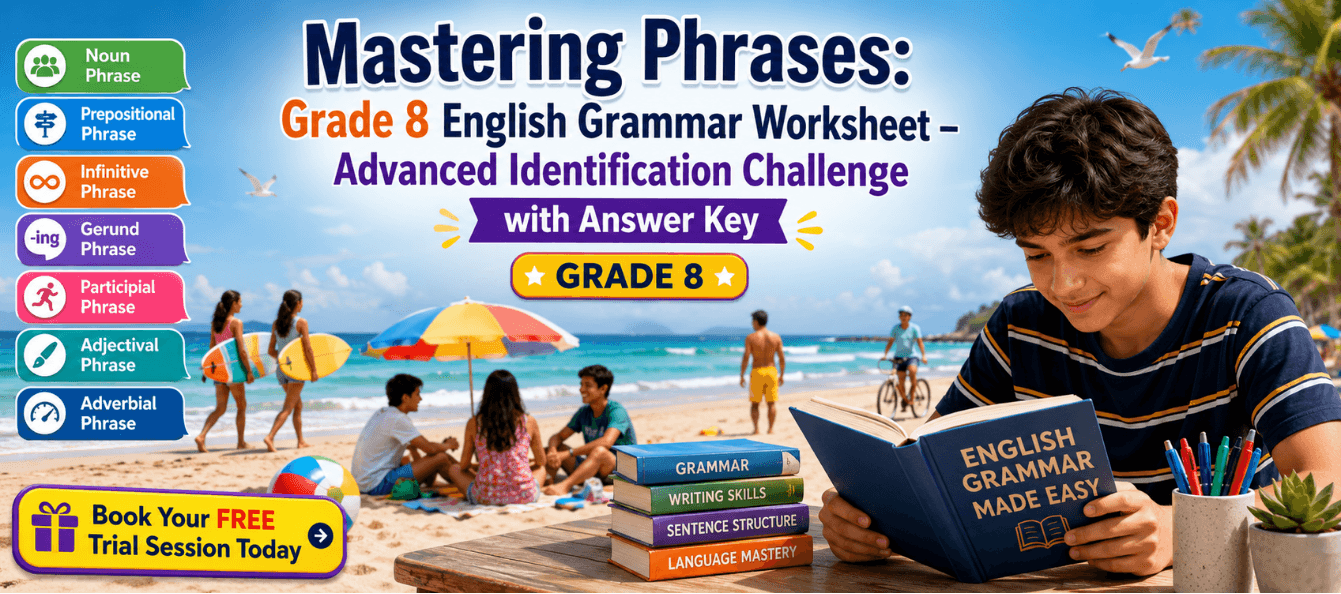
Look at the picture and describe it using different types of phrases.
1. On the sandy beach, people are enjoying their day.
2. The tall palm trees provide shade near the shore.
3. A group of friends is sitting under a beach umbrella.
4. Two girls carrying surfboards are walking by the water.
5. A man in yellow shorts stands near the ocean.
6. Riding a bicycle along the beach, a person enjoys the scenery.
7. To enjoy the sunny weather, many people have gathered here.
8. The colorful beach ball lies on the sand.
9. Walking near the waves is a relaxing activity.
10. By the beautiful coastline, everyone appears happy.
This Grade 8 English grammar worksheet on Phrases – Advanced Identification provides valuable practice in identifying, classifying, and using phrases correctly. Regular practice with matching exercises, multiple-choice questions, sentence rearranging, sentence rewriting, and picture descriptions can improve grammar skills and sentence construction. Keep practicing different phrase types to build confidence and become a stronger English communicator.