
Grade 8 Sentence Transformation Exercises for Advanced Learners
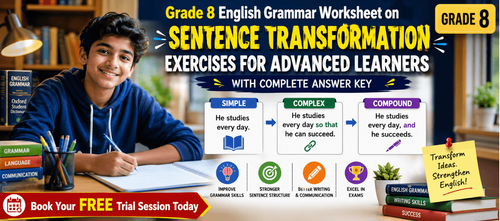

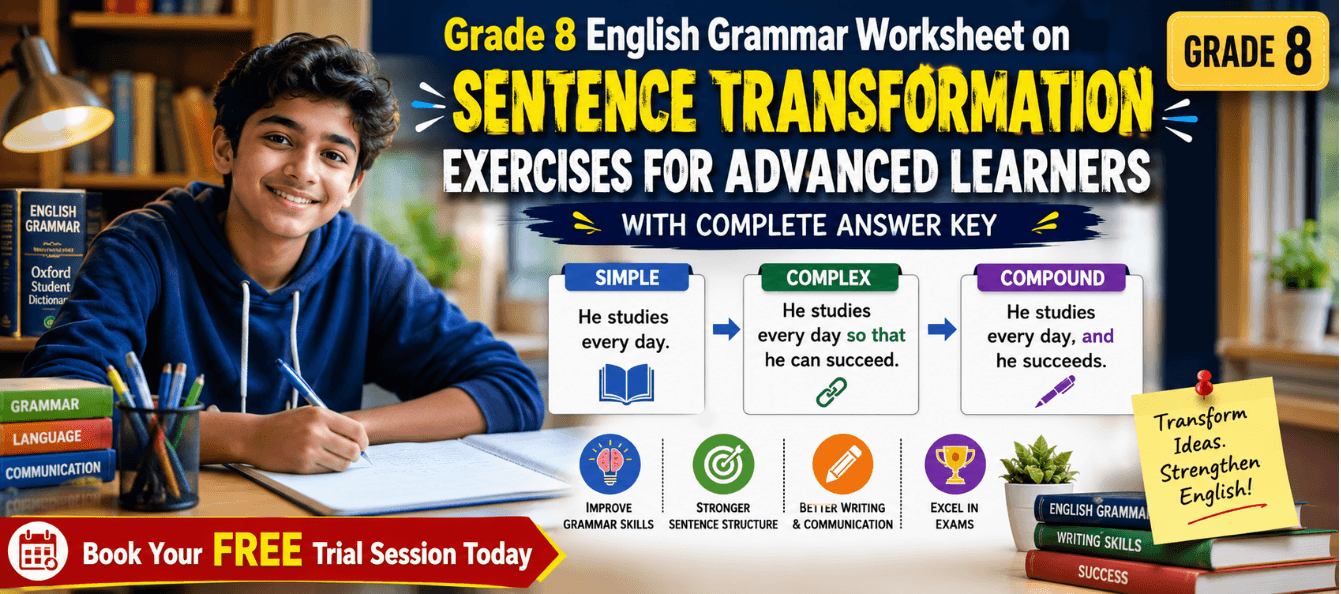
Grade 8 English Grammar Worksheet on Sentence Transformation Exercises for Advanced Learners with Complete Answer Key
Sentence transformation helps students learn how to express the same idea in different sentence structures while keeping the meaning unchanged. This Grade 8 English grammar worksheet on Sentence Transformation Exercises for Advanced Learners gives students valuable practice in identifying sentence types and converting simple, complex, and compound sentences accurately. Through carefully designed exercises, learners strengthen grammar skills, improve sentence construction, and build confidence in writing and speaking English.
This worksheet includes transformation activities that encourage students to observe sentence patterns, understand relationships between clauses, and practice rewriting sentences correctly. By working through these exercises, Grade 8 students can improve their grammatical accuracy and develop stronger communication skills.
Download these English grammar worksheets and practice regularly to strengthen your language skills and build a strong foundation. You can also book a free trial to get expert guidance and improve your reading, writing, and comprehension abilities. The worksheets are designed in a simple and structured way to help K–8 students learn grammar concepts easily and use them confidently in everyday communication.
What Is the Topic?
Sentence transformation is the process of changing one type of sentence into another without changing its meaning. In this worksheet, students work with three major sentence structures:
• Simple sentences
• Complex sentences
• Compound sentences
Students learn to identify sentence types and transform them from one form to another. These activities help learners understand sentence construction, clause relationships, and grammatical accuracy.
What’s in This Worksheet?
1. Identification of sentence transformation types.
2. Transformation of simple sentences into complex sentences.
3. Transformation of simple sentences into compound sentences.
4. Transformation of complex sentences into simple sentences.
5. Transformation of complex sentences into compound sentences.
6. Practice with different sentence structures.
7. Activities that strengthen grammar accuracy.
8. Exercises arranged from identification to sentence rewriting.
9. Useful practice for school assessments and grammar revision.
10. Opportunities to improve sentence-building skills through structured exercises.
Definitions, Examples, Techniques, and Tips
Definitions
Simple Sentence:
A sentence that contains a single main clause.
Complex Sentence:
A sentence that contains one main clause and one subordinate clause.
Compound Sentence:
A sentence that contains two independent clauses joined by a coordinating conjunction.
Examples From the Worksheet
Simple:
He is my uncle.
Complex:
If it rains, we will stay home.
Compound:
I was late and the party was finished.
Techniques
• Identify joining words such as and, because, when, if, although, and since.
• Look for dependent clauses in complex sentences.
• Find independent clauses in compound sentences.
• Preserve the original meaning while changing the structure.
Quick Learning Tips
• Read the sentence carefully before transforming it.
• Identify the relationship between ideas.
• Use suitable connecting words.
• Check that the meaning remains unchanged.
• Review sentence structure after rewriting.
Why Is It Important to Learn This?
Learning sentence transformation helps students:
• Understand different sentence structures.
• Improve grammar accuracy.
• Write more effectively.
• Express ideas in multiple ways.
• Develop stronger communication skills.
• Build confidence in academic writing.
• Enhance reading comprehension.
• Prepare for grammar-based examinations.
Where Will This Knowledge Help You?
Students can use sentence transformation skills in:
• English grammar examinations.
• Classroom assignments.
• Creative writing activities.
• Essay writing.
• Paragraph writing.
• Reading comprehension tasks.
• School projects.
• Oral presentations.
• Everyday communication.
• Advanced grammar learning.
How to Use This Worksheet?
1. Read each sentence carefully before attempting the answer.
2. Identify whether the sentence is simple, complex, or compound.
3. Apply the required transformation while preserving the meaning.
4. Compare your answers carefully with the solutions provided.
5. Follow the exact worksheet order while reviewing answers.
6. Check grammar, punctuation, and sentence structure.
7. Correct mistakes and rewrite incorrect answers.
8. Practice similar transformations regularly for better mastery.
Important Tips and Tricks
1. Read the instruction before answering each question.
2. Identify the sentence type correctly before transforming it.
3. Do not change the meaning of the original sentence.
4. Use suitable conjunctions when forming compound sentences.
5. Use appropriate subordinate clauses when forming complex sentences.
6. Maintain correct tense throughout the transformation.
7. Check subject-verb agreement after rewriting.
8. Avoid unnecessary words.
9. Review punctuation carefully.
10. Practice each transformation type repeatedly to improve accuracy and confidence.
Complete Answer Key
Exercise:1
Choose the correct transformation type for each question.
1. I was late and the party was finished.
Answer: c. Compound
2. We cooked dinner.
Answer: a. Simple
3. She smiled when she saw me.
Answer: b. Complex
4. He runs fast, so he wins races.
Answer: c. Compound
5. He is my uncle.
Answer: a. Simple
6. I read the book and enjoyed it.
Answer: c. Compound
7. If it rains, we will stay home.
Answer: b. Complex
8. She is too tired to study.
Answer: a. Simple
Exercise: 2
Transform the following simple sentences into complex sentences.
1. He worked hard to win the prize.
Answer: He worked hard so that he might win the prize.
2. She is too tired to walk.
Answer: She is so tired that she cannot walk.
3. The sun set, ending the day.
Answer: When the sun set, the day ended.
4. On hearing the news, she cried.
Answer: When she heard the news, she cried.
5. He was rich enough to buy the car.
Answer: He was so rich that he could buy the car.
6. The boy ran fast to catch the bus.
Answer: The boy ran fast so that he could catch the bus.
7. We eat food to live.
Answer: We eat food so that we may live.
8. In spite of his illness, he attended school.
Answer: Although he was ill, he attended school.
9. The teacher punished him for making noise.
Answer: The teacher punished him because he made noise.
10. She opened the window to let in fresh air.
Answer: She opened the window so that fresh air might come in.
Exercise: 3
Transform the following simple sentences into compound sentences.
1. He must work hard to succeed.
Answer: He must work hard, and then he will succeed.
2. She is very poor but honest.
Answer: She is poor, but she is honest.
3. The weather being fine, we went out.
Answer: The weather was fine, so we went out.
4. He was punished for being late.
Answer: He was late, so he was punished.
5. She opened the box to find her toy.
Answer: She opened the box, and she found her toy.
6. The boy stood up on seeing the teacher.
Answer: The boy saw the teacher, and he stood up.
7. Being hungry, he ate quickly.
Answer: He was hungry, so he ate quickly.
8. The soldier fought bravely to save his country.
Answer: The soldier fought bravely, and he saved his country.
9. Hearing the bell, the students entered the class.
Answer: The students heard the bell, and they entered the class.
10. He failed due to his laziness.
Answer: He was lazy, so he failed.
Exercise:4
Transform the following complex sentences into simple sentences.
1. She ran so that she could catch the train.
Answer: She ran to catch the train.
2. He failed because he was careless.
Answer: He failed due to his carelessness.
3. I know where he lives.
Answer: I know his residence.
4. If you run fast, you can catch the bus.
Answer: By running fast, you can catch the bus.
5. Although he was tired, he finished the work.
Answer: In spite of being tired, he finished the work.
6. She smiled when she saw me.
Answer: On seeing me, she smiled.
7. Since it rained heavily, the match was cancelled.
Answer: Due to heavy rain, the match was cancelled.
8. The teacher praised the boy because he was honest.
Answer: The teacher praised the boy for his honesty.
9. We eat food because we want to live.
Answer: We eat food to live.
10. When he saw the dog, he ran away.
Answer: On seeing the dog, he ran away.
Exercise:5
Transform the following complex sentences into compound sentences.
1. He worked hard so that he might succeed.
Answer: He worked hard, and he succeeded.
2. We stayed at home because it was raining.
Answer: It was raining, so we stayed at home.
3. He did not go to school since he was ill.
Answer: He was ill, so he did not go to school.
4. Although she is rich, she is not proud.
Answer: She is rich, but she is not proud.
5. If you study hard, you will pass the exam.
Answer: Study hard, and you will pass the exam.
6. She went home as she was tired.
Answer: She was tired, so she went home.
7. The match was postponed because it rained.
Answer: It rained, so the match was postponed.
8. Though he is old, he works very hard.
Answer: He is old, but he works very hard.
9. I waited until she arrived.
Answer: She arrived, and then I stopped waiting.
10. I was happy because I won the prize.
Answer: I won the prize, so I was happy.
This Grade 8 English grammar worksheet on Sentence Transformation Exercises for Advanced Learners provides excellent practice in identifying and converting sentence structures. Regular practice with simple, complex, and compound sentence transformations helps students improve grammatical accuracy, writing skills, and confidence. Continue practicing these sentence transformation exercises to strengthen your understanding of English grammar and achieve better results in school assessments.