
Grade 8 Synonym & Antonym Transformation Worksheet
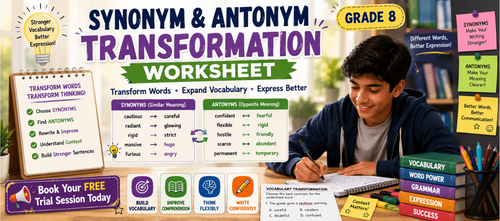

Strengthen Word Choice Skills with This Grade 8 Vocabulary Transformation Worksheet
Understanding synonyms and antonyms helps students improve vocabulary precision, comprehension, and sentence-writing skills. This Grade 8 Vocabulary Transformation (Synonym/Antonym Shift) Worksheet helps students practice replacing words with suitable synonyms and antonyms through contextual exercises and sentence transformation activities.
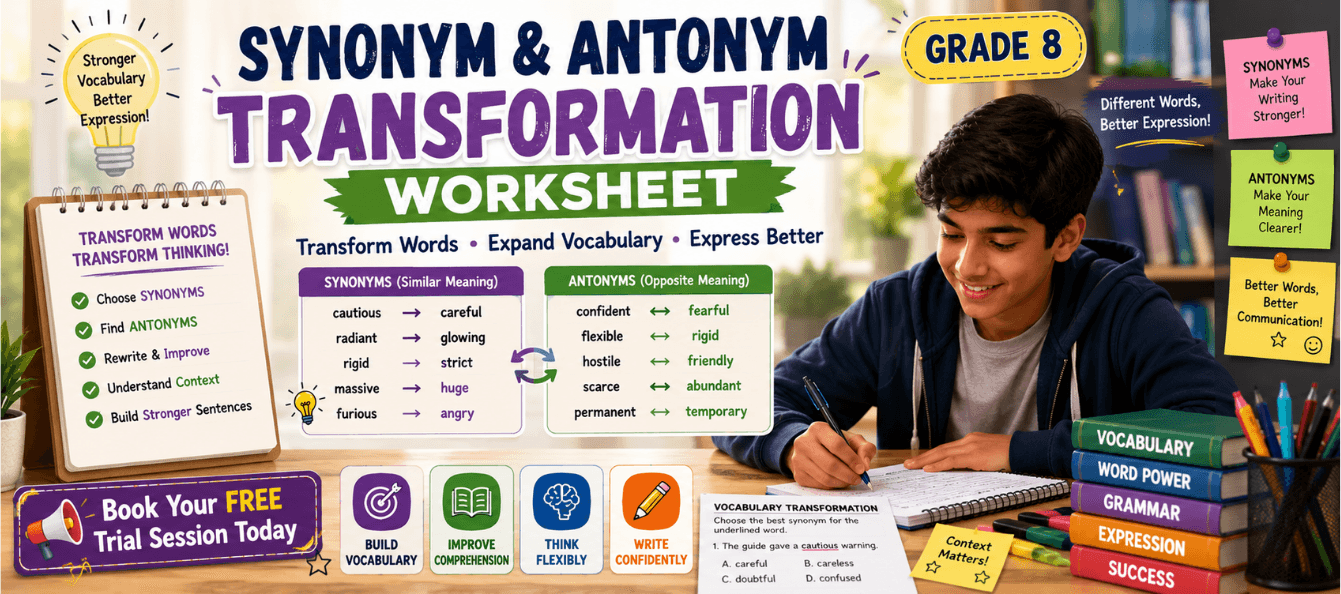
Students learn how words such as “cautious,” “massive,” “radiant,” “rigid,” and “furious” can be transformed into suitable synonyms or antonyms depending on sentence meaning. Through structured exercises, learners improve vocabulary flexibility and strengthen contextual understanding while editing and rewriting sentences.
Download these English grammar worksheets and practice regularly to strengthen your language skills and build a strong foundation. You can also book a free trial to get expert guidance and improve your reading, writing, and comprehension abilities. The worksheets are designed in a simple and structured way to help K–8 students learn grammar concepts easily and use them confidently in everyday communication.
What Is the Topic?
Vocabulary transformation focuses on replacing words with suitable synonyms or antonyms while maintaining correct sentence meaning. This worksheet helps students improve vocabulary range, contextual understanding, and word-usage accuracy.
Students practice vocabulary such as:
- cautious
- massive
- radiant
- rigid
- furious
- gloomy
- elegant
- rapid
- scarce
- transparent
The worksheet encourages students to understand how word meaning changes when synonyms and antonyms are used in different contexts.
What’s in This Worksheet?
1. Multiple choice questions based on synonym selection
2. Fill in the blanks activities using antonyms
3. True and False exercises focused on vocabulary usage
4. Underline-the-incorrect-word activities
5. Sentence transformation tasks using synonyms and antonyms
6. Context-based vocabulary interpretation exercises
7. Writing practice focused on precise word replacement
Definitions, Examples, Techniques, and Tips
This worksheet helps students understand how synonyms and antonyms improve sentence variety, clarity, and expression. Students learn how suitable word replacement changes tone and meaning naturally.
Examples included in the worksheet are:
- “The guide gave a cautious warning.”
- “The player felt furious after losing.”
- “The empty street looked gloomy tonight.”
- “The rabbit made a rapid escape.”
Students also practice vocabulary such as:
- confident
- flexible
- hostile
- artificial
- inferior
- permanent
- reluctant
- meticulous
- captivating
- tranquil
The worksheet helps students:
- Improve vocabulary flexibility
- Strengthen contextual understanding
- Build stronger reading comprehension
- Use precise vocabulary naturally
- Develop stronger sentence-writing skills
Why Is It Important to Learn This?
Synonym and antonym transformation helps students avoid repetition and improve communication quality. Strong vocabulary transformation skills also strengthen comprehension, editing abilities, and academic writing.
This grammar and vocabulary skill improves:
- Reading comprehension
- Sentence construction
- Vocabulary precision
- Editing and proofreading
- Academic writing
- Communication skills
Students who practice vocabulary transformation regularly usually become more confident readers and writers.
Where Will This Knowledge Help You?
Understanding synonym and antonym transformation helps students in many academic and real-life situations, including:
- School grammar assessments
- Essay and paragraph writing
- Reading comprehension activities
- Editing and rewriting tasks
- Competitive exams
- Debate and discussion activities
- Higher-level English assignments
These skills also help students use more varied and expressive vocabulary while speaking and writing.
How to Use This Worksheet?
1. Read each sentence carefully before choosing a synonym or antonym.
2. Use context clues to understand sentence meaning naturally.
3. Think about tone and meaning before replacing a word.
4. Attempt all exercises independently before checking solutions.
5. Compare your responses carefully with the answer key below.
6. Practice using synonyms and antonyms in daily writing regularly.
7. Read rewritten sentences aloud to improve fluency and understanding.
The solutions follow the exact worksheet order, so students should compare their answers carefully.
Important Tips and Tricks
1. Synonyms help improve sentence variety and expression.
2. Antonyms help students understand opposite meanings clearly.
3. Always read the full sentence before replacing a word.
4. Context clues help identify suitable vocabulary replacements.
5. In underline-the-word activities, focus only on the incorrect word.
6. Strong vocabulary improves communication and comprehension skills.
7. Sentence transformation strengthens editing and writing abilities.
8. Reading regularly helps students recognize synonyms and antonyms naturally.
Complete Answer Key
Multiple Choice Questions
1. careful
2. huge
3. glowing
4. strict
5. angry
6. depressing
7. old
8. stylish
9. quick
10. rare
Exercise No. 2
Fill in the Blanks
1. confident
2. flexible
3. scarce
4. hostile
5. artificial
6. fragile
7. inferior
8. permanent
9. transparent
10. reluctant
Exercise No. 3
True or False
1. True
2. True
3. True
4. True
5. True
6. False
7. True
8. True
9. True
10. False
Exercise No. 4
Underline the Incorrect Word
1. energetic
2. transparent
3. selfish
4. safe
5. silent
6. natural
7. biased
8. confident
9. ancient
10. silent
Exercise No. 5
Sentence Transformation (Sample Answers)
1. The audience gave a concise reaction.
2. The forest looked tranquil at night.
3. The scientist made a meticulous observation.
4. The team faced a chaotic situation during the emergency.
5. The workers completed the task in an improper manner.
6. The traveler carried an invaluable map.
7. The athlete remained pessimistic before the finals.
8. The child gave a truthful explanation.
9. The teacher gave a harsh warning before the exam.
10. The speaker delivered a captivating presentation.
Practicing this Grade 8 Vocabulary Transformation Worksheet helps students strengthen vocabulary flexibility, improve contextual understanding, and develop stronger editing and writing skills. With regular practice, students can use synonyms and antonyms more confidently, improve sentence variety, and communicate ideas more effectively.