
Grade 8 Vocabulary Editing Practice Worksheet
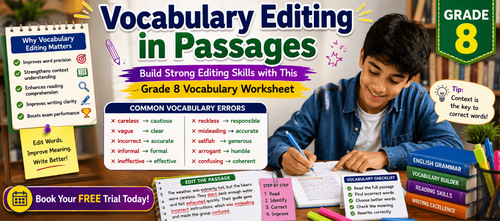

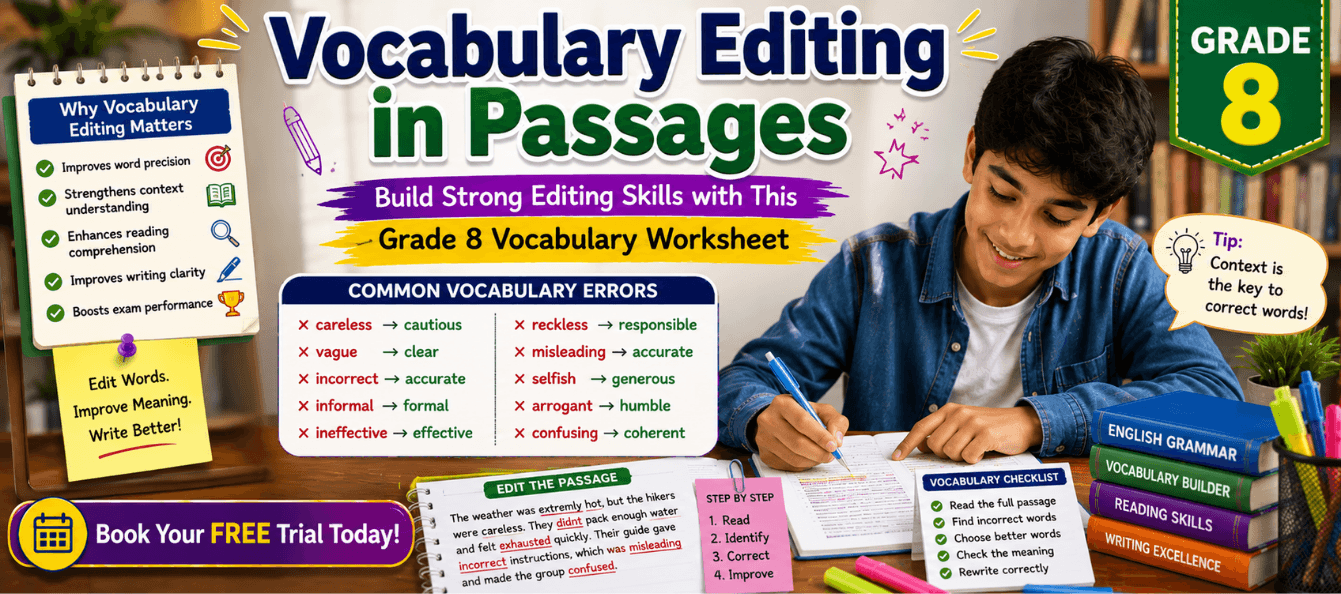
Build Strong Editing Skills with This Grade 8 Vocabulary Editing in Passages Worksheet
Understanding how vocabulary fits correctly within a sentence is an important part of advanced reading and writing. This Grade 8 Vocabulary Editing in Passages Worksheet helps students improve vocabulary accuracy, identify incorrect word usage, and strengthen contextual editing skills through engaging passage-based exercises.
Students learn how words such as “coherent,” “cautious,” “misleading,” “disciplined,” and “trustworthy” affect sentence meaning and clarity. Through contextual editing tasks, mini-passages, and rewriting activities, learners practice spotting vocabulary errors and replacing weak or unsuitable words with more accurate alternatives.
Download these English grammar worksheets and practice regularly to strengthen your language skills and build a strong foundation. You can also book a free trial to get expert guidance and improve your reading, writing, and comprehension abilities. The worksheets are designed in a simple and structured way to help K–8 students learn grammar concepts easily and use them confidently in everyday communication.
What Is the Topic?
Vocabulary editing focuses on identifying incorrect word choices and replacing them with suitable vocabulary based on sentence meaning and context. This worksheet helps students strengthen contextual understanding and improve vocabulary precision.
Students practice vocabulary such as:
- coherent
- cautious
- disciplined
- trustworthy
- misleading
- reckless
- ambitious
- exhausted
- ineffective
- formal
The worksheet encourages students to carefully analyze sentence meaning before deciding whether a vocabulary word fits correctly.
What’s in This Worksheet?
1. Multiple choice questions based on incorrect vocabulary usage
2. Fill in the blanks activities using contextual corrections
3. True and False exercises focused on vocabulary accuracy
4. Underline-the-incorrect-word activities
5. Paragraph rewriting tasks using suitable vocabulary
6. Reading-based vocabulary editing exercises
7. Writing practice focused on vocabulary precision
Definitions, Examples, Techniques, and Tips
This worksheet helps students understand how incorrect vocabulary changes sentence meaning and creates confusion. Students learn how to analyze context clues and replace unsuitable words accurately.
Examples included in the worksheet are:
- “The scientist gave a vague explanation filled with precise details.”
- “The hikers remained careless while crossing the broken bridge.”
- “The report presented a highly coherent explanation.”
- “The guide stayed cautious near the slippery path.”
Students also practice vocabulary such as:
- weary
- uncertain
- upset
- ineffective
- reckless
- graceful
- skeptical
- disciplined
- arrogant
- sensible
The worksheet helps students:
- Improve vocabulary editing skills
- Strengthen contextual understanding
- Build stronger reading comprehension
- Identify unsuitable vocabulary accurately
- Develop clearer writing skills
Why Is It Important to Learn This?
Vocabulary editing helps students recognize how precise word choice improves communication and sentence clarity. Strong editing skills also improve comprehension, writing quality, and exam performance.
This grammar and vocabulary skill improves:
- Reading comprehension
- Editing and proofreading
- Academic writing
- Vocabulary accuracy
- Sentence interpretation
- Analytical thinking
Students who practice vocabulary editing regularly usually become more careful readers and stronger writers.
Where Will This Knowledge Help You?
Understanding vocabulary editing helps students in many academic and real-life situations, including:
- School grammar assessments
- Essay and paragraph writing
- Reading comprehension exercises
- Editing and proofreading tasks
- Competitive exams
- Academic discussions
- Higher-level English assignments
These skills also help students identify vocabulary mistakes more confidently while reading and writing.
How to Use This Worksheet?
1. Read each passage carefully before selecting an answer.
2. Use context clues to identify incorrect vocabulary naturally.
3. Think about tone, meaning, and sentence logic while editing.
4. Attempt all exercises independently before checking solutions.
5. Compare your responses carefully with the answer key below.
6. Practice replacing weak or incorrect vocabulary regularly.
7. Read corrected sentences aloud to improve fluency and understanding.
The solutions follow the exact worksheet order, so students should compare their answers carefully.
Important Tips and Tricks
1. Context clues help identify incorrect vocabulary words.
2. Suitable vocabulary improves sentence clarity and meaning.
3. Always read the full sentence before editing a word.
4. Strong editing skills improve writing quality significantly.
5. In underline-the-word activities, focus only on incorrect vocabulary usage.
6. Rewriting passages helps students apply vocabulary naturally.
7. Reading regularly improves vocabulary accuracy.
8. Precise vocabulary strengthens communication and comprehension skills.
Complete Answer Key
Exercise No. 1
Multiple Choice Questions
1. energetic
2. vague
3. careless
4. informal
5. nervously
6. accurate
7. efficient
8. uninterested
9. confident
10. coherent
Exercise No. 2
Fill in the Blanks
1. exhausted, cautious
2. formal, strict
3. uncertain, recklessly
4. affect, upset
5. ineffective, weary
Exercise No. 3
True or False
1. True
2. False
3. False
4. True
5. True
6. True
7. True
8. False
9. True
10. True
Exercise No. 4
Underline the Incorrect Vocabulary Words
1. cowardly, careless
2. careless, poorly
3. confusing, vague
4. selfish, meaningless
5. reckless, irresponsible
Exercise No. 5
Rewrite the Paragraphs Correctly (Sample Answers)
1. The school captain stayed completely disciplined while organizing the annual function. Students followed her sensible instructions throughout rehearsal.
2. Kabir handled the cracked science model in a very cautious manner during the exhibition. His teacher praised his disciplined behavior near the fragile materials.
3. The hikers followed the trustworthy guide confidently through the dangerous forest trail at night. Everyone considered his risky decisions extremely misleading during the journey.
4. Meera remained completely ambitious while preparing for the national debate competition. Her coach admired her disciplined practice sessions before the final round.
5. The journalist published a highly misleading report filled with incorrect facts and exaggerated claims. Readers also disliked the writer’s arrogant attitude during interviews.
Practicing this Grade 8 Vocabulary Editing in Passages Worksheet helps students strengthen vocabulary accuracy, improve contextual understanding, and develop stronger editing skills. With regular practice, students can identify vocabulary errors more confidently, improve writing clarity, and become more effective readers and communicators.