
Grade 8 Vocabulary Exercises for Academic Writing Practice
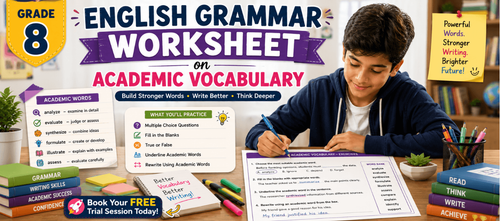

Build Stronger Writing Skills with This Grade 8 English Grammar Worksheet on Academic Vocabulary
Academic writing becomes more effective when students use clear, meaningful, and precise vocabulary. In Grade 8, students begin writing detailed essays, explanations, reports, and analytical answers where strong academic words play an important role. This English grammar worksheet on vocabulary for academic writing helps students improve the way they express ideas in formal and structured writing tasks.
Students often use simple everyday words repeatedly in essays and assignments. This worksheet introduces useful academic vocabulary that helps students explain, analyze, evaluate, compare, summarize, and support ideas more effectively. Through engaging activities, learners practice identifying correct academic words, using them in context, and understanding how they improve communication in academic writing.
Download these English grammar worksheets and practice regularly to strengthen your language skills and build a strong foundation. You can also book a free trial to get expert guidance and improve your reading, writing, and comprehension abilities. The worksheets are designed in a simple and structured way to help K–8 students learn grammar concepts easily and use them confidently in everyday communication.
What Is the Topic?
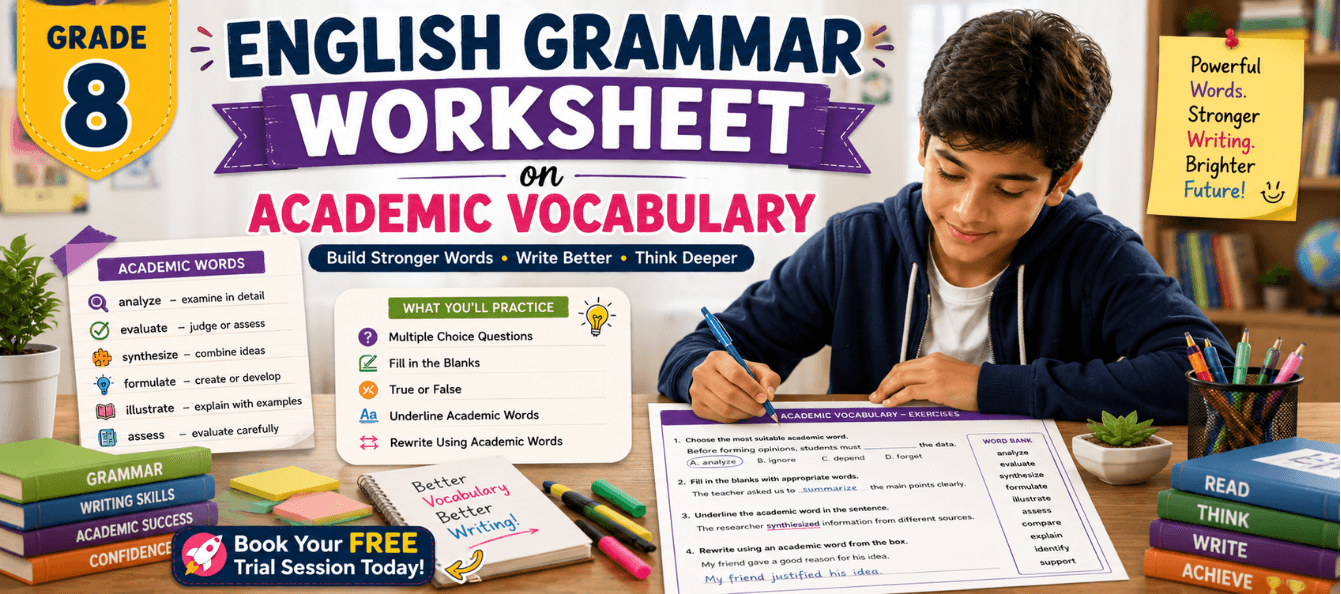
Vocabulary for academic writing focuses on words commonly used in essays, reports, explanations, discussions, and analytical writing. This Grade 8 English grammar worksheet helps students understand how academic words improve clarity, precision, and organization in formal writing.
The worksheet introduces words such as:
- analyze
- evaluate
- summarize
- support
- interpret
- classify
- assess
- define
- formulate
- synthesize
Students learn how these words are used in different contexts and how they help communicate ideas clearly and logically in academic tasks.
What’s in This Worksheet?
1. Multiple choice questions based on selecting the correct academic word
2. Fill in the blanks exercises using suitable academic vocabulary from a word bank
3. True and False activities to identify whether academic words are used correctly in context
4. Underline the academic word exercises to improve vocabulary recognition
5. Sentence rewriting tasks using appropriate academic vocabulary
6. Vocabulary-building exercises focused on formal and academic communication
7. Grammar and writing activities that strengthen analytical and critical thinking skills
Definitions, Examples, Techniques, and Tips
This worksheet focuses on vocabulary used in academic writing and formal communication. Academic words help students explain ideas more clearly and write in a more structured and professional way.
Students practice words and phrases such as:
- analyze
- explain
- compare
- evaluate
- summarize
- identify
- support
- interpret
- classify
- elaborate
- assess
- formulate
- synthesize
- validate
The worksheet includes examples such as:
- “Before forming opinions, students must analyze the data.”
- “Researchers must justify their claims using evidence.”
- “Students must analyze the data before forming conclusions.”
- “The conclusion summarized the main points.”
Students also learn techniques such as:
- Choosing academic words based on sentence meaning
- Identifying formal vocabulary in context
- Rewriting simple ideas using stronger academic words
- Understanding how academic vocabulary improves clarity and precision
Quick learning tips included in this worksheet help students improve essay writing, formal explanations, and analytical thinking skills.
Why Is It Important to Learn This?
Learning academic vocabulary helps students communicate ideas more clearly and confidently in school writing tasks. Strong academic words make essays and answers more organized, precise, and meaningful.
This grammar and vocabulary skill improves:
- Essay writing
- Report writing
- Reading comprehension
- Critical thinking
- Analytical writing
- Classroom discussions
Academic vocabulary also helps students express complex ideas more effectively while improving overall writing quality.
Where Will This Knowledge Help You?
Understanding academic vocabulary helps students in many school and real-life situations, including:
- Grammar and vocabulary exams
- Essay and paragraph writing
- Project and report writing
- Classroom presentations
- Reading comprehension activities
- Debate and discussion tasks
- Higher-level academic writing in future grades
These skills also help students become more confident readers, writers, and speakers.
How to Use This Worksheet?
1. Read each sentence carefully before choosing an academic word.
2. Think about the meaning of the sentence and select the most suitable vocabulary word.
3. Attempt all exercises independently before checking answers.
4. Review how academic words are used in different contexts.
5. Compare your answers carefully with the solutions provided below.
6. Practice using these words regularly in essays and school assignments.
7. Pay attention to how academic words improve sentence clarity and formality.
The solutions follow the exact worksheet order, so students should compare their answers carefully.
Important Tips and Tricks
1. Choose academic words based on meaning, not just familiarity.
2. Words like “analyze,” “evaluate,” and “assess” are often used in formal writing and exams.
3. Read the entire sentence carefully before selecting a vocabulary word.
4. In True and False exercises, check whether the academic word matches the context correctly.
5. While rewriting sentences, use the new academic word naturally and correctly.
6. Underline only the academic vocabulary word in underline-the-word activities.
7. Practice using academic vocabulary in daily writing tasks to improve fluency.
8. Strong academic vocabulary helps students score better in formal writing tasks and exams.
Complete Answer Key
Exercise No. 1
Choose the correct academic word for each sentence.
1. analyze
2. evaluate
3. infer
4. explain
5. compare
6. summarize
7. justify
8. identify
9. interpret
10. defend
Exercise No. 2
Fill in the blanks with suitable academic words from the bank.
1. explain
2. analyze
3. assess
4. define
5. outline
6. examine
7. illustrate
8. classify
9. determine
10. elaborate
Exercise No. 3
Tick True if the academic word is used correctly in context. Tick False if it is used incorrectly.
1. False
2. True
3. False
4. True
5. True
6. True
7. False
8. True
9. False
10. True
Exercise No. 4
Underline the academic word in each sentence.
1. formulate
2. synthesize
3. compared
4. summarized
5. clarify
6. illustrate
7. highlight
8. analyzed
9. demonstrated
10. evaluate
Exercise No. 5
Rewrite each sentence using an appropriate academic word from the box. Use each word only once.
1. The researcher synthesized ideas from different sources.
2. The scientist validated the findings before publishing.
3. The student formulated a clear plan.
4. The writer constructed an argument step by step.
5. The detective deduced the answer using evidence.
6. The speaker articulated ideas clearly in the presentation.
7. The reviewer critiqued the work carefully.
8. The team proposed a solution.
9. The notes consolidated ideas together at the end.
10. The scientist hypothesized a prediction based on evidence.
Practicing this Grade 8 English grammar worksheet on vocabulary for academic writing helps students improve clarity, precision, and confidence in formal writing tasks. With regular practice, students can strengthen their academic vocabulary, organize ideas more effectively, and communicate thoughtfully in essays, reports, and classroom discussions.