
Gulliver in Lilliput Reading Comprehension for Students Grade 6
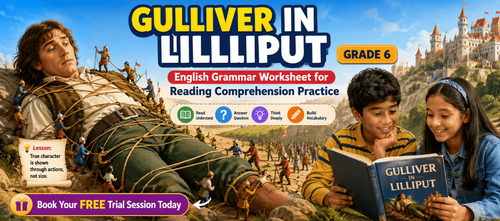

Gulliver in Lilliput English Grammar Worksheet for Grade 6 Reading Comprehension Practice
Reading stories about adventure and discovery can make learning English exciting and meaningful for students. This Grade 6 English grammar worksheet based on Gulliver in Lilliput helps students improve their reading comprehension skills through interesting questions and thoughtful activities. The passage introduces students to Gulliver’s unusual experience in the land of tiny people called the Lilliputians. Through this worksheet, students learn to understand passages carefully, identify important details, answer objective and subjective questions, and connect ideas from the story.
This English grammar worksheet for Grade 6 also helps students build vocabulary, improve sentence understanding, and develop confidence in answering comprehension-based questions. Students can practice reading carefully and learn how to identify the correct answers from the passage itself. The exercises encourage students to think deeply about the actions, feelings, and lessons shown in the story while improving their language skills in a structured and engaging way.
Download these English grammar worksheets and practice regularly to strengthen your language skills and build a strong foundation. You can also book a free trial to get expert guidance and improve your reading, writing, and comprehension abilities. The worksheets are designed in a simple and structured way to help K–8 students learn grammar concepts easily and use them confidently in everyday communication.
What Is the Topic?
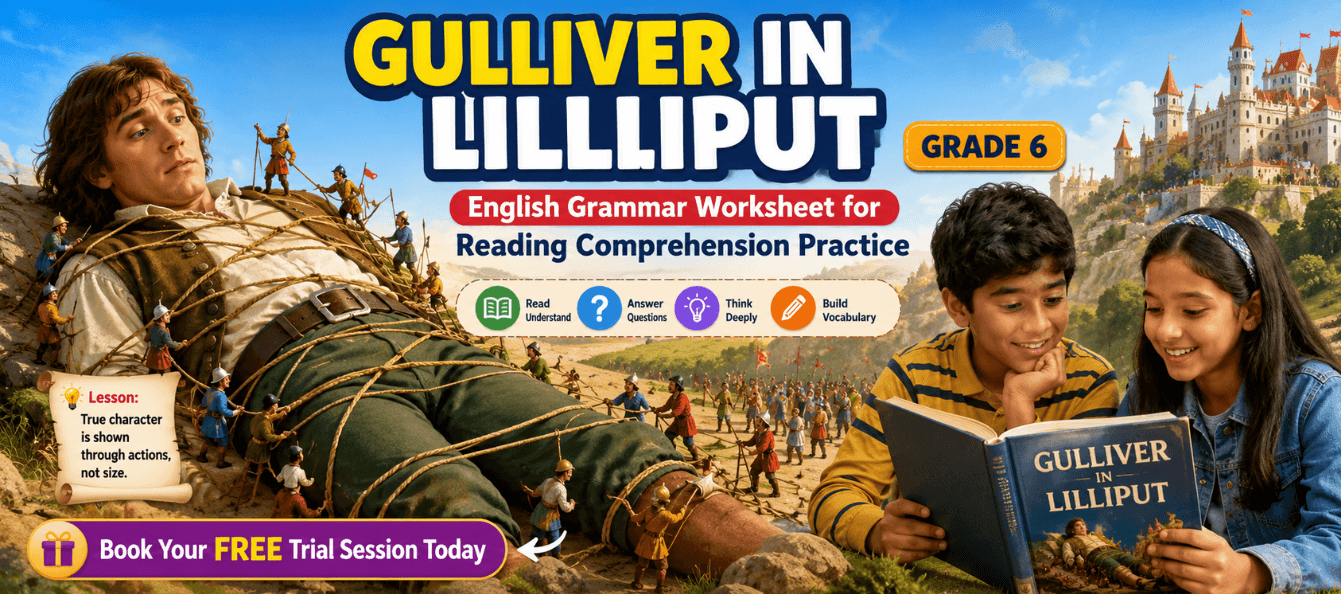
The topic of this worksheet is reading comprehension through the story Gulliver in Lilliput. Students read an abridged passage about Gulliver, whose ship is destroyed in a storm before he reaches an unknown land called Lilliput. The worksheet focuses on understanding the story, identifying facts, and answering different kinds of questions based on the passage.
Students are expected to:
• Read the passage carefully
• Understand the sequence of events
• Identify correct answers from the text
• Answer subjective and objective questions
• Build vocabulary through word-based questions
• Understand the message and moral shown in the story
The worksheet also teaches students how actions, trust, and communication help people understand one another better.
What’s in This Worksheet?
1. A detailed reading passage about Gulliver and the people of Lilliput.
2. Multiple-choice questions to test factual understanding from the passage.
3. Short-answer questions based on important details from the story.
4. Thinking and connection-based questions that help students understand deeper meanings from the passage.
5. A vocabulary-based question asking students to find a synonym from the story.
6. Questions that improve comprehension, interpretation, and critical thinking skills.
7. Exercises arranged in a simple and structured order for easy learning and practice.
8. Activities that support school exam preparation and improve confidence in reading comprehension sections.
Definitions, Examples, Techniques, and Tips
Definitions
Reading comprehension:
Reading comprehension means reading a passage carefully and understanding its meaning, events, characters, and important details.
Objective-type questions:
These are questions with fixed answers, such as multiple-choice questions.
Subjective-type questions:
These questions require students to explain ideas using complete sentences based on the passage.
Examples From the Worksheet
• Gulliver’s ship was caught in a terrible storm.
• The people of Lilliput were very tiny.
• Gulliver was tied down with many tiny ropes.
• The Emperor ordered Gulliver to be taken to the capital.
• Gulliver learned some of their language over time.
Techniques
• Read the full passage before answering.
• Underline important details while reading.
• Focus on names, places, and actions.
• Read every option carefully before selecting an answer.
• Use clues from the passage to answer subjective questions.
Quick Learning Tips
• Read slowly and carefully.
• Do not skip lines from the passage.
• Recheck answers after completing the worksheet.
• Pay attention to keywords in the questions.
• Use complete sentences while answering subjective questions.
Why Is It Important to Learn This?
Reading comprehension is an important part of English learning because it improves understanding, vocabulary, and communication skills. This Grade 6 English grammar worksheet helps students learn how to identify important details from a story and answer questions correctly.
Students also improve their ability to:
• Read confidently
• Understand story sequences
• Recognize character actions and feelings
• Build stronger vocabulary
• Answer exam-based comprehension questions
The story also teaches an important lesson that true character is shown through actions, not size or power. Learning such ideas helps students become thoughtful readers and better communicators.
Where Will This Knowledge Help You?
This knowledge will help students in many ways:
• School exams and comprehension tests
• English reading activities
• Classroom discussions
• Vocabulary improvement
• Story understanding exercises
• Writing answers in complete sentences
• Competitive exams with reading passages
• Daily reading and communication practice
Students who practice reading comprehension regularly become faster and more confident readers.
How to Use This Worksheet?
1. Read the full passage carefully before starting the exercises.
2. Understand the story sequence and important details about Gulliver and the Lilliputians.
3. Attempt the multiple-choice questions independently first.
4. Answer the subjective questions using details from the passage.
5. Compare your answers carefully with the solutions given below.
6. The solutions follow the exact worksheet order, so students should check answers step by step carefully.
7. Correct mistakes after reviewing the answers.
8. Practice similar reading comprehension worksheets regularly to improve speed and accuracy.
Important Tips and Tricks
1. Always read the passage completely before answering any question.
2. Pay attention to important words like names, actions, places, and events.
3. For multiple-choice questions, eliminate incorrect options carefully.
4. Use information directly from the passage while writing answers.
5. Write complete and clear sentences in subjective questions.
6. For vocabulary questions, search for similar meaning words from the passage carefully.
7. Examiners expect accurate answers based on the passage, not personal opinions.
8. Recheck spellings and sentence formation before final submission.
9. Keep answers in the correct serial order to avoid confusion.
10. Practice comprehension passages regularly to score full marks in English exams.
Complete Answer Key
Gulliver in Lilliput (abridged)
Gulliver’s ship was caught in a terrible storm, and strong waves crashed against it from every side. The sailors tried their best to control the ship, but it soon broke apart in the rough sea. Gulliver managed to swim for many hours before he finally reached the shore of an unknown land. Exhausted, he fell asleep on the beach. When Gulliver woke up, he was shocked to find that he could not move. His arms, legs, and even his hair were tied down with many tiny ropes. He could feel small movements on his body. As he looked carefully, he saw dozens of tiny people, each no taller than the length of his hand, standing around him. They spoke in a language he could not understand and watched him carefully. These were the people of Lilliput.
Although they were frightened of Gulliver because of his large size, they were also curious. They slowly brought him food and water, though in very small amounts for someone his size. Gulliver remained calm and tried to show that he meant no harm. The Emperor of Lilliput ordered that Gulliver be taken to the capital. Since he was huge, the people built a large wooden platform with wheels to move him there. People from faraway villages came to see the “giant.” Over time, Gulliver learned some of their language. He promised to help protect Lilliput from danger. The Lilliputians learned that true character is shown through actions, not size.
Exercise No. 1
1. Where did Gulliver wake up after the storm?
✔ b) On a beach
2. What was unusual about the people Gulliver met?
✔ c) They were very tiny
3. How was Gulliver transported to the capital city?
✔ a) On a wooden platform with wheels
Exercise No. 2
1. Why could Gulliver not move when he woke up?
He was tied down with many tiny ropes by the Lilliputians.
2. How did Gulliver show that he meant no harm?
He behaved gently and accepted their food and water.
3. Why did people from far villages come to see Gulliver?
They wanted to see the giant who had arrived in their land.
Exercise No. 3
1. Why were the Lilliputians cautious at first?
They were cautious because Gulliver was much larger and unfamiliar to them.
2. How did learning the Lilliputian language change Gulliver’s relationship with them?
Knowing the language helped them communicate, reducing fear and building respect.
3. What idea about trust and understanding does the story highlight?
The story shows that trust develops through respectful actions and understanding, not size or power.
4. Find a synonym of “Faithfulness” from the passage.
The word is “Loyalty”.
Practicing reading comprehension passages like Gulliver in Lilliput helps Grade 6 students become more confident readers and better English learners. This English grammar worksheet improves understanding, vocabulary, and answer-writing skills in a simple and engaging way. Regular practice of comprehension exercises will help students perform well in exams and strengthen their reading abilities step by step. Keep practicing carefully, follow the question order correctly, and continue building strong language skills with interesting worksheets like this one.