
Hands-Themed Reading Activity for KG – Fun Practice Sheet
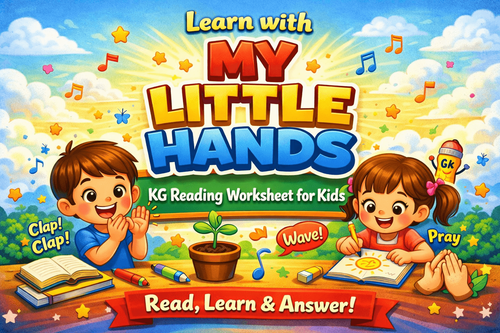

Learn with My Little Hands KG Reading Worksheet for Kids
Young learners love exploring the world with their hands. From clapping and drawing to waving and planting seeds, hands help children perform many daily activities. This Grade KG English grammar worksheet titled “Learn with My Little Hands” introduces children to a fun poem about how little hands help in different ways. Through simple reading comprehension questions, students can improve their reading, understanding, and observation skills while enjoying a playful poem.
This English grammar worksheet for Grade KG encourages children to read carefully and answer questions based on what they understand from the poem. It helps students build early reading comprehension abilities and strengthens their confidence in understanding short poems.
What Is Understanding Poems?
Understanding poems means reading a poem carefully and finding the meaning behind the lines. Poems often use simple words, sounds, and actions that help children imagine what is happening in the poem. In Grade KG worksheets, poems are short, easy to read, and connected to everyday activities that children can relate to.
In the worksheet “My Little Hands,” children read about how little hands clap, tap, draw, wave, hold books, help with daily activities, plant seeds, and fold in prayer. By reading the poem, students learn how to observe actions and identify information mentioned in the poem.
Reading comprehension activities help students answer questions about what they read. Instead of guessing, children learn to look back at the poem and find the correct answer. This strengthens their reading accuracy and understanding skills.
What’s in This Worksheet?
This Grade KG English grammar worksheet includes several helpful learning components designed to support early reading development.
1. A short and simple poem titled “My little hands” that children can read easily.
2. Questions based directly on the poem to test reading comprehension.
3. Multiple-choice questions where students choose the correct answer.
4. Clear and simple answer choices suitable for young learners.
5. Practice questions that help students connect words from the poem with real actions.
These activities encourage children to read the poem carefully and find answers by thinking about what the poem says.
Definitions, Examples, Techniques, and Tips
Definitions
Reading comprehension means understanding what we read. When children read a poem or passage and answer questions about it, they are practicing reading comprehension.
A poem is a short piece of writing that may use rhythm, rhyme, or repeated sounds. Poems often describe actions, feelings, or events in a creative way.
Examples from the Worksheet
The poem “My little hands” describes many actions performed by little hands:
My little hands clap clap clap.
They tap the desk rap rap rap.
My little hands draw a sun.
They wave to all when day is done.
My little hands hold a book.
They help me eat and help me cook.
My little hands can plant a seed.
They fold in prayer for all I need.
My little hands are small and sweet.
They make my day feel bright and neat.
Each line tells us something that hands can do. The questions in the worksheet ask students to find information from these lines.
Techniques for Solving Questions
One helpful technique is reading the poem slowly and carefully. When students read a question, they can look back at the poem and find the line that mentions the answer.
Another technique is identifying key action words like clap, tap, draw, wave, hold, plant, and fold. These words help students understand what the hands are doing in the poem.
Tips for Students
Students should read the poem more than once to understand it clearly. After reading, they should look at each question and think about which line in the poem gives the answer.
Why Is It Important to Learn This?
Learning through poems helps children enjoy reading. Poems are fun, rhythmic, and easy to remember, which makes them perfect for young learners in Grade KG.
Reading comprehension activities help children develop strong language skills. When students understand what they read, they become better at answering questions, following instructions, and expressing ideas.
This English grammar worksheet also improves vocabulary and observation skills. Children learn new words and understand how sentences describe actions and feelings.
Where Will This Knowledge Help You?
The skills learned from this worksheet can help students in many areas of learning.
First, it helps students in school exams where they need to read passages or poems and answer questions.
Second, it improves everyday reading skills. When children read stories, poems, or instructions, they can understand them better.
Third, it builds confidence in classroom discussions. Students who understand what they read can participate more actively in class.
Finally, it strengthens early language development, which is very important for young learners.
How to Use This Worksheet?
Students and parents can follow these steps to make the most of this worksheet.
1. Read the poem carefully from beginning to end.
2. Read each question slowly and understand what it asks.
3. Look back at the poem and find the correct answer.
4. Choose the correct option from the given choices.
5. Review all answers to make sure they match the poem.
The solutions below follow the exact order of the worksheet questions. Students should compare their answers carefully to see if they understood the poem correctly.
Important Tips and Tricks
1. Always read the poem first before answering any question.
2. Pay attention to action words like clap, tap, draw, wave, hold, plant, and fold.
3. Look for clues in the poem that directly answer the question.
4. Do not guess randomly. The correct answer is always connected to the poem.
5. Read each option carefully before choosing the correct answer.
Complete Answer Key
Choose the correct answer for each question.
1. What do my little hands do first?
✔ Clap
2. What do the hands tap?
✔ Desk
3. What do my little hands draw?
✔ Sun
4. When do the hands wave?
✔ When day is done
5. What do my hands hold?
✔ Book
6. What do hands help me do?
✔ Eat
7. What can my little hands plant?
✔ Seed
8. What do my little hands fold in?
✔ Prayer
9. How are my little hands?
✔ Small and sweet
10. What do hands make my day?
✔ Bright and neat
This Grade KG English grammar worksheet shows how small daily actions can become a fun learning experience through poems. By reading the poem “My Little Hands,” students practice understanding words, actions, and meanings in a simple and engaging way.
Regular practice with reading comprehension worksheets helps children become confident readers. With continued practice, Grade KG learners can improve their understanding skills and enjoy reading poems and stories even more.